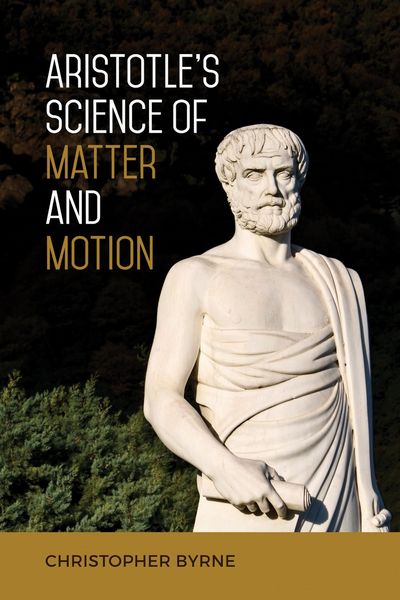
Produktbild: Aristotle's Science of Matter and Motion
- 20%

Aristotle's Science of Matter and Motion

20% sparen

45,99 € UVP 57,50 €

inkl. gesetzl. MwSt., Versandkostenfrei


Beschreibung

Produktdetails

Einband

Gebundene Ausgabe

Erscheinungsdatum

11.07.2018

Verlag

University of Toronto Press

Seitenzahl

208

Maße (L/B/H)

23,6/15,9/2,5 cm

Gewicht

496 g

Sprache

Englisch

ISBN

978-1-4875-0396-3

Beschreibung

Produktdetails

Einband

Gebundene Ausgabe

Erscheinungsdatum

11.07.2018

Verlag

University of Toronto Press

Seitenzahl

208

Maße (L/B/H)

23,6/15,9/2,5 cm

Gewicht

496 g

Sprache

Englisch

ISBN

978-1-4875-0396-3

Herstelleradresse

Libri GmbH
Europaallee 1
36244 Bad Hersfeld
DE

Email: gpsr@libri.de

Kundinnen und Kunden meinen

0 Bewertungen

Informationen zu Bewertungen

Zur Abgabe einer Bewertung ist eine Anmeldung im Konto notwendig. Die Authentizität der Bewertungen wird von uns nicht überprüft. Wir behalten uns vor, Bewertungstexte, die unseren Richtlinien widersprechen, entsprechend zu kürzen oder zu löschen.

Die Bewertungen sind nach Format, Anzahl Sterne und Datum sortiert.

Verfassen Sie die erste Bewertung zu diesem Artikel

Helfen Sie anderen Kund*innen durch Ihre Meinung

Kundinnen und Kunden meinen

0 Bewertungen filtern

  • Produktbild: Aristotle's Science of Matter and Motion
  • Preface
    Acknowledgments
    Introduction: The Case against an Aristotelian Physics

    1 Motion and Change in Perceptible Objects
    1.1 The Common Attributes of Perceptible Objects
    1.1.1 Perceptible Objects and Physical Contact
    1.1.2 Perceptible Objects and Motion
    1.1.3 Perceptible Objects and Change
    1.2 Motion and Natural Motion
    1.2.1 Motion and the Definition of Change
    1.2.2 Motion and Place
    1.2.3 Motion and Inertial Motion

    2 E fficient Causality in Perceptible Objects
    2.1 General Principles of Efficient Causality
    2.1.1 Efficient Causality Belongs to Physical Agents
    2.1.2 Causation by Internal Parts
    2.1.3 Transmission Model of Causal Agency
    2.1.4 Causation by Commensurate Powers
    2.2 Mechanics and the Laws of Nature
    2.2.1 No Action at a Distance
    2.2.2 Proportion of Change to Physical Contact
    2.2.3 Spatial Dissipation of Causal Influence
    2.2.4 Combination of Causal Powers
    2.2.5 Necessity of Prior Motion
    2.2.6 P roportion between Cause and Effect
    2.2.7 Like Produces Like
    2.2.8 Universal Application and Experiments

    3 The Material Causes of Perceptible Objects
    3.1 The Definition of a Material Cause
    3.2 Perceptible Matter and the Division of the Sciences
    3.3 The Physical Requirements for Motion and Change
    3.3.1 The Substratum of Physical Interaction
    3.3.2 The Substratum of Locomotion
    3.3.3 The Substratum of Generation and Destruction

    4 The Material Elements and Prime Matter
    4.1 The Common Substratum of the Material Elements
    4.2 The Generation of the Material Elements

    5 Simple Physical Necessity in the Material Elements
    5.1 Simple versus Hypothetical Necessity
    5.2 Simple Teleological Necessity in the Elements
    5.3 Simple Non-Teleological Necessity in the Elements

    6 Simple Physical Necessity in Objects Made out of the Elements
    6.1 Simple Teleological Necessity in Perceptible Objects
    6.2 Simple Non-Teleological Necessity in Perceptible Objects
    6.3 Generation of Homogeneous Mixtures

    7 The Dual Nature of Perceptible Objects
    7.1 The Dual Nature of Physical Artefacts
    7.2 The Many Natures of Natural Substances
    7.3 The Difference between Natural Substances and Physical Artefacts
    7.4 The Unity of Natural Substances

    8 Matter and the Soul
    8.1 The Soul as the Actuality of the Body
    8.2 The Soul and Efficient Causality

    9 The Role of Teleological Explanation
    9.1 The Limits of Teleological Explanation
    9.2 The Compatibility of Natural Teleology with Non-Teleological Necessity
    9.3 The Dependence of Natural Teleology on Non-Teleological Necessity

    10 C onclusion: The Independence of the Material Cause
    10.1 The Material Cause and the Substratum of Generation
    10.2 The Material Cause and Potentiality
    10.3 The Material Cause and Definition
    10.4 The Material Cause and Change

    Notes
    Works Cited
    Index of Texts from Aristotle