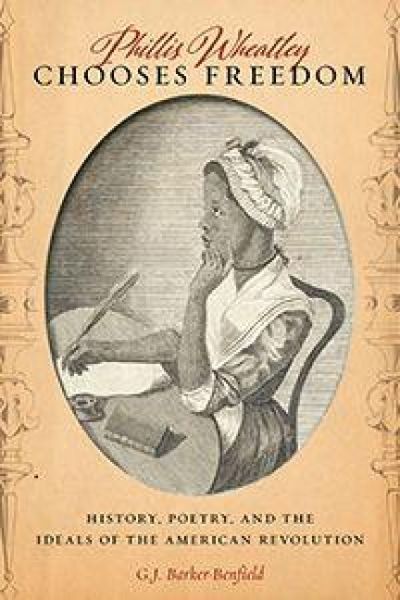
Phillis Wheatley Chooses Freedom History, Poetry, and the Ideals of the American Revolution
53,99 €
inkl. gesetzl. MwSt.,
Beschreibung
Produktdetails
Einband
Gebundene Ausgabe
Erscheinungsdatum
11.09.2018
Verlag
NYU Press - IPSSeitenzahl
232
Maße (L/B/H)
23,2/16,3/2,5 cm
Gewicht
503 g
Sprache
Englisch
ISBN
978-1-4798-7925-0
The dramatic story of Phillis Wheatley, a free, black poet who resisted the pressures of arranged marriage, truly embodying the ideals of the American Revolution
There is an uncomfortable paradox at the heart of the American Revolution: many of the men leading the war for independence were slave owners, contradicting the ideal of freedom that they claimed to represent. Meanwhile, abolitionist sentiments of the time contained contradictions as well. Abolitionists encouraged freed Christianized slaves to return to Africa. In this way, they hoped to send more missionaries to Africa in order to Christianize the continent and, at the same time, to send free blacks away from America.
This tension is revealed through the dramatic story of Phillis Wheatley, an African-American poet who refused to marry a man she had never met and return with him to Africa as a missionary. She was enslaved in Africa as a child and transported to Boston, where she was sold to an evangelical family. Agreeing to the proposed marriage - arranged by Congregationalist minister Samuel Hopkins - would have echoed the social mores of the time, particularly those for enslaved black women. However, due to her prodigious talents as a poet, Wheatley won her freedom a year prior to Hopkins' arrangement, allowing her to take her future into her own hands.
G.J. Barker-Benfield considers Wheatley's story and Hopkins's plan in the broader context of the American Revolution. The ideals of the revolution motivated Hopkins and some of his contemporaries to propose freeing African slaves and thus address the "monstrous inconsistency" fundamental to the white slave owners leading the revolution. In so doing, they presented themselves as freedom fighters who resisted the threat of slavery at the hands of British tyranny. Wheatley challenged this inconsistency and, taking the revolutionaries' rhetoric seriously, called for liberty for all human hearts: women's and men's, blacks' and whites'.
Noch keine Bewertungen vorhanden
Verfassen Sie die erste Bewertung zu diesem Artikel
Helfen Sie anderen Kundinnen und Kunden durch Ihre Meinung.
Kurze Frage zu unserer Seite
Vielen Dank für Ihr Feedback
Wir nutzen Ihr Feedback, um unsere Produktseiten zu verbessern. Bitte haben Sie Verständnis, dass wir Ihnen keine Rückmeldung geben können. Falls Sie Kontakt mit uns aufnehmen möchten, können Sie sich aber gerne an unseren Kund*innenservice wenden.
zum Kundenservice