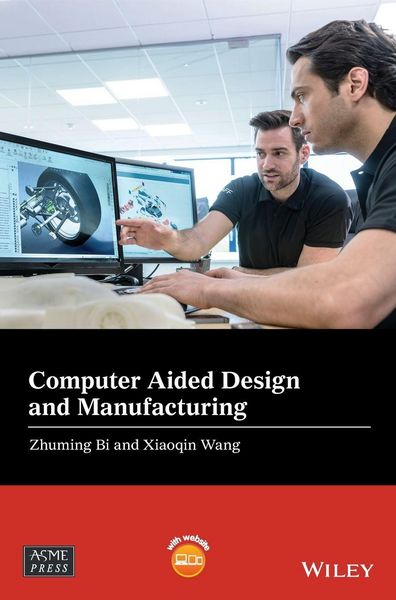
Computer Aided Design and Manufacturing
-
- Englisch ausgewählt
161,99 €
inkl. gesetzl. MwSt.,
Beschreibung
Produktdetails
Einband
Gebundene Ausgabe
Erscheinungsdatum
19.03.2020
Verlag
John Wiley & Sons IncSeitenzahl
658
Maße (L/B/H)
24,4/17/3,5 cm
Gewicht
1239 g
Auflage
1. Auflage
Sprache
Englisch
ISBN
978-1-119-53421-1
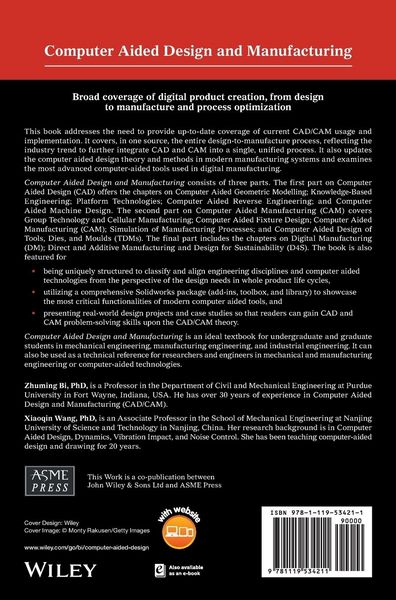
This book addresses the need to provide up-to-date coverage of current CAD/CAM usage and implementation. It covers, in one source, the entire design-to-manufacture process, reflecting the industry trend to further integrate CAD and CAM into a single, unified process. It also updates the computer aided design theory and methods in modern manufacturing systems and examines the most advanced computer-aided tools used in digital manufacturing.
Computer Aided Design and Manufacturing consists of three parts. The first part on Computer Aided Design (CAD) offers the chapters on Geometric Modelling; Knowledge Based Engineering; Platforming Technology; Reverse Engineering; and Motion Simulation. The second part on Computer Aided Manufacturing (CAM) covers Group Technology and Cellular Manufacturing; Computer Aided Fixture Design; Computer Aided Manufacturing; Simulation of Manufacturing Processes; and Computer Aided Design of Tools, Dies and Molds (TDM). The final part includes the chapters on Digital Manufacturing; Additive Manufacturing; and Design for Sustainability. The book is also featured for
* being uniquely structured to classify and align engineering disciplines and computer aided technologies from the perspective of the design needs in whole product life cycles,
* utilizing a comprehensive Solidworks package (add-ins, toolbox, and library) to showcase the most critical functionalities of modern computer aided tools, and
* presenting real-world design projects and case studies so that readers can gain CAD and CAM problem-solving skills upon the CAD/CAM theory.
Computer Aided Design and Manufacturing is an ideal textbook for undergraduate and graduate students in mechanical engineering, manufacturing engineering, and industrial engineering. It can also be used as a technical reference for researchers and engineers in mechanical and manufacturing engineering or computer-aided technologies.
Noch keine Bewertungen vorhanden
Verfassen Sie die erste Bewertung zu diesem Artikel
Helfen Sie anderen Kundinnen und Kunden durch Ihre Meinung.
Kurze Frage zu unserer Seite
Vielen Dank für Ihr Feedback
Wir nutzen Ihr Feedback, um unsere Produktseiten zu verbessern. Bitte haben Sie Verständnis, dass wir Ihnen keine Rückmeldung geben können. Falls Sie Kontakt mit uns aufnehmen möchten, können Sie sich aber gerne an unseren Kund*innenservice wenden.
zum Kundenservice