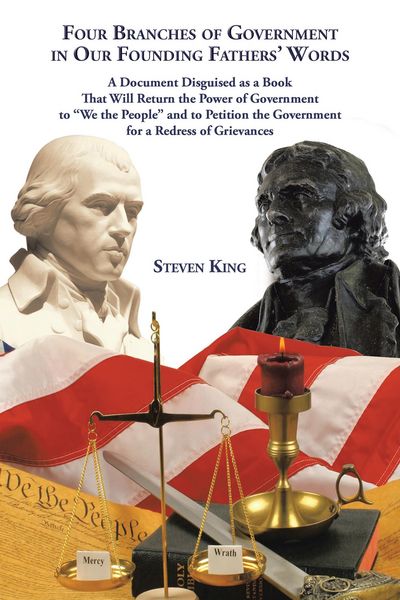
Four Branches of Government in Our Founding Fathers' Words A Document Disguised as a Book That Will Return the Power of Government to "We the People" and to Petition the Government for a Redress of Grievances
-
- Hardcover
- Taschenbuch
- eBook ausgewählt
-
Form:Einzelkauf Download
-
Sprache:Englisch
9,49 €
inkl. gesetzl. MwSt.Beschreibung
Produktdetails
Format
ePUB
Kopierschutz
Ja
Family Sharing
Nein
Text-to-Speech
Ja
Erscheinungsdatum
14.10.2015
Verlag
AuthorhouseSeitenzahl
352 (Printausgabe)
Dateigröße
509 KB
Sprache
Englisch
EAN
9781504919289
Four Branches of Government
The words that describe and name our branches of government in the Constitutions Articles I, II and III are the following in order of appearance: Congress, Senate, House of Representatives, Representative, Representatives, Senators, Senator, Vice President, the President of the United States, each House, either House, neither House, two Houses, that House, the other House, both Houses, a President of the United States of America, said House, the President, one supreme Court and those are all the words.
Having four branches being the President, House of Representatives, Senate, and supreme Court, each branch now has 25 percent of the power if disbursed evenly.
How many branches of government can shut down government? The answer is three branches, the President (25 percent of power), the House of Representatives (25 percent of power), and the Senate (25 percent of power), this being done while the supreme Court (25 percent of power) can only watch because it has no legislative or executive powers. During the last government shutdown, who shut down the government, the legislative branch or the House of Representatives? If you answer the legislative branch, then which one? That in itself is an admittance of two branches of government that come together using their shared powers to legislate our laws.
Now as you should be able to see the proper descriptive phrase too describe our government (NOT the Actual Bodies or Branches but the Powers of the branches) is executive branch, legislative branches (meaning two or more and both branches, House of Representatives and the Senate, convene to form Congress to legislate laws under the powers of the Constitution given to both branches) and judicial branch.
The words that describe and name our branches of government in the Constitutions Articles I, II and III are the following in order of appearance: Congress, Senate, House of Representatives, Representative, Representatives, Senators, Senator, Vice President, the President of the United States, each House, either House, neither House, two Houses, that House, the other House, both Houses, a President of the United States of America, said House, the President, one supreme Court and those are all the words.
Having four branches being the President, House of Representatives, Senate, and supreme Court, each branch now has 25 percent of the power if disbursed evenly.
How many branches of government can shut down government? The answer is three branches, the President (25 percent of power), the House of Representatives (25 percent of power), and the Senate (25 percent of power), this being done while the supreme Court (25 percent of power) can only watch because it has no legislative or executive powers. During the last government shutdown, who shut down the government, the legislative branch or the House of Representatives? If you answer the legislative branch, then which one? That in itself is an admittance of two branches of government that come together using their shared powers to legislate our laws.
Now as you should be able to see the proper descriptive phrase too describe our government (NOT the Actual Bodies or Branches but the Powers of the branches) is executive branch, legislative branches (meaning two or more and both branches, House of Representatives and the Senate, convene to form Congress to legislate laws under the powers of the Constitution given to both branches) and judicial branch.
Noch keine Bewertungen vorhanden
Verfassen Sie die erste Bewertung zu diesem Artikel
Helfen Sie anderen Kundinnen und Kunden durch Ihre Meinung.
Kurze Frage zu unserer Seite
Vielen Dank für Ihr Feedback
Wir nutzen Ihr Feedback, um unsere Produktseiten zu verbessern. Bitte haben Sie Verständnis, dass wir Ihnen keine Rückmeldung geben können. Falls Sie Kontakt mit uns aufnehmen möchten, können Sie sich aber gerne an unseren Kund*innenservice wenden.
zum Kundenservice