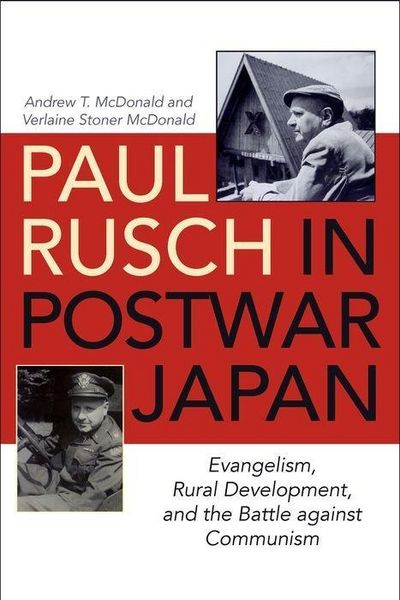
Paul Rusch in Postwar Japan Evangelism, Rural Development, and the Battle Against Communism
-
- Englisch ausgewählt
47,99 €
inkl. gesetzl. MwSt.,
Beschreibung
Produktdetails
Einband
Gebundene Ausgabe
Erscheinungsdatum
07.12.2018
Verlag
University Press Of KentuckySeitenzahl
296
Maße (L/B/H)
22,9/15,2/2,1 cm
Gewicht
603 g
Sprache
Englisch
ISBN
978-0-8131-7607-9
Paul Rusch first traveled from Louisville, Kentucky, to Tokyo in 1925 to help rebuild YMCA facilities in the wake of the Great Kanto earthquake. What was planned as a yearlong stay became his life's work as he joined with the Japan Episcopal Church to promote democracy and Western Christian ideals. Over the course of his remarkable life, Rusch served as a college professor and Episcopal missionary, and he was a catalyst for agricultural development, introducing dairy farming to highland Japan.
In Paul Rusch in Postwar Japan, Andrew T. McDonald and Verlaine Stoner McDonald present Rusch's life as an epic story that crisscrosses two cultures, traversing war and peace, destruction and rebirth, private struggle and public triumph. As World War II approached, Rusch battled racial prejudice against Japanese Americans, yet also became an apologist for Japan's expansionist foreign policy. After Pearl Harbor, he was arrested as an enemy alien and witnessed the Doolittle Raid on Tokyo. Upon his release to the US in 1942, he joined military intelligence and returned to Japan in that capacity during the US occupation.
Though Rusch was of modest origins, he deftly climbed social and military ladders to befriend some of the most intriguing figures of the era, including prime ministers and members of the Japanese royal family. Though he is perhaps best remembered for introducing organized American football in Japan, his greatest legacy is the founding of the Kiyosato Educational Experiment Project (KEEP), a vehicle for feeding, educating, and uplifting the rural poor of highland Japan. Today his legacy continues to inspire KEEP in the twenty-first century to promote peace, cultural exchange, environmental sustainability, and ecological preservation in Japan and beyond.
Noch keine Bewertungen vorhanden
Verfassen Sie die erste Bewertung zu diesem Artikel
Helfen Sie anderen Kundinnen und Kunden durch Ihre Meinung.
Kurze Frage zu unserer Seite
Vielen Dank für Ihr Feedback
Wir nutzen Ihr Feedback, um unsere Produktseiten zu verbessern. Bitte haben Sie Verständnis, dass wir Ihnen keine Rückmeldung geben können. Falls Sie Kontakt mit uns aufnehmen möchten, können Sie sich aber gerne an unseren Kund*innenservice wenden.
zum Kundenservice