
• Produktbild: State of the Parties 2018
  • Produktbild: State of the Parties 2018

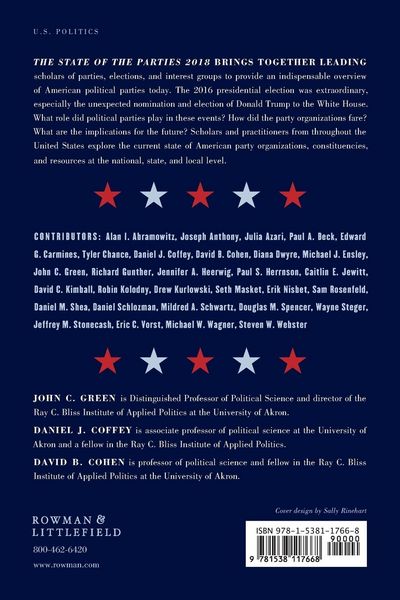
State of the Parties 2018 The Changing Role of Contemporary American Political Parties

53,99 €

inkl. gesetzl. MwSt., Versandkostenfrei


Beschreibung

Produktdetails

Einband

Taschenbuch

Erscheinungsdatum

25.09.2018

Abbildungen

12 tables; 55 charts

Herausgeber

John C. Green + weitere

Verlag

Rowman & Littlefield

Seitenzahl

346

Maße (L/B/H)

22,9/15,2/2 cm

Gewicht

562 g

Sprache

Englisch

ISBN

978-1-5381-1766-8

Beschreibung

Produktdetails

Einband

Taschenbuch

Erscheinungsdatum

25.09.2018

Abbildungen

12 tables; 55 charts

Herausgeber

Verlag

Rowman & Littlefield

Seitenzahl

346

Maße (L/B/H)

22,9/15,2/2 cm

Gewicht

562 g

Sprache

Englisch

ISBN

978-1-5381-1766-8

Herstelleradresse

Libri GmbH
Europaallee 1
36244 Bad Hersfeld
DE

Email: gpsr@libri.de

Noch keine Bewertungen vorhanden

Verfassen Sie die erste Bewertung zu diesem Artikel

Helfen Sie anderen Kundinnen und Kunden durch Ihre Meinung.

Kundinnen und Kunden meinen

Bewertungen (0)

Die Leseprobe wird geladen.
  • Produktbild: State of the Parties 2018
  • Produktbild: State of the Parties 2018
  • List of Tables
    List of Figures
    Acknowledgments

    Chapter 1. The State of the Parties: Change and Continuity in 2016, by Daniel J. Coffey, David B. Cohen, and John C. Green

    Part One: State of the Parties
    Chapter 2. Failing Party Organizations: Lessons from the 2016 Election, by Mildred A. Schwartz
    Chapter 3. Party Blobs and Partisan Visions: Making Sense of our Hollow Parties, by Daniel Schlozman and Sam Rosenfeld
    Chapter 4. Saving Democracy from Elections?, by Daniel M. Shea

    Part Two: Party Activists
    Chapter 5. The Power of a Narrative: Donald Trump (and the Republicans), by Jeffrey M. Stonecash
    Chapter 6. "The Mandate of the People:" The 2016 Sanders Campaign in Context, by Julia Azari and Seth Masket
    Chapter 7. State Party Activism in 2016, by Daniel J. Coffey
    Chapter 8. #Polarized2016: Affective Campaign Rhetoric and Mass Polarization in Social Media, by Eric C. Vorst

    Part Three: Party Nominations
    Chapter 9. The State of the Primaries 2016, by Drew Kurlowski
    Chapter 10. Perception of the Parties and the 2016 Presidential Nominations, by Caitlin E. Jewitt
    Chapter 11. Populist Waves in the 2016 Presidential Nominations: Another Limit to the Party Decides Thesis, by Wayne Steger

    Part Four: Party in Electorate
    Chapter 12. Political Identity and Party Polarization in the American Electorate, by David C. Kimball, Joseph Anthony, and Tyler Chance
    Chapter 13. The Angry American Voter: Negative Partisanship, Voter Anger, and the 2016 Presidential Election, by Alan I. Abramowitz and Steven W. Webster
    Chapter 14. The Role of the Populists in the 2016 U.S. Presidential Election and Beyond, by Edward G. Carmines, Michael J. Ensley, and Michael W. Wagner

    Part Five: Party Resources
    Chapter 15. The 2016 Money Race: The Limits of Campaign Money, and the Nature of Popular Love for the Presidential Candidates, by Robin Kolodny
    Chapter 16. Everything is Relative: Are Political Parties Playing a Meaningful Campaign Finance Role in the U.S. Federal Elections?, by Diana Dwyre
    Chapter 17. The Impact of Organization Characteristics on Super PAC Financing, by Paul S. Herrnson, Jennifer A. Heerwig, and Douglas M. Spencer
    Chapter 18. What Happened to the Ground Game in 2016?, by Paul A. Beck, Richard Gunther, and Erik Nisbet

    References
    Index
    About the Contributors