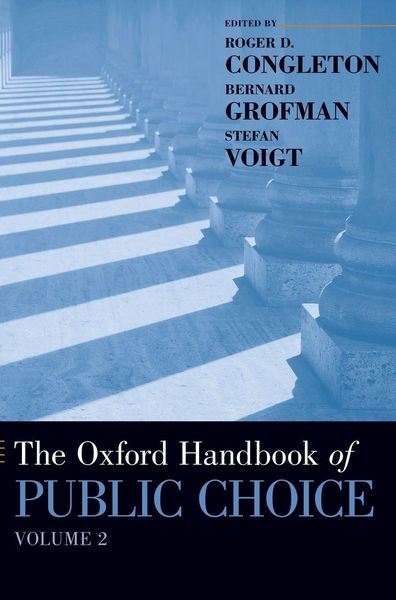
Produktbild: Oxford Handbook of Public Choice, Volume 2

Oxford Handbook of Public Choice, Volume 2

248,99 €

inkl. gesetzl. MwSt., Versandkostenfrei


Beschreibung

Produktdetails

Einband

Gebundene Ausgabe

Erscheinungsdatum

14.01.2019

Herausgeber

Congleton Roger D. + weitere

Verlag

Oxford University Press

Seitenzahl

1016

Maße (L/B/H)

25/17,5/5,8 cm

Gewicht

1769 g

Sprache

Englisch

ISBN

978-0-19-046977-1

Beschreibung

Produktdetails

Einband

Gebundene Ausgabe

Erscheinungsdatum

14.01.2019

Herausgeber

Verlag

Oxford University Press

Seitenzahl

1016

Maße (L/B/H)

25/17,5/5,8 cm

Gewicht

1769 g

Sprache

Englisch

ISBN

978-0-19-046977-1

Kundinnen und Kunden meinen

0 Bewertungen

Informationen zu Bewertungen

Zur Abgabe einer Bewertung ist eine Anmeldung im Konto notwendig. Die Authentizität der Bewertungen wird von uns nicht überprüft. Wir behalten uns vor, Bewertungstexte, die unseren Richtlinien widersprechen, entsprechend zu kürzen oder zu löschen.

Die Bewertungen sind nach Format, Anzahl Sterne und Datum sortiert.

Verfassen Sie die erste Bewertung zu diesem Artikel

Helfen Sie anderen Kund*innen durch Ihre Meinung

Kundinnen und Kunden meinen

0 Bewertungen filtern

Die Leseprobe wird geladen.
  • Produktbild: Oxford Handbook of Public Choice, Volume 2
    • PART V: Constitutional Political Economy

    • A. On the Architecture of Governance

    • 1. How Should Votes be Cast and Counted?

    • Nicolaus Tideman

    • 2. Voters and representatives: How should representatives be selected?

    • Thomas Braendle and Alois Stutzer

    • 3. Divided Government: the king and the council

    • George Tridimas

    • 4. Bicameralism

    • Cecilia Testa

    • 5. Federalism

    • Jaroslaw Kantorowicz

    • 6. Executive Veto Power and Constitutional Design

    • Nicholas R. Miller

    • 7. Politics and the Legal System

    • Lee Epstein, Andrew D. Martin, Kevin Quinn and Jeffrey A. Segal

    • 8. Constitutional Review

    • Nuno Garoupa

    • 9. Institutions for Amending Constitutions

    • Cristina Bucur and Bjørn Erik Rasch

    • 10. Constitutional Transition

    • Zachary Elkins

    • 11. Electoral systems in the making

    • Daniel Bochsler

    • 12. Choosing Voting Rules in the European Union

    • B?la Plechanovová, Madeleine O. Hosli and Anatolij Plechanov

    • B. The Theory of Dictatorship

    • 13. Leviathan, Taxation, and Public Goods

    • Martin C. McGuire

    • 14. Fiscal Powers Revisited: The Leviathan Model after 40 Years

    • Geoffrey Brennan and Hartmut Kliemt

    • 15. Are There Types of Dictatorship?

    • Ronald Wintrobe

    • 16. Are there really dictatorships? The Selectorate and authoritarian governance

    • Alejandro Quiroz Flores

    • 17. The coup: competition for office in authoritarian regimes

    • Toke Aidt and Gabriel Leon

    • 18. The Logic of Revolutions: Rational Choice Perspectives

    • Timur Kuran and Diego Romero

    • C. On the Effects of the Institutions of Governance

    • 19. Direct Democracy and Public Policy

    • John G. Matsusaka

    • 20. Policy differences among parliamentary and presidential systems

    • Sebastian M. Saiegh

    • 21. The Significance of Political Parties

    • Michael Munger

    • 22. The least dangerous branch? Public choice, constitutional courts, and democratic governance

    • Georg Vanberg

    • 23. Challenges in Estimating the Effects of Constitutional Design on Public Policy

    • Stefan Voigt and Jerg Gutmann

    • PART VI: APPLICATIONS, EXTENSIONS, AND METHODOLOGICAL ISSUES

    • A. The Politics of Public Policy

    • 24. The Political Economy of Taxation: Power, Structure, Redistribution

    • Stanley L. Winer

    • 25. The politics of central bank independence

    • Jakob de Haan and Sylvester C.W. Eijffinger

    • 26. The Political Economy of Redistribution Policy

    • Luna Bellani and Heinrich Ursprung

    • 27. Political Participation and the welfare

    • Rainald Borck

    • 28. Institutions for Solving Commons Problems: Lessons and Implications for Institutional Design

    • Paul Dragos Aligica and Michael E. Cox

    • 29. Rational Ignorance and Public Choice

    • Ilya Somin

    • 30. Is Government Growth Inevitable?

    • Randall G. Holcombe

    • B. International Public Choice

    • 31. The Political Economy of International Organizations

    • Axel Dreher and Valentin F. Lang

    • 32. The Politics of International Trade

    • Wilfred J. Ethier and Arye L. Hillman

    • 33. Politics, Direct Investment, Public Debt Markets and the Shadow Economy: What do we (not) know?

    • Friedrich Schneider

    • 34. The Politics of International Aid

    • Hristos Doucouliagos

    • 35. Is democracy exportable?

    • Pierre Salmon

    • C. Public Choice and History

    • 36. Ancient Greece: Democracy and Autocracy

    • Robert K. Fleck and F. Andrew Hanssen

    • 37. Christian History and Public Choice

    • Mario Ferrero

    • 38. Voting at the U.S. Constitutional Convention

    • Keith L. Dougherty

    • 39. Precursors to public choice

    • Iain McLean

    • D. Measurement and other Methodological Issues

    • 40. Estimates of the Spatial Voting Model

    • Christopher Hare and Keith T. Poole

    • 41. The Dimensionality of Parliamentary Voting

    • Keith T. Poole

    • 42. Voting and Popularity

    • Gebhard Kirchgässner

    • 43. Detection of election fraud

    • Susumu Shikano and Verena Mack

    • 44. Experimental Public Choice: Elections

    • Aaron Kamm and Arthur Schram

    • 45. Experimental Evidence on Expressive Voting

    • Jean-Robert Tyran and Alexander K. Wagner