
• Produktbild: Handbook of Political, Social, and Economic Transformation
  • Produktbild: Handbook of Political, Social, and Economic Transformation

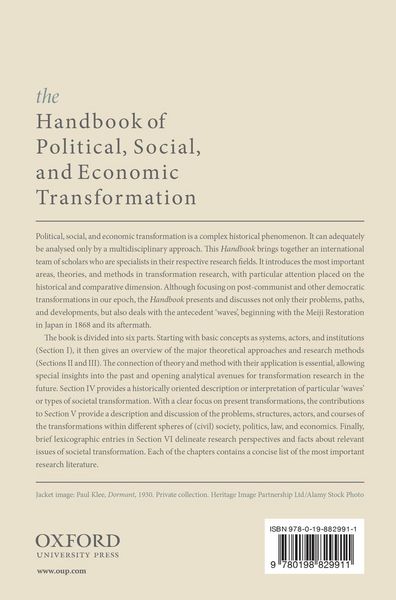
Handbook of Political, Social, and Economic Transformation

319,99 €

inkl. gesetzl. MwSt., Versandkostenfrei


Beschreibung

Produktdetails

Einband

Gebundene Ausgabe

Erscheinungsdatum

13.04.2019

Herausgeber

Wolfgang Merkel + weitere

Verlag

Oxford University Press

Seitenzahl

716

Maße (L/B/H)

25/17,5/4,3 cm

Gewicht

1400 g

Sprache

Englisch

ISBN

978-0-19-882991-1

Beschreibung

Produktdetails

Einband

Gebundene Ausgabe

Erscheinungsdatum

13.04.2019

Herausgeber

Verlag

Oxford University Press

Seitenzahl

716

Maße (L/B/H)

25/17,5/4,3 cm

Gewicht

1400 g

Sprache

Englisch

ISBN

978-0-19-882991-1

Herstelleradresse

Libri GmbH
Europaallee 1
36244 Bad Hersfeld
DE

Email: gpsr@libri.de

Noch keine Bewertungen vorhanden

Verfassen Sie die erste Bewertung zu diesem Artikel

Helfen Sie anderen Kundinnen und Kunden durch Ihre Meinung.

Kundinnen und Kunden meinen

Bewertungen (0)

Die Leseprobe wird geladen.
  • Produktbild: Handbook of Political, Social, and Economic Transformation
  • Produktbild: Handbook of Political, Social, and Economic Transformation
    • 1: Wolfgang Merkel, Raj Kollmorgen, and Hans-Jÿrgen Wagener: Transformation and Transition Research: An Introduction

    • Section I Theoretical Frameworks

    • 2: Wolfgang Merkel, Julian Brÿckner, and Hans-Jÿrgen Wagener: System

    • 3: Stefan Voigt: Institutions

    • 4: Wolfgang Merkel and Hans-Jÿrgen Wagener: Actors

    • Section II Research Approaches

    • 5: Raj Kollmorgen: Modernization Theories

    • 6: Julian Brÿckner: Transition Approaches

    • 7: Julian Brÿckner: Structuralism

    • 8: Jan Kubik: Cultural Approaches

    • 9: Christoph H. Stefes: Historical Institutionalism and Societal Transformations

    • 10: Malcolm H. Dunn and Joseph P. Ganahl: Development Economics and Transformation Studies

    • 11: Stefan Kolev and Joachim Zweynert: Approaches to Transformation in Economics

    • 12: Frank Bönker: Political Economy Approaches

    • 13: Jÿrgen Beyer: Political Steering Approach

    • 14: Karl-Dieter Opp: Political Mobilization Approaches

    • 15: Grzegorz Ekiert: Civil Society Approach

    • 16: Raj Kollmorgen and Wolfgang Merkel: Combining Theoretical Approaches

    • Section III Methods

    • 17: Carsten Q. Schneider: Macro-Qualitative Approaches

    • 18: Bruno Hildenbrand: Micro-Qualitative Research

    • 19: Gert Pickel and Susanne Pickel: Quantitative Methods in Transformation Research

    • 20: Tatjana Thelen: Ethnographic Methods

    • 21: Johannes Angermuller and Raj Kollmorgen: Discourse Approaches

    • 22: Martin Myant and Jan Drahokoupil: Economic Methods

    • 23: Dirk Berg-Schlosser: Comparative Methods in Transformation Research: Political Culture

    • Section IV Historic Waves and Types of Societal Transformations

    • 24: Raj Kollmorgen: Post-Absolutist Transformations in the Nineteenth and Early Twentieth Centuries

    • 25: Dieter Segert: State-Socialist Transformations in the Twentieth Century

    • 26: Alexander Nÿtzenadel: Transformation in Fascist Interbellum Europe

    • 27: Wolfgang Merkel and Johannes Gerschewski: Democratic Transformations after the Second World War

    • 28: Carsten Herrmann-Pillath: China's Transformations in the Twentieth Century: Economic, Political and Cultural Interdependencies

    • 29: Siegmar Schmidt: Postcolonial Transformations in Africa in the Twentieth Century

    • 30: Naser Ghobadzadeh: Islamist Transformations: From Utopian Vision to Dystopian Reality

    • 31: Peter Thiery: Democratic Transitions in the Late Twentieth Century

    • 32: Raj Kollmorgen: Post-socialist Transformations in the Twentieth and Twenty-First Centuries

    • Section V Spheres

    • 33: John Keane and Wolfgang Merkel: Civil Society

    • 34: Christian Kirchner and David Ehmke: Law

    • 35: Hans-Jÿrgen Wagener: Economy

    • Section VI Basic Problems of Transformation

    • 36: Antje Kÿstner: Autocracy Promotion

    • 37: Anton Sterbling: Collective Identities

    • 38: Astrid Lorenz: Constitution-building

    • 39: Bernhard Weßels: Corporative Actors: Parties, Associations

    • 40: Attila Ágh: Deconsolidation of Democracy in East-Central Europe

    • 41: Aurel Croissant and Wolfgang Merkel: Defective Democracy

    • 42: Julia Leininger: Democracy Promotion

    • 43: Leonardo Morlino: Democratic Consolidation

    • 44: Jÿrgen Dorbritz: Demographic Transitions

    • 45: Ilyas Saliba and Wolfgang Merkel: Dilemma of Simultaneity

    • 46: Michael Fritsch: Economic Restructuring

    • 47: Andreas Schedler: Elections and Transformation

    • 48: Cristóbal Rovira Kaltwasser: Elites

    • 49: Vera Trappmann: External Transformation Anchors

    • 50: Hans-Dieter Klingemann: Founding Elections

    • 51: Silke Roth and Charlie Walker: Gender Relations

    • 52: Aurel Croissant: Historical Legacies

    • 53: Alexander Schmotz: Hybrid Regimes

    • 54: Hans-Jÿrgen Wagener: Institutional Transfer

    • 55: Herman W. Hoen: Internationalization

    • 56: Katharina Pistor: Legal Systems and Economic Development

    • 57: Daniel Lambach: Legitimacy

    • 58: László Csaba: Liberalization

    • 59: Marek Dabrowski: Macroeconomic Stabilization

    • 60: Barbara Thomaß: Mass Media

    • 61: Sonja Grimm: Military Intervention

    • 62: Hubert Gabrisch: Monetary Transformation

    • 63: Saara Inkinen: Parties as Agents of Transition

    • 64: Wolfgang Merkel and Lea Heyne: Phases of Transformation

    • 65: Detlef Pollack: Political Culture

    • 66: Dag Tanneberg: Political Repression

    • 67: Bruno Dallago and Chiara Guglielmetti: Privatization

    • 68: Thomas Apolte: Property Rights

    • 69: Hans-Joachim Lauth: Regime Diffusion

    • 70: Hans-Joachim Bÿrkner: Regional Disparities

    • 71: Detlef Pollack: Religious Change

    • 72: Anne van Aaken: Rule of Law and Statehood

    • 73: Kenneth Newton: Social Capital

    • 74: Raj Kollmorgen: Social Inequalities

    • 75: Katharina Mÿller: Social Security

    • 76: Timm Beichelt: Stateness

    • 77: Vladimir Popov: Strategies of Economic Transformation

    • 78: Jan Fidrmuc: Transformation Crises

    • 79: Brigitte Weiffen: Transitional Justice

    • 80: Bernhard Weßels: Value Change