
• Produktbild: Doing Ethnography in Criminology
  • Produktbild: Doing Ethnography in Criminology

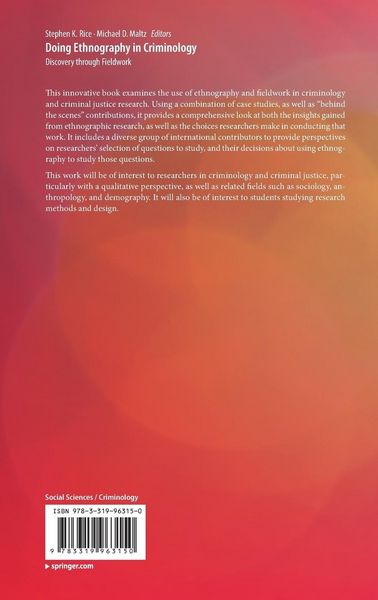
Doing Ethnography in Criminology Discovery through Fieldwork

126,99 €

inkl. gesetzl. MwSt., Versandkostenfrei


Beschreibung

Produktdetails

Einband

Gebundene Ausgabe

Erscheinungsdatum

22.10.2018

Abbildungen

XV, 12 illus., 8 illus. in color., schwarz-weiss Illustrationen, farbige Illustrationen

Herausgeber

Stephen K. Rice + weitere

Verlag

Springer

Seitenzahl

361

Maße (L/B/H)

24,1/16/2,6 cm

Gewicht

735 g

Auflage

1st ed. 2018

Sprache

Englisch

ISBN

978-3-319-96315-0

Beschreibung

Portrait

Stephen K. Rice is Associate Professor of Criminal Justice at Seattle University. He studies cooperation and defiance in individuals’ interactions with the justice system. Toward this end, his work has focused on emotions and crime, radicalization, procedural and restorative justice, racial / ethnic profiling (African Americans, Latinos, Muslim Americans), police / community relations (e.g., the police officer as “guardian”), final statements of the condemned, and social media and criminal justice.  His publications have appeared in outlets to include Criminology, Justice Quarterly, Deviant Behavior, Policing, the Journal of Quantitative Criminology, and the Harvard Executive Session on Policing and Public Safety.  He is also co-editor of Envisioning Criminology: Researchers on Research as a Process of Discovery (Springer) (with Michael D. Maltz) and Race, Ethnicity, and Policing (NYU Press) (with Michael D. White). His scholarship has been featured in public outlets to include The Final Report of The President’s Task Force on 21st Century Policing, The Washington Post, The Atlantic, and The New York Times. He received his Ph.D. from the University of Florida.

Michael D. Maltz is professor emeritus of criminal justice and of information and decision sciences at the University of Illinois at Chicago and senior research scientist and adjunct professor of sociology at the Criminal Justice Research Center at Ohio State University. A past editor of the Journal of Quantitative Criminology, he was on the staff of the National Institute of Justice (1969-72) and was a visiting fellow at the Bureau of Justice Statistics (1995-2000). In 1996, he held a Fulbright Scholarship at El Colegio de Michoacán in Mexico. His primary research interests have been on the assessing the validity of, and developing measures to extract useful inferences from, crime data. His 1984 book, Recidivism (Academic Press), was awarded the Wilkins Award for theoutstanding book in criminology and the Lanchester Prize of the Operations Research Society of America. He is coauthor of Mapping Crime in Its Community Setting (Springer), (with Andrew Gordon and Warren Friedman), author of Bridging Gaps in Police Crime Data (US Government Printing Office), and co-editor of Envisioning Criminology: Researchers on Research as a Process of Discovery (Springer) (with Stephen K. Rice). He holds a Ph.D. in electrical engineering from Stanford University.

Produktdetails

Einband

Gebundene Ausgabe

Erscheinungsdatum

22.10.2018

Abbildungen

XV, 12 illus., 8 illus. in color., schwarz-weiss Illustrationen, farbige Illustrationen

Herausgeber

Verlag

Springer

Seitenzahl

361

Maße (L/B/H)

24,1/16/2,6 cm

Gewicht

735 g

Auflage

1st ed. 2018

Sprache

Englisch

ISBN

978-3-319-96315-0

Herstelleradresse

Springer-Verlag KG
Sachsenplatz 4-6
1201 Wien
AT

Email: GPSR Kontakt

Noch keine Bewertungen vorhanden

Verfassen Sie die erste Bewertung zu diesem Artikel

Helfen Sie anderen Kundinnen und Kunden durch Ihre Meinung.

Kundinnen und Kunden meinen

Bewertungen (0)

  • Produktbild: Doing Ethnography in Criminology
  • Produktbild: Doing Ethnography in Criminology
  • Introduction.- Part 1: Ethnographies of Subculture.- Drug Dealing, Drug Violence, and Teenage Prostitutes.- Youth Violence and Concentrated Disadvantage.- Gender, Race, Sexuality and Place.- Political Mobilization of Ethnicity, Immigration and Labor in the US Inner City.- Social Class, Race and Gender in Everyday Decision-Making.- Cultural Dispositions and Underground Boxing Clubs.- Telling Stories: Narrative Criminology.- Gay Gang Members.- Ethnography of Prison Writing Workshops with Female Inmates.- Ethnographies of State-Corporate Crime.- Part 2: Ethnographies of Place.- How Neighborhood Residents Make Sense of Their Lives within Severe Constraints.- Security and Politics in Latin America.- Youth Drug Use in Suburbs and Affluent Communities.- Offender Decision Making.- "The Wire" as Ethnography.- Imprisonment, Rehabilitation and Reentry.- Drift and the Urban Underground.- Part 3: Ethnographies of Policing.- The Surveillance State.- Ethnographies of Policing.- Policing the Lives of Black and Latino Boys.- Urban Violence and Policing.- Policing the Urban Poor: Skid Row.- Militarization of Policing.- Conclusion.