• Produktbild: Radical Collegiality through Student Voice
  • Produktbild: Radical Collegiality through Student Voice
- 12%

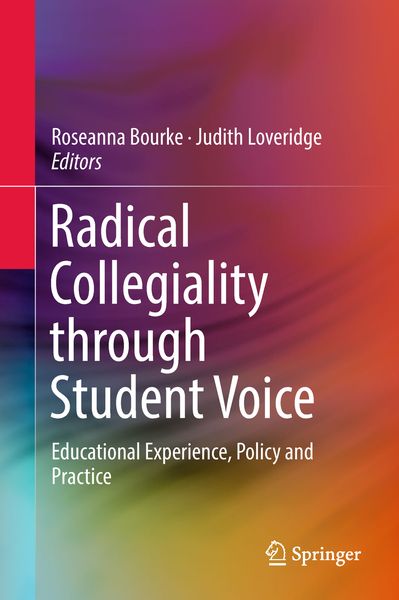
Radical Collegiality through Student Voice Educational Experience, Policy and Practice

12% sparen

93,99 € UVP 106,99 €

inkl. gesetzl. MwSt., Versandkostenfrei


Beschreibung

Produktdetails

Einband

Gebundene Ausgabe

Erscheinungsdatum

07.09.2018

Abbildungen

XII, 2 illus., schwarz-weiss Illustrationen

Herausgeber

Roseanna Bourke + weitere

Verlag

Springer Singapore

Seitenzahl

219

Maße (L/B/H)

24,1/16/1,9 cm

Gewicht

518 g

Auflage

1st ed. 2018

Sprache

Englisch

ISBN

978-981-13-1857-3

Beschreibung

Portrait

Roseanna Bourke is an Associate Professor of Learning and Assessment at the Institute of Education, Massey University, New Zealand. Roseanna is a registered teacher and psychologist and researches in the areas of learning and assessment, student voice, informal and everyday learning, applied professional ethics, and the impact of institutionalised practices on student learning. She was the co-principal investigator of a 3-year TLRI research study on the impact of children’s everyday learning on teaching and learning in classrooms (2015-2017). She is an Associate Editor of the International Journal of Student Voice Research and former Co-Editor of the New Zealand Journal of Educational Studies. Roseanna is interested in helping students, teachers, psychologists and parents embrace a broader concept of learning to ensure that young people’s learning identity is not narrowed through a curriculum-specific lens.

Judith Loveridge is a senior lecturer at Victoria University of Wellington. She is particularly interested in the intersection between social and cultural processes and individuals’ learning and development. Her major on-going area of research concerns the ways in which children and adults learn and develop through their experiences of implicit cultural practices, as well as through the experiences they have as a result of explicitly stated educational goals and pedagogical philosophies and practices. This theme has been addressed through research examining young children’s learning in home, community and educational settings, children’s enculturation, home, centre and school relations, and adults’ learning in informal contexts. A related research interest is the question of how to appropriately and authentically involve children and young people in research. Ensuring that the diversity of groups’ and individuals’ experiences is given expression has been another important theme in her research.

Produktdetails

Einband

Gebundene Ausgabe

Erscheinungsdatum

07.09.2018

Abbildungen

XII, 2 illus., schwarz-weiss Illustrationen

Herausgeber

Verlag

Springer Singapore

Seitenzahl

219

Maße (L/B/H)

24,1/16/1,9 cm

Gewicht

518 g

Auflage

1st ed. 2018

Sprache

Englisch

ISBN

978-981-13-1857-3

Herstelleradresse

Springer-Verlag GmbH
Tiergartenstr. 17
69121 Heidelberg
DE

Email: ProductSafety@springernature.com

Kundinnen und Kunden meinen

0 Bewertungen

Informationen zu Bewertungen

Zur Abgabe einer Bewertung ist eine Anmeldung im Konto notwendig. Die Authentizität der Bewertungen wird von uns nicht überprüft. Wir behalten uns vor, Bewertungstexte, die unseren Richtlinien widersprechen, entsprechend zu kürzen oder zu löschen.

Die Bewertungen sind nach Format, Anzahl Sterne und Datum sortiert.

Verfassen Sie die erste Bewertung zu diesem Artikel

Helfen Sie anderen Kund*innen durch Ihre Meinung

Kundinnen und Kunden meinen

0 Bewertungen filtern

  • Produktbild: Radical Collegiality through Student Voice
  • Produktbild: Radical Collegiality through Student Voice
  • Chapter 1. Using student voice to challenge understandings of educational research, policy and practice.- Chapter 2. Tracing the evolution of student voice in Educational Research.- Chapter 3. Voice and the ethics of children's agency in educational research.- Chapter 4. Representing youth voices in indigenous community research.- Chapter 5. Marginalised youth speak back through research: Empowerment and transformation of educational experience.- Chapter 6. Challenges of student voice within a context of threatened identities.- Chapter 7. Gathering and listening to the voices of M¿ori students: What are the system responses?.- Chapter 8. Foregrounding the stories of secondary school students with disabilities.- Chapter 9. Students' voice shifting the gaze from measured learning to the point of learning.- Chapter 10. Beyond the official language of learning: Teachers engaging with student voice research.- Chapter 11. Student voice, citizenship and regulated spaces.- Chapter 12. Teachers and Power in Student Voice: 'Finger on the Pulse, Not Children Under the Thumb'.