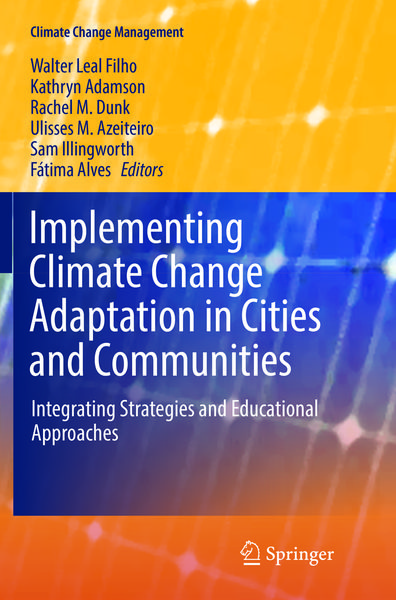
Produktbild: Implementing Climate Change Adaptation in Cities and Communities
- 10%

Implementing Climate Change Adaptation in Cities and Communities Integrating Strategies and Educational Approaches

10% sparen

95,99 € UVP 106,99 €

inkl. gesetzl. MwSt., Versandkostenfrei


Beschreibung

Produktdetails

Einband

Taschenbuch

Erscheinungsdatum

31.05.2018

Abbildungen

IX, 70 illus., 60 illus. in color., farbige Illustrationen, schwarz-weiss Illustrationen

Herausgeber

Walter Leal Filho + weitere

Verlag

Springer

Seitenzahl

405

Maße (L/B/H)

23,5/15,5/2,3 cm

Gewicht

628 g

Auflage

Softcover reprint of the original 1st ed. 2016

Sprache

Englisch

ISBN

978-3-319-80382-1

Beschreibung

Portrait

Walter Leal Filho is a Professor at Hamburg University of Applied Sciences in Germany and Manchester Metropolitan University, UK, where he leads a set of international projects on matters related to sustainable development and climate change.

Kathryn Adamson is a Lecturer in Physical Geography at Manchester Metropolitan University, UK. Kathryn’s research is focused on long-term climate change in the Mediterranean and Arctic regions. She is a field-based scientist, with expertise in geomorphology, sedimentology, and geochemical analysis. Her research examines the response of glaciers and river systems to changing environmental conditions during the Quaternary (the last 2.6 million years). These long-term records provide important context for our understanding of present and future climate change.

Rachel Dunk is a Lecturer at the School of Science and the Environment at Manchester Metropolitan University, UK. Her research interests are on carbon accounting methodologies; effective engagement in climate change mitigation and adaptation in the non-traded sector; distributional and equity considerations of climate change policy; terrestrial and marine carbon storage and the biogeochemistry of greenhouse gases.

Ulisses M Azeiteiro is a Professor at the Universidade Aberta and a Senior Researcher at the Centre for Functional Ecology of Coimbra University where he is the Coordinator of the Group History of Science, Scientific Communication and Dissemination. In the area of Sustainability he is member of the Editorial Board of the International Journal of Sustainability in Higher Education and he published several books in Sustainability Science.

Sam Illingworth is a lecturer in Science Communication at Manchester Metropolitan University, UK. He is an expert in Science Communication with a background in atmospheric physics, theatre, and education. As well conducting research into the relationship between sciences and the arts, he also uses his unique skillset to inspire a future generation of scientists to learn how to communicate in an effective and engaging manner. As a lecturer in science communication, his responsibility include researching pedagogic technique and scientific communication practice, and helping to promote science as a fundamental part of our culture and society.

Fátima Alves , Phd in Sociology of Health, is Professor at Social Sciences an Management Department, Universidade Aberta and senior Researcher at CEMRI, UAb and at CEF, Coimbra University. Coordinates the extension of the Centre for Functional Ecology of Coimbra University. 

Produktdetails

Einband

Taschenbuch

Erscheinungsdatum

31.05.2018

Abbildungen

IX, 70 illus., 60 illus. in color., farbige Illustrationen, schwarz-weiss Illustrationen

Herausgeber

Verlag

Springer

Seitenzahl

405

Maße (L/B/H)

23,5/15,5/2,3 cm

Gewicht

628 g

Auflage

Softcover reprint of the original 1st ed. 2016

Sprache

Englisch

ISBN

978-3-319-80382-1

Herstelleradresse

Springer-Verlag KG
Sachsenplatz 4-6
1201 Wien
AT

Email: GPSR Kontakt

Noch keine Bewertungen vorhanden

Verfassen Sie die erste Bewertung zu diesem Artikel

Helfen Sie anderen Kundinnen und Kunden durch Ihre Meinung.

Kundinnen und Kunden meinen

Bewertungen (0)

  • Produktbild: Implementing Climate Change Adaptation in Cities and Communities
  • Preface.- Part I: Climate Change Adaptation in Cities and Communities.- Part II: Integrating Adaptation Strategies and Educational Approaches.