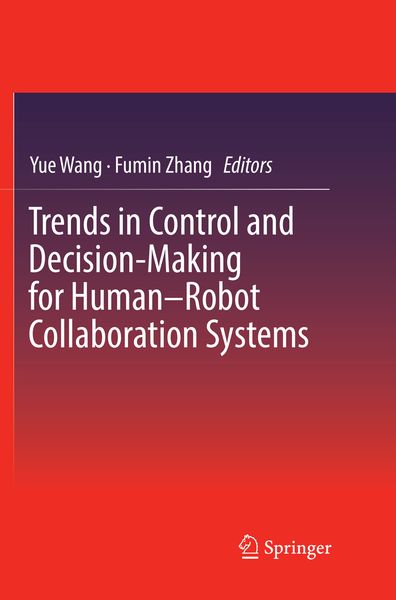
Trends in Control and Decision-Making for Human–Robot Collaboration Systems
-
- Hardcover
- Taschenbuch ausgewählt
- eBook
-
Sprache:Englisch
147,99 €
inkl. gesetzl. MwSt.,
Beschreibung
Produktdetails
Einband
Taschenbuch
Erscheinungsdatum
12.07.2018
Abbildungen
XIX, 418 p. 173 illus., 121 illus. in color.
Herausgeber
Yue Wang + weitereVerlag
SpringerSeitenzahl
418
Maße (L/B/H)
23,5/15,5/2,3 cm
Gewicht
743 g
Auflage
Softcover reprint of the original 1st ed. 2017
Sprache
Englisch
ISBN
978-3-319-82124-5
This book provides an overview of recent research developments in the automation and control of robotic systems that collaborate with humans. A measure of human collaboration being necessary for the optimal operation of any robotic system, the contributors exploit a broad selection of such systems to demonstrate the importance of the subject, particularly where the environment is prone to uncertainty or complexity. They show how such human strengths as high-level decision-making, flexibility, and dexterity can be combined with robotic precision, and ability to perform task repetitively or in a dangerous environment.
The book focuses on quantitative methods and control design for guaranteed robot performance and balanced human experience from both physical human-robot interaction and social human-robot interaction. Its contributions develop and expand upon material presented at various international conferences. They are organized into three parts covering:
- one-human–one-robot collaboration;
- one-human–multiple-robot collaboration; and
- human–swarm collaboration.
Individual topic areas include resource optimization (human and robotic), safety in collaboration, human trust in robot and decision-making when collaborating with robots, abstraction of swarm systems to make them suitable for human control, modeling and control of internal force interactions for collaborative manipulation, and the sharing of control between human and automated systems, etc. Control and decision-making algorithms feature prominently in the text, importantly within the context of human factors and the constraints they impose. Applications such as assistive technology, driverless vehicles, cooperative mobile robots, manufacturing robots and swarm robots are considered. Illustrative figures and tables are provided throughout the book.
Researchers and students working in controls, and the interaction of humans and robots will learn new methods for human–robot collaboration from this book and will find the cutting edge of the subject described in depth.
Noch keine Bewertungen vorhanden
Verfassen Sie die erste Bewertung zu diesem Artikel
Helfen Sie anderen Kundinnen und Kunden durch Ihre Meinung.
Kurze Frage zu unserer Seite
Vielen Dank für Ihr Feedback
Wir nutzen Ihr Feedback, um unsere Produktseiten zu verbessern. Bitte haben Sie Verständnis, dass wir Ihnen keine Rückmeldung geben können. Falls Sie Kontakt mit uns aufnehmen möchten, können Sie sich aber gerne an unseren Kund*innenservice wenden.
zum Kundenservice