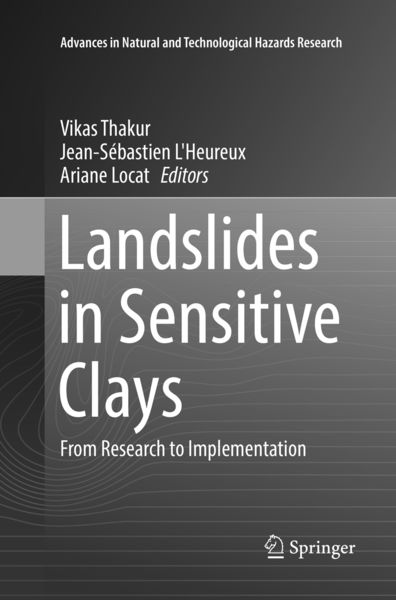
Landslides in Sensitive Clays From Research to Implementation
-
- Hardcover
- Taschenbuch ausgewählt
- eBook
-
Sprache:Englisch
-
Verlag:Springer
- Springer 213,99 € ausgewählt
- Springer Netherland 139,99 €
213,99 €
inkl. gesetzl. MwSt.,
Beschreibung
Produktdetails
Einband
Taschenbuch
Erscheinungsdatum
31.07.2018
Abbildungen
XIX, 603 p. 287 illus., 228 illus. in color.
Herausgeber
Vikas Thakur + weitereVerlag
SpringerSeitenzahl
603
Maße (L/B/H)
23,5/15,5/3,2 cm
Gewicht
1045 g
Auflage
Softcover reprint of the original 1st ed. 2017
Sprache
Englisch
ISBN
978-3-319-85924-8
This book gathers the most recent scientific research on the geological, geotechnical and geophysical aspects of slope failure in sensitive clays. Gathering contributions by international experts, it focuses on understanding the complete and practical spectrum of challenges presented by landslides in such complex materials. Based on sound and validated research results, the book also presents several recommendations that could be implemented in the guidelines or code-of-practice. These recommendations cover topics including the characterization and behavior of sensitive clays; the pre-failure, failure and post-failure stages of sensitive clays; mapping and identification methods; climate change; hazard assessment; and risk management.
Sensitive clays are known for their potential for causing large landslides, which pose a serious risk to human lives, infrastructure, and surrounding ecosystems within their reach. This has been demonstrated by the recent catastrophic landslides in e.g. Sørum (2016), Skjeggestad (2015), Statland (2014), Byneset (2012), St-Jude (2010), Lyngen (2010) and Kattmarka (2009). The 2015 collapse of the Skjeggestad Bridge in Norway – which was due to a landslide in sensitive clay – alone costs millions of dollars in repairs. Recently, efforts are being made to increase society’s ability to cope with such landslide hazards. Geoscientists are now expected to provide input to the agencies responsible for landslide-risk preparedness. In other words, geoscientists’ role is not only to act as technologists to establish new theories, but also to go the extra mile to implement them in practice, so as to find meaningful solutions to geotechnical problems.Noch keine Bewertungen vorhanden
Verfassen Sie die erste Bewertung zu diesem Artikel
Helfen Sie anderen Kundinnen und Kunden durch Ihre Meinung.
Kurze Frage zu unserer Seite
Vielen Dank für Ihr Feedback
Wir nutzen Ihr Feedback, um unsere Produktseiten zu verbessern. Bitte haben Sie Verständnis, dass wir Ihnen keine Rückmeldung geben können. Falls Sie Kontakt mit uns aufnehmen möchten, können Sie sich aber gerne an unseren Kund*innenservice wenden.
zum Kundenservice