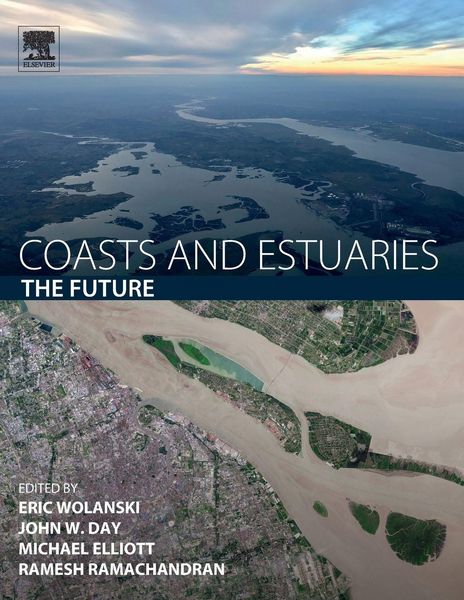
• Produktbild: Coasts and Estuaries
  • Produktbild: Coasts and Estuaries
- 26%

Coasts and Estuaries The Future

26% sparen

128,99 € UVP 175,50 €

inkl. gesetzl. MwSt., Versandkostenfrei


Beschreibung

Produktdetails

Einband

Taschenbuch

Erscheinungsdatum

06.02.2019

Herausgeber

Eric Wolanski + weitere

Verlag

Elsevier Science & Technology

Seitenzahl

728

Maße (L/B/H)

27,7/21,5/4 cm

Gewicht

1944 g

Sprache

Englisch

ISBN

978-0-12-814003-1

Beschreibung

Rezension

"Within each section the chapters deal with very different issues and have a different focus. For example, some authors address a specific system or issue, whereas others have taken a much broader approach, synthesizing information from a number of systems within a wider geographic region. Chapters vary in length, and therefore information contained within them varies greatly in detail. Some authors have included short, focused boxed essays, whereas others have not. For these reasons I believe that some chapters are of more value than others. Because the book mainly concentrates on soft sediment in resolution, with labelling that is difficult to read. There is also a randomness in the use of colour and puzzlingly, the size of maps and diagrams varies from full page to quite small. Bringing this 700+ page multi-author volume together will have been a mammoth task for the editors. Despite the quality of some of the images, maps, and diagrams, the book will be of value to those scientists and resource managers working on risk assessments and management of coastal systems. environments, I was surprised that there was very little information on the impact of armouring shorelines and erosion control. Whilst I found that useful tables and figures accompany the text of most chapters, the quality of the figures and illustrations is variable. Some diagrams are sharp and clear, whereas others are rather poor" --The Marine Biologist

Portrait

Professor Eric Wolanski is an estuarine oceanographer at James Cook University and the Australian Institute of Marine Science. His research interests range from the oceanography of coral reefs, mangroves, and muddy estuaries, to the interaction between physical and biological processes determining ecosystem health in tropical waters. He has published 396 publications and reports. Eric is a fellow of the Australian Academy of Technological Sciences and Engineering, the Institution of Engineers Australia (ret.), and l’Académie Royale des Sciences d’Outre-Mer. He was awarded an Australian Centenary medal, a Doctorate Honoris Causa by the Catholic University of Louvain, a second Doctorate Honoris Causa by the University Hull, and a Lifetime Achievement Award by the Estuarine & Coastal Sciences Association. Eric is a member of the Scientific and Policy Committee of the Japan-based International Center for Environmental Management of Enclosed Coastal Seas.

Professor John Day is an Emeritus Professor at the Department of Oceanography & Coastal Sciences, Louisiana State University. His research interests include Estuarine Ecology, Systems Ecology, Wetland Ecology, Ecological Modeling, Effects of Humans on Natural Systems, Tropical Coastal Ecology. Professor Day has edited numerous books on aquatic ecology and has contributed to numerous journal articles and special issues.

Professor Michael Elliott is the Director of the Institute of Estuarine & Coastal Studies (IECS) and Professor of Estuarine and Coastal Sciences at the University of Hull, U.K. He is a marine biologist with wide experience in teaching, research, advisory and consultancy work in estuarine and marine aspects of ecological components and communities, and the impacts of human activities, as well as policy, governance, and management of estuaries and coasts. He is a Fellow of the Royal Geographical Society and of the Society of Biology. Mike has published widely, coauthoring/coediting 15 books and contributing to over 200 scientific publications. Mike has acted as an advisor on many marine and estuarine environmental matters for academia, industry, government, and statutory bodies in Europe and elsewhere. Mike is a past-president of the international Estuarine & Coastal Sciences Association (ECSA) and is also one of the four editors-in-chief of the international journal Estuarine, Coastal & Shelf Science and is on the editorial board of Marine Pollution Bulletin. He is the Sir Walter Murdoch Distinguished Adjunct Professor, Murdoch University, Australia, and also has adjunct professor and research positions at Klaipeda University (Lithuania), the University of Palermo (Italy), and the South African Institute for Aquatic Biodiversity, Grahamstown. In 2014, he was appointed an independent non-executive member of the UK Marine Science Coordinating Committee and member of the Science Advisory Board of Marine Scotland. In 2014, Mike was awarded the Laureate of the Honorary Winberg Medal of the Russian Hydrobiological Academic Society.

Ramachandran Ramesh’s expertise includes coastal biogeochemistry and Integrated Coastal Zone Management. He received his MPhil and PhD in Environmental Sciences from Jawaharlal Nehru University, New Delhi and a second PhD in Marine Sciences from the McGill University, Canada.

As Former Chair of Future Coasts (formerly Land Ocean Interactions in the Coastal Zone; LOICZ) from 2011 to 2015, he implemented the LOICZ Nutrient Budget for major estuaries on the east and west coast of India among several other studies globally. Another significant contribution is the development of an Ecosystem Health Report Card for Chilika Lagoon, Odisha and the Marine National Park, Jamnagar, Gujarat, India. Currently, many such ecosystems in India (viz. Gulf of Mannar, Kavaratti Island, Lakshadweep) are underway.

For the past decade, Ramesh Ramachandran has been involved in coupled land-ocean interface studies and their management to aid policy decisions of the Ministry of Environment, Forest & Climate Change. As the Founder and Director of the National Centre for Sustainable Coastal Management of the Ministry of Environment, Forest & Climate Change, several trans-disciplinary research studies spanning coastal vulnerability, socio-economic development, coastal/ marine conservation, spatial planning, land-based pollution, island management, integrated coastal zone management and climate change are being undertaken under his leadership.

Produktdetails

Einband

Taschenbuch

Erscheinungsdatum

06.02.2019

Herausgeber

Verlag

Elsevier Science & Technology

Seitenzahl

728

Maße (L/B/H)

27,7/21,5/4 cm

Gewicht

1944 g

Sprache

Englisch

ISBN

978-0-12-814003-1

Herstelleradresse

Libri GmbH
Europaallee 1
36244 Bad Hersfeld
DE

Email: gpsr@libri.de

Noch keine Bewertungen vorhanden

Verfassen Sie die erste Bewertung zu diesem Artikel

Helfen Sie anderen Kundinnen und Kunden durch Ihre Meinung.

Kundinnen und Kunden meinen

Bewertungen (0)

  • Produktbild: Coasts and Estuaries
  • Produktbild: Coasts and Estuaries
  • 1. A Synthesis: What Is the Future for Coasts, Estuaries, Deltas and Other Transitional Habitats in 2050 and Beyond?

    Section A: Estuaries
    2. An Assessment of Saltwater Intrusion in the Changjiang (Yangtze) River Estuary, China
    3. Río De La Plata: A Neotropical Estuarine System
    4. Estuaries and Coastal Zones in the Northern Persian Gulf (Iran)
    5. Protecting Water Quality in Urban Estuaries: Australian Case Studies
    6. Management of Megafauna in Estuaries and Coastal Waters: Moreton Bay as a Case Study
    7. Peel-Harvey Estuary, Western Australia

    Section B: Deltas
    8. Arctic Deltas and Estuaries: A Canadian Perspective
    9. Delta Winners and Losers in the Anthropocene
    10. Mississippi Delta Restoration and Protection: Shifting Baselines, Diminishing Resilience, and Growing Nonsustainability
    11. Integrated Management of the Ganges Delta, India
    12. The Indus Delta-Catchment, River, Coast, and People
    13. A Brief Overview of Ecological Degradation of the Nile Delta: What We Can Learn
    14. Status and Sustainability of Mediterranean Deltas: The Case of the Ebro, Rhône, and Po Deltas and Venice Lagoon

    Section C: Wetlands,  Lagoons and Catchments
    15. Coastal Lagoons: Environmental Variability, Ecosystem Complexity, and Goods and Services Uniformity
    16. The Everglades: At the Forefront of Transition
    17. Population Growth, Nutrient Enrichment, and Science-Based Policy in the Chesapeake Bay Watershed
    18. The Senegal and Pangani Rivers: Examples of Over-Used River Systems Within Water-Stressed Environments in Africa
    19. Damming the Mekong: Impacts in Vietnam and Solutions

    Section D: Enclosed, Semi-enclosed, and Open Coast
    20. Baltic Sea: A Recovering Future From Decades of Eutrophication
    21. The Black Sea-The Past, Present, and Future Status
    22. Ecosystem Functioning and Sustainable Management in Coastal Systems With High Freshwater Input in the Southern Gulf of Mexico and Yucatan Peninsula

    Section E: Restoration of Estuaries
    23. Restoration of Estuaries and Bays in Japan-What's Been Done So Far, and Future Perspectives
    24. Challenges of Restoring Polluted Industrialized Muddy NW European Estuaries
    25. Can Bivalve Habitat Restoration Improve Degraded Estuaries?

    Section F: Coral Reefs
    26. Successful Management of Coral Reef-Watershed Networks
    27. Challenges and Opportunities  in the Management of Coral Islands of Lakshadweep, India
    28. The Future of the Great Barrier Reef: The Water Quality Imperative

    Section G: Over-Arching Topics
    29. Estuarine Ecohydrology Modeling: What Works and Within What Limits?
    30. Hypersalinity: Global Distribution, Causes, and Present and Future Effects on the Biota of Estuaries and Lagoons
    31. Alien Species Invasion: Case Study of the Black Sea
    32. Coastal Fisheries: The Past, Present, and Possible Futures
    33. Temperate Estuaries: Their Ecology Under Future Environmental Changes
    34. Plastic Pollution in the Coastal Environment: Current Challenges and Future Solutions
    35. Changing Hydrology: A UK Perspective

    Section H: Management of Change
    36. Global Change Impacts on the Future of Coastal Systems: Perverse Interactions Among Climate Change, Ecosystem Degradation, Energy Scarcity, and Population
    37. Human-Nature Relations in Flux: Two Decades of Research in Coastal and Ocean Management
    38. Megacities and the Coast: Global Context and Scope for Transformation
    39. Arctic Coastal Systems: Evaluating the DAPSI(W)R(M) Framework