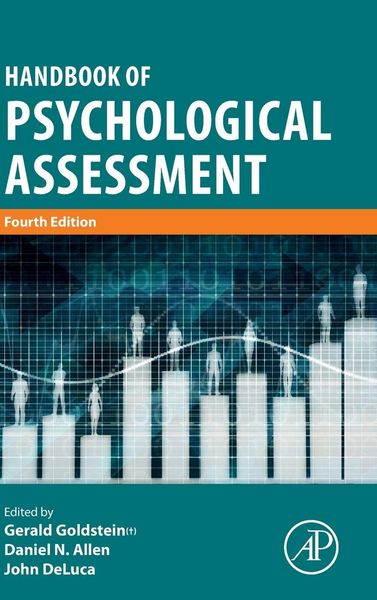
• Produktbild: Handbook of Psychological Assessment
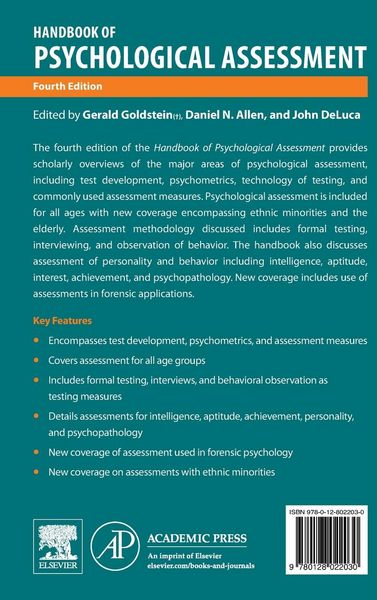
  • Produktbild: Handbook of Psychological Assessment

Handbook of Psychological Assessment

148,99 €

inkl. gesetzl. MwSt., Versandkostenfrei


Beschreibung

Produktdetails

Einband

Gebundene Ausgabe

Erscheinungsdatum

26.02.2019

Herausgeber

Goldstein Gerald + weitere

Verlag

Elsevier Science & Technology

Seitenzahl

648

Maße (L/B/H)

22,9/15,2/3,5 cm

Gewicht

1030 g

Auflage

4. Auflage

Sprache

Englisch

ISBN

978-0-12-802203-0

Beschreibung

Portrait

Dr. Gerald Goldstein was a Senior Research Career Scientist in the Department of Veterans' Affairs and a Professor of Psychiatry and Psychology at the University of Pittsburgh. Formerly, Dr. Goldstein was a research psychologist at the Topeka Veterans' Administration Hospital, and a faculty member of the University of Kansas and the Menninger Foundation. He had a Ph.D. degree in clinical psychology obtained at the University of Kansas.

Dr. Goldstein was a past president of the International Neuropsychological Society, the National Academy of Neuropsychology, and the Division of Clinical Neuropsychology of the American Psychological Association. He was a diplomate of the American Board of Professional Psychology in clinical neuropsychology. He had published extensively in the field of clinical neuropsychology, with particular emphases in the areas of alcoholism, schizophrenia, autism, and adult learning disability.

Daniel Allen uses clinical and cognitive neuropsychological approaches to study people with psychiatric and neurological disorders. His aim is to understand better how the brain supports complex cognitive activities such as memory, attention, and problem solving. His recent work has focused on understanding the considerable heterogeneity in neurocognitive function exhibited by those with schizophrenia and bipolar disorder by examining such factors as comorbid substance use disorders, endophenotype expression, negative symptoms, trauma and premorbid adjustment. He has also examined abnormalities in social cognition and emotion processing as core features of these disorders, and has developed a number of new methods to examine cognitive components of the emotion processing system. More recently, he has investigated neuropsychological and behavioral deficits associated with traumatic brain injury in children and adolescents.

Dr. Allen was recently elected president of the National Academy of Neuropsychology, and is a fellow of the American Psychological Association (Division 40), National Academy of Neuropsychology, and Western Psychological Association. He is the director of the Neuropsychology Research Program at UNLV. He received his Ph.D. in clinical psychology from the University of South Dakota in 1993.John DeLuca, Ph.D. is the Senior Vice President for Research at Kessler Foundation, a Professor in the Departments of Physical Medicine & Rehabilitation (PM&R) Department of Neurology at Rutgers New Jersey Medical School and a licensed psychologist in the States of New Jersey and New York. Dr. DeLuca devotes 100% of his time to research and training. He is currently studying disorders of memory and information processing in a variety of clinical populations including: Multiple Sclerosis, Aneurysmal Subarachnoid Hemorrhage, Chronic Fatigue Syndrome, and Traumatic Brain Injury. Dr. DeLuca's accomplishments include over 275 published articles, abstracts, and chapters in these areas. He is on the editorial board of several journals and serves as the editor for special issues of the journal NeuroRehabilitation on Multiple Sclerosis and for the journal Applied Neuropsychology on chronic fatigue syndrome. Dr. DeLuca is listed in "Who is Who in Science and Engineering, 1994-1995," and he is the recipient of early career awards for his research from both the American Psychological Association (Division 40: Clinical Neuropsychology) and the National Academy of Neuropsychology. In 2005, Dr. DeLuca received the Distinguished Researcher Award for the New Jersey Psychological Association. In 2017, he was awarded the Fred Foley Award for Best Practices in Mental Health and Multiple Sclerosis by the Consortium of Multiple Sclerosis Centers for his outstanding contributions to advancing research in the understanding and clinical treatment of cognitive impairments in MS. He serves as a member and chair for the Ph.D. Postdoctoral Fellowship Committee in the Department of PM&R at Rutgers New Jersey Medical School (formerly, UMDNJ-NJMS) and directs the post-doctoral fellowship program in Neuropsychology for the Department. He is also a member and past Chair of the IRB at Kessler Foundation. Dr. DeLuca serves on numerous committees for both national and international societies associated with Neuropsychology.

Produktdetails

Einband

Gebundene Ausgabe

Erscheinungsdatum

26.02.2019

Herausgeber

Verlag

Elsevier Science & Technology

Seitenzahl

648

Maße (L/B/H)

22,9/15,2/3,5 cm

Gewicht

1030 g

Auflage

4. Auflage

Sprache

Englisch

ISBN

978-0-12-802203-0

EU-Ansprechpartner

Kolibri 360 GmbH
Ettore-Bugatti-Straße 6-14
51149 Köln
DE
produktsicherheit@kolibri360.de

Herstelleradresse

Elsevier Science & Technology
125 London Wall
EC2Y 5AS London
GB
tradeorders@elsevier.com

Noch keine Bewertungen vorhanden

Verfassen Sie die erste Bewertung zu diesem Artikel

Helfen Sie anderen Kundinnen und Kunden durch Ihre Meinung.

Kundinnen und Kunden meinen

Bewertungen (0)

Die Leseprobe wird geladen.
  • Produktbild: Handbook of Psychological Assessment
  • Produktbild: Handbook of Psychological Assessment
  • Part I. Introduction
    1. Historical perspectives
    Gerald Goldstein, Daniel N, Allen, John DeLuca

    PART II. Psychometric Foundations
    2. How to develop an empirically based psychological test
    Cecil Reynolds & Ron Livingston

    Part III. Assessment of Intelligence
    3. Interpreting pediatric intelligence tests: a framework from evidence-based medicine
    Andrew J. Freeman & Yen-Ling Chen
    4. The development, expansion, and future of the WAIS-IV as a cornerstone in comprehensive cognitive assessments
    James A. Holdnack

    Part IV. Achievement and Interest
    5. Aptitude and achievement testing
    Lynda J. Katz & Franklin C. Brown
    6. Interest inventories
    Jo-Ida C. Hansen

    PART V. Neuropsychological Assessment
    7. Sources of error and meaning in the pediatric neuropsychological evaluation
    Michael D. Welier, W. Grant Willis & Mary Lynne Kennedy
    8. Adult comprehensive neuropsychological assessment
    N. Allen & John DeLuca
    9. Assessment in sports: psychological and neuropsychological approaches
    Ruben J. Echemendia, Frank M. Webbe, Victoria C. Merritt, Gabriela Gonzalez

    Part VI. Interviewing
    10. Clinical interviewing
    Daniel N. Allen & Megan L. Becker
    11.  Structured and Semi-structured interviews for children
    Christopher A. Kearney, Andrew Freeman, Victoria Bacon
    12. Diagnostic and symptom interviews for adults
    Daniel N. Allen & Megan Becker

    Part VII. Personality Assessment
    13. Overview of multidimensional inventories of psychopathology with a focus on the MMPI-2
    Carolyn  L. Williams, James N. Butcher, Jacob A. Paulsen
    14. The Rorschach
    Philip Erdberg

    Part VIII. Behavioral Assesment
    15. Behavioral assessment of children
    Ross W. Greene, Thomas H. Ollendick
    16. Behavioral assessment of adults in clinical settings
    Stephen N. Haynes, William H. O'Brien, Joseph Keawe'aimoku Kaholokula

    Part IX. Special Topics and Applications
    17. Psychological assessment of the elderly
    18. Forensic psychology: practice issues
    MacNeill Horton, Henry V. Soper
    19. Fairness in psychological testing
    Zarui A. Melikyan, Anna V. Agranovich, Antonio E. Puente
    20. Technological developments in assessment
    Robert L. Kane, Thomas D. Parsons