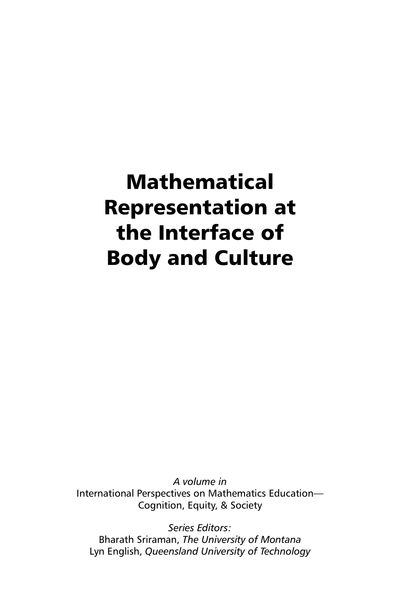
Mathematical Representation at the Interface of Body and Culture
-
- Taschenbuch
- eBook ausgewählt
-
Form:Einzelkauf Download
-
Sprache:Englisch
58,99 €
inkl. gesetzl. MwSt.Beschreibung
Produktdetails
Format
ePUB
Kopierschutz
Ja
Family Sharing
Ja
Text-to-Speech
Ja
Erscheinungsdatum
06.01.2009
Herausgeber
Wolff-Michael RothVerlag
Information Age PublishingSeitenzahl
369 (Printausgabe)
Dateigröße
6252 KB
Sprache
Englisch
EAN
9781607521914
Over the past two decades, the theoretical interests of mathematics educators have changed substantially-as any brief look at the titles and abstracts of articles shows. Largely through the work of Paul Cobb and his various collaborators, mathematics educators came to be attuned to the intricate relationship between individual and the social configuration of which she or he is part. That is, this body of work, running alongside more traditional constructivist and psychological approaches, showed that what happens at the collective level in a classroom both constrains and affords opportunities for what individuals do (their practices). Increasingly, researchers focused on the mediational role of sociomathematical norms and how these emerged from the enacted lessons.
A second major shift in mathematical theorizing occurred during the past decade: there is an increasing focus on the embodied and bodily manifestation of mathematical knowing (e.g., Lakoff & Núñez, 2000). Mathematics educators now working from this perspective have come to their position from quite different bodies of literatures: for some, linguistic concerns and mathematics as material praxis lay at the origin for their concerns; others came to their position through the literature on the situated nature of cognition; and yet another line of thinking emerged from the work on embodiment that Humberto Maturana and Francisco Varela advanced. Whatever the historical origins of their thinking, mathematics educators taking an embodiment perspective presuppose that it is of little use to think of mathematical knowing in terms of transcendental concepts somehow recorded in the brain, but rather, that we need to conceptual knowing as mediated by the human body, which, because of its senses, is at the origin of sense.
One of the question seldom asked is how the two perspectives, one that focuses on the bodily, embodied nature of mathematical cognition and the other that focuses on its social nature, can be thought together. This edited volume situates itself at the intersection of theoretical and focal concerns of both of these lines of work. In all chapters, the current culture both at the classroom and at the societal level comes to be expressed and provides opportunities for expressing oneself in particular ways; and these expressions always are bodily expressions of body-minds. As a collective, the chapters focus on mathematical knowledge as an aspect or attribute of mathematical performance; that is, mathematical knowing is in the doing rather than attributable to some mental substrate structured in particular ways as conceived by conceptual change theorists or traditional cognitive psychologists. The collection as a whole shows readers important aspects of mathematical cognition that are produced and observable at the interface between the body (both human and those of [inherently material] inscriptions) and culture. Drawing on cultural-historical activity theory, the editor develops an integrative perspective that serves as a background to a narrative that runs through and pulls together the book into an integrated whole.
A second major shift in mathematical theorizing occurred during the past decade: there is an increasing focus on the embodied and bodily manifestation of mathematical knowing (e.g., Lakoff & Núñez, 2000). Mathematics educators now working from this perspective have come to their position from quite different bodies of literatures: for some, linguistic concerns and mathematics as material praxis lay at the origin for their concerns; others came to their position through the literature on the situated nature of cognition; and yet another line of thinking emerged from the work on embodiment that Humberto Maturana and Francisco Varela advanced. Whatever the historical origins of their thinking, mathematics educators taking an embodiment perspective presuppose that it is of little use to think of mathematical knowing in terms of transcendental concepts somehow recorded in the brain, but rather, that we need to conceptual knowing as mediated by the human body, which, because of its senses, is at the origin of sense.
One of the question seldom asked is how the two perspectives, one that focuses on the bodily, embodied nature of mathematical cognition and the other that focuses on its social nature, can be thought together. This edited volume situates itself at the intersection of theoretical and focal concerns of both of these lines of work. In all chapters, the current culture both at the classroom and at the societal level comes to be expressed and provides opportunities for expressing oneself in particular ways; and these expressions always are bodily expressions of body-minds. As a collective, the chapters focus on mathematical knowledge as an aspect or attribute of mathematical performance; that is, mathematical knowing is in the doing rather than attributable to some mental substrate structured in particular ways as conceived by conceptual change theorists or traditional cognitive psychologists. The collection as a whole shows readers important aspects of mathematical cognition that are produced and observable at the interface between the body (both human and those of [inherently material] inscriptions) and culture. Drawing on cultural-historical activity theory, the editor develops an integrative perspective that serves as a background to a narrative that runs through and pulls together the book into an integrated whole.
Noch keine Bewertungen vorhanden
Verfassen Sie die erste Bewertung zu diesem Artikel
Helfen Sie anderen Kundinnen und Kunden durch Ihre Meinung.
Kurze Frage zu unserer Seite
Vielen Dank für Ihr Feedback
Wir nutzen Ihr Feedback, um unsere Produktseiten zu verbessern. Bitte haben Sie Verständnis, dass wir Ihnen keine Rückmeldung geben können. Falls Sie Kontakt mit uns aufnehmen möchten, können Sie sich aber gerne an unseren Kund*innenservice wenden.
zum Kundenservice