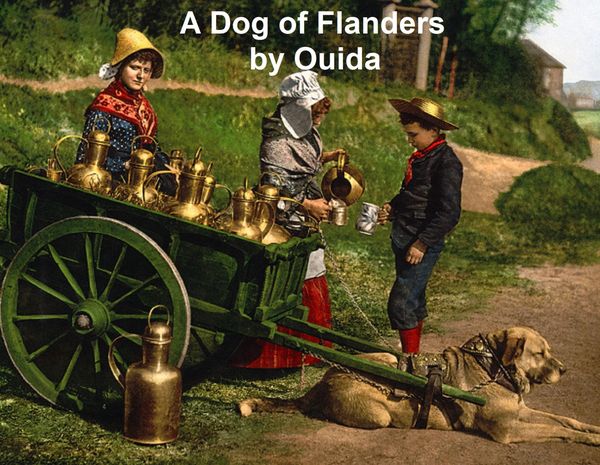
A Dog of Flanders
-
- Hardcover
- Taschenbuch
- eBook ausgewählt
-
Form:Einzelkauf Download
-
Sprache:Englisch
-
Verlag:Seltzer Books
0,91 €
inkl. gesetzl. MwSt.Beschreibung
Produktdetails
Format
ePUB
Kopierschutz
Nein
Family Sharing
Ja
Text-to-Speech
Ja
Erscheinungsdatum
01.03.2018
Verlag
Seltzer BooksSeitenzahl
416 (Printausgabe)
Sprache
Englisch
EAN
9781455333868
According to Wikipedia: A Dog of Flanders is an 1872 novel by English author Marie Louise de la Ramée published with her pseudonym "Ouida". It is about a Flemish boy named Nello and the titular dog, Patrasche.The story, of English origin, has not been read widely in Belgium, but is becoming better known because of the tourists it attracts to Antwerp. There is a small statue of Nello and Patrasche at the Kapelstraat in the Antwerp suburb of Hoboken, and a commemorative plaque in front of the Antwerp Cathedral donated by Toyota. The story is widely read in Japan, and has been adapted into several films and anime... Ouida (January 1, 1839 [1] - January 25, 1908) was the pen name of the English novelist Maria Louise Ramé (although she preferred to be known as Marie Louise de la Ramée). ... During her career, she wrote more than 40 novels, children's books and collections of short stories and essays. She was an animal rights activist and animal rescuer, and at times owned as many as thirty dogs. For many years she lived in London, but about 1874 she went to Italy, where she died. Ouida's work went through several phases during her career. In her early period, her novels were a hybrid of the sensationalism of the 1860s and the proto-adventure novels dubbed "muscular fiction" that were emerging in part as a romanticization of imperial expansion. Later her work was more along the lines of historical romance, though she never stopped comment on contemporary society. She also wrote several stories for children. One of her most famous novels, Under Two Flags, described the British in Algeria in the most extravagant of terms, while nonetheless also expressing sympathy for the French--with whom Ouida deeply identified--and, to some extent, the Arabs. This book went on to be staged in plays, and subsequently to be turned into at least three movies, transitioning Ouida in the 20th century."
Noch keine Bewertungen vorhanden
Verfassen Sie die erste Bewertung zu diesem Artikel
Helfen Sie anderen Kundinnen und Kunden durch Ihre Meinung.
Kurze Frage zu unserer Seite
Vielen Dank für Ihr Feedback
Wir nutzen Ihr Feedback, um unsere Produktseiten zu verbessern. Bitte haben Sie Verständnis, dass wir Ihnen keine Rückmeldung geben können. Falls Sie Kontakt mit uns aufnehmen möchten, können Sie sich aber gerne an unseren Kund*innenservice wenden.
zum Kundenservice