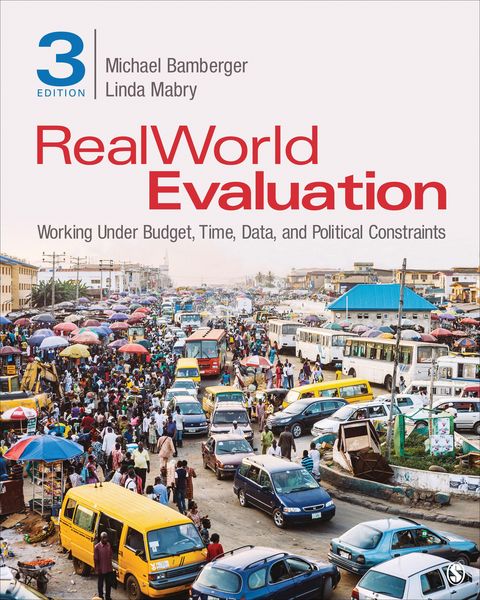
Produktbild: RealWorld Evaluation

RealWorld Evaluation Working Under Budget, Time, Data, and Political Constraints

167,99 €

inkl. gesetzl. MwSt., Versandkostenfrei


Beschreibung

Produktdetails

Einband

Taschenbuch

Erscheinungsdatum

27.09.2019

Verlag

Sage Publications

Seitenzahl

568

Maße (L/B/H)

25,4/20,2/2,7 cm

Gewicht

1113 g

Auflage

3 Revised edition

Sprache

Englisch

ISBN

978-1-5443-1878-3

Beschreibung

Produktdetails

Einband

Taschenbuch

Erscheinungsdatum

27.09.2019

Verlag

Sage Publications

Seitenzahl

568

Maße (L/B/H)

25,4/20,2/2,7 cm

Gewicht

1113 g

Auflage

3 Revised edition

Sprache

Englisch

ISBN

978-1-5443-1878-3

Herstelleradresse

Libri GmbH
Europaallee 1
36244 Bad Hersfeld
DE

Email: gpsr@libri.de

Noch keine Bewertungen vorhanden

Verfassen Sie die erste Bewertung zu diesem Artikel

Helfen Sie anderen Kundinnen und Kunden durch Ihre Meinung.

Kundinnen und Kunden meinen

Bewertungen (0)

  • Produktbild: RealWorld Evaluation
  • List of Boxes, Figures, and Tables
    List of Appendices
    Foreword by Jim Rugh
    Preface
    Acknowledgments
    About the Authors
    PART I ¿ THE SEVEN STEPS OF THE REALWORLD EVALUATION APPROACH
    Chapter 1 ¿ Overview: RealWorld Evaluation and the Contexts in Which It Is Used
    1. Welcome to RealWorld Evaluation
    2. The RealWorld Evaluation Context
    3. The Four Types of Constraints Addressed by the RealWorld Approach
    4. Additional Organizational and Administrative Challenges
    5. The RealWorld Approach to Evaluation Challenges
    6. Who Uses RealWorld Evaluation, for What Purposes, and When?
    Summary
    Further Reading
    Chapter 2 ¿ First Clarify the Purpose: Scoping the Evaluation
    1. Stakeholder Expectations of Impact Evaluations
    2. Understanding Information Needs
    3. Developing the Program Theory Model
    4. Identifying the Constraints to Be Addressed by RWE and Determining the Appropriate Evaluation Design
    5. Developing Designs Suitable for RealWorld Evaluation Conditions
    Summary
    Further Reading
    Chapter 3 ¿ Not Enough Money: Addressing Budget Constraints
    1. Simplifying the Evaluation Design
    2. Clarifying Client Information Needs
    3. Using Existing Data
    4. Reducing Costs by Reducing Sample Size
    5. Reducing Costs of Data Collection and Analysis
    6. Assessing the Feasibility and Utility of Using New Information Technology (NIT) to Reduce the Costs of Data Collection
    7. Threats to Validity of Budget Constraints
    Summary
    Further Reading
    Chapter 4 ¿ Not Enough Time: Addressing Scheduling and Other Time Constraints
    1. Similarities and Differences Between Time and Budget Constraints
    2. Simplifying the Evaluation Design
    3. Clarifying Client Information Needs and Deadlines
    4. Using Existing Documentary Data
    5. Reducing Sample Size
    6. Rapid Data-Collection Methods
    7. Reducing Time Pressure on Outside Consultants
    8. Hiring More Resource People
    9. Building Outcome Indicators Into Project Records
    10. New Information Technology for Data Collection and Analysis
    11. Common Threats to Adequacy and Validity Relating to Time Constraints
    Summary
    Further Reading
    Chapter 5 ¿ Critical Information Is Missing or Difficult to Collect: Addressing Data Constraints
    1. Data Issues Facing RealWorld Evaluators
    2. Reconstructing Baseline Data
    3. Special Issues Reconstructing Baseline Data for Project Populations and Comparison Groups
    4. Collecting Data on Sensitive Topics or From Difficult-to-Reach Groups
    5. Common Threats to Adequacy and Validity of an Evaluation Relating to Data Constraints
    Summary
    Further Reading
    Chapter 6 ¿ Political Constraints
    1. Values, Ethics, and Politics
    2. Societal Politics and Evaluation
    3. Stakeholder Politics
    4. Professional Politics
    5. Political Issues in the Design Phase
    6. Political Issues in the Conduct of an Evaluation
    7. Political Issues in Evaluation Reporting and Use
    8. Advocacy
    Summary
    Further Reading
    Chapter 7 ¿ Strengthening the Evaluation Design and the Validity of the Conclusions
    1. Validity in Evaluation
    2. Factors Affecting Adequacy and Validity
    3. A Framework for Assessing the Validity and Adequacy of QUANT, QUAL, and Mixed-Method Designs
    4. Assessing and Addressing Threats to Validity for Quantitative Impact Evaluations
    5. Assessing Adequacy and Validity for Qualitative Impact Evaluations
    6. Assessing Validity for Mixed-Method (MM) Evaluations
    7. Using the Threats-to-Validity Worksheets
    Summary
    Further Reading
    Chapter 8 ¿ Making It Useful: Helping Clients and Other Stakeholders Utilize the Evaluation
    1. What Do We Mean by Influential Evaluations and Useful Evaluations?
    2. The Underutilization of Evaluation Studies
    3. Strategies for Promoting the Utilization of Evaluation Findings and Recommendations
    Summary
    Further Reading
    PART II ¿ A REVIEW OF EVALUATION METHODS AND APPROACHES AND THEIR APPLICATION IN REALWORLD EVALUATION: FOR THOSE WHO WOULD LIKE TO DIG DEEPER
    Chapter 9 ¿ Standards and Ethics
    1. Standards of Competence
    2. Professional Standards
    3. Ethical Codes of Conduct
    4. Issues
    Summary
    Further Reading
    Chapter 10 ¿ Theory-Based Evaluation and Theory of Change
    1. Theory-Based Evaluation (TBE) and Theory of Change (TOC)
    2. Applications of Program Theory in Program Evaluation
    3. Using TOC in Program Evaluation
    4. Designing a Theory of Change Evaluation Framework
    5. Integrating a Theory of Change Into the Program Management, Monitoring, and Evaluation Cycle
    6. Program Theory Evaluation and Causality
    Summary
    Further Reading
    Chapter 11 ¿ Evaluation Designs: The RWE Strategy for Selecting the Appropriate Evaluation Design to Respond to the Purpose and Context of Each Evaluation
    1. Different Approaches to the Classification of Evaluation Designs
    2. Assessing Causality Attribution and Contribution
    3. The RWE Approach to the Selection of the Appropriate Impact Evaluation Design
    4. Tools and Techniques for Strengthening the Basic Evaluation Designs
    5. Selecting the Best Design for RealWorld Evaluation Scenarios
    Summary
    Further Reading
    Chapter 12 ¿ Quantitative Evaluation Methods
    1. Quantitative Evaluation Methodologies
    2. Experimental and Quasi-Experimental Designs
    3. Strengths and Weaknesses of Quantitative Evaluation Methodologies
    4. Applications of Quantitative Methodologies in Program Evaluation
    5. Quantitative Methods for Data Collection
    6. The Management of Data Collection for Quantitative Studies
    7. Data Analysis
    Summary
    Further Reading
    Chapter 13 ¿ Qualitative Evaluation Methods
    1. Design
    2. Data Collection
    3. Data Analysis
    4. Reporting
    5. Real-World Constraints
    Summary
    Further Reading
    Chapter 14 ¿ Mixed-Method Evaluation
    1. The Mixed-Method Approach
    2. Rationale for Mixed-Method Approaches
    3. Approaches to the Use of Mixed Methods
    4. Mixed-Method Strategies
    5. Implementing a Mixed-Method Design
    6. Using Mixed Methods to Tell a More Compelling Story of What a Program Has Achieved
    7. Case Studies Illustrating the Use of Mixed Methods
    Summary
    Further Reading
    Chapter 15 ¿ Sampling Strategies for RealWorld Evaluation
    1. The Importance of Sampling for RealWorld Evaluation
    2. Purposive Sampling
    3. Probability (Random) Sampling
    4. Using Power Analysis and Effect Size for Estimating the Appropriate Sample Size for an Impact Evaluation
    5. The Contribution of Meta-Analysis
    6. Sampling Issues for Mixed-Method Evaluations
    7. Sampling Issues for RealWorld Evaluation
    Summary
    Further Reading
    Chapter 16 ¿ Evaluating Complex Projects, Programs, and Policies
    1. The Move Toward Complex, Country-Level Development Programming
    2. Defining Complexity in Development Programs and Evaluations
    3. A Framework for the Evaluation of Complex Development Programs
    Summary
    Further Reading
    Chapter 17 ¿ Gender Evaluation: Integrating Gender Analysis Into Evaluations
    1. Why a Gender Focus Is Critical
    2. Gender Issues in Evaluations
    3. Designing a Gender Evaluation
    4. Gender Evaluations With Different Scopes
    5. The Tools of Gender Evaluation
    Summary
    Further Reading
    Chapter 18 ¿ Evaluation in the Age of Big Data
    1. Introducing Big Data and Data Science
    2. Increasing Application of Big Data in the Development Context
    3. The Tools of Data Science
    4. Potential Applications of Data Science in Development Evaluation
    5. Building Bridges Between Data Science and Evaluation
    Summary
    Further Reading
    PART III ¿ MANAGING EVALUATIONS
    Chapter 19 ¿ Managing Evaluations
    1. Organizational and Political Issues Affecting the Design, Implementation, and Use of Evaluations
    2. Planning and Managing the Evaluation
    3. Institutionalizing Impact Evaluation Systems at the Country and Sector Levels
    4. Evaluating Capacity Development
    Summary
    Further Reading
    Chapter 20 ¿ The Road Ahead
    1. Conclusions
    2. Recommendations
    Glossary of Terms and Acronyms
    References
    Author Index
    Subject Index