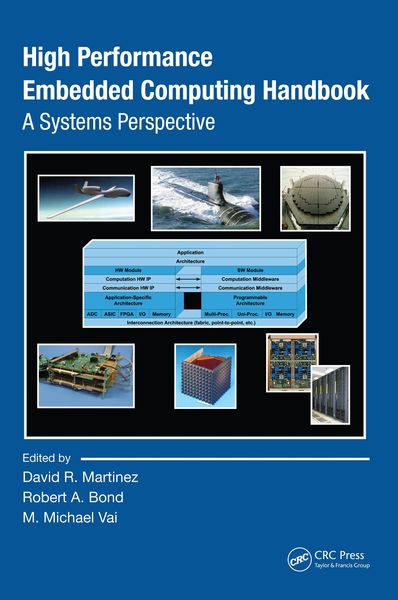
High Performance Embedded Computing Handbook A Systems Perspective
-
- Einzelkauf Download ausgewählt
-
Sprache:Englisch
-
eBook Format:ePUB 3
- PDF 281,99 €
- ePUB 3 281,99 € ausgewählt
281,99 €
inkl. gesetzl. MwSt.Beschreibung
Produktdetails
Format
ePUB 3
Kopierschutz
Ja
Family Sharing
Nein
Text-to-Speech
Ja
Erscheinungsdatum
03.10.2018
Herausgeber
David R. Martinez + weitereVerlag
Taylor & Francis eBooksSeitenzahl
600 (Printausgabe)
Dateigröße
17512 KB
Sprache
Englisch
EAN
9781351837798
Over the past several decades, applications permeated by advances in digital signal processing have undergone unprecedented growth in capabilities. The editors and authors of High Performance Embedded Computing Handbook: A Systems Perspective have been significant contributors to this field, and the principles and techniques presented in the handbook are reinforced by examples drawn from their work.
The chapters cover system components found in today's HPEC systems by addressing design trade-offs, implementation options, and techniques of the trade, then solidifying the concepts with specific HPEC system examples. This approach provides a more valuable learning tool, Because readers learn about these subject areas through factual implementation cases drawn from the contributing authors' own experiences.
Discussions include:
- Key subsystems and components
- Computational characteristics of high performance embedded algorithms and applications
- Front-end real-time processor technologies such as analog-to-digital conversion, application-specific integrated circuits, field programmable gate arrays, and intellectual property-based design
- Programmable HPEC systems technology, including interconnection fabrics, parallel and distributed processing, performance metrics and software architecture, and automatic code parallelization and optimization
- Examples of complex HPEC systems representative of actual prototype developments
- Application examples, including radar, communications, electro-optical, and sonar applications
The handbook is organized around a canonical framework that helps readers navigate through the chapters, and it concludes with a discussion of future trends in HPEC systems. The material is covered at a level suitable for practicing engineers and HPEC computational practitioners and is easily adaptable to their own implementation requirements.
Noch keine Bewertungen vorhanden
Verfassen Sie die erste Bewertung zu diesem Artikel
Helfen Sie anderen Kundinnen und Kunden durch Ihre Meinung.
Kurze Frage zu unserer Seite
Vielen Dank für Ihr Feedback
Wir nutzen Ihr Feedback, um unsere Produktseiten zu verbessern. Bitte haben Sie Verständnis, dass wir Ihnen keine Rückmeldung geben können. Falls Sie Kontakt mit uns aufnehmen möchten, können Sie sich aber gerne an unseren Kund*innenservice wenden.
zum Kundenservice