
• Produktbild: Police Innovation
  • Produktbild: Police Innovation

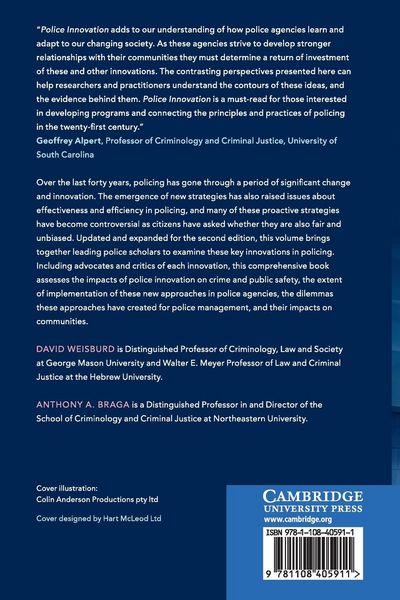
Police Innovation Contrasting Perspectives

69,99 €

inkl. gesetzl. MwSt., Versandkostenfrei


Beschreibung

Produktdetails

Einband

Taschenbuch

Erscheinungsdatum

29.08.2019

Herausgeber

Weisburd David + weitere

Verlag

Cambridge Academic

Seitenzahl

586

Maße (L/B/H)

22,9/15,2/3,5 cm

Gewicht

840 g

Sprache

Englisch

ISBN

978-1-108-40591-1

Beschreibung

Produktdetails

Einband

Taschenbuch

Erscheinungsdatum

29.08.2019

Herausgeber

Verlag

Cambridge Academic

Seitenzahl

586

Maße (L/B/H)

22,9/15,2/3,5 cm

Gewicht

840 g

Sprache

Englisch

ISBN

978-1-108-40591-1

Herstelleradresse

Libri GmbH
Europaallee 1
36244 Bad Hersfeld
DE

Email: gpsr@libri.de

Kundinnen und Kunden meinen

0 Bewertungen

Informationen zu Bewertungen

Zur Abgabe einer Bewertung ist eine Anmeldung im Konto notwendig. Die Authentizität der Bewertungen wird von uns nicht überprüft. Wir behalten uns vor, Bewertungstexte, die unseren Richtlinien widersprechen, entsprechend zu kürzen oder zu löschen.

Die Bewertungen sind nach Format, Anzahl Sterne und Datum sortiert.

Verfassen Sie die erste Bewertung zu diesem Artikel

Helfen Sie anderen Kund*innen durch Ihre Meinung

Kundinnen und Kunden meinen

0 Bewertungen filtern

Die Leseprobe wird geladen.
  • Produktbild: Police Innovation
  • Produktbild: Police Innovation
  • Introduction: the context of police innovation David Weisburd and Anthony Braga; Part I. Community Policing: 1. Advocate: community policing Wesley Skogan; 2. Critic: community policing: a skeptical view Stephen Mastroski; Part II. Broken Windows Policing: 3. Advocate: of 'broken windows' criminology and criminal justice William Sousa and George Kelling; 4. Critic: incivilities reduction policing, zero tolerance, and the retreat from coproduction: even weaker foundations and stronger pressures Ralph Taylor; Part III. Procedural Justice Policing: 5. Advocate: procedural justice policing Tom Tyler and Tracey Meares; 6. Critic: the limits of procedural justice David Thacher; Part IV. Problem-Oriented Policing: 7. Advocate: why problem-oriented policing John Eck; 8. Critic: problem-oriented policing: the disconnect between principles and practice Anthony Braga and David Weisburd; Part V. Pulling Levers (Focused Deterrence) Policing: 9. Advocate: policing and the lessons of focused deterrence David M. Kennedy; 10. Critic: partnership, accountability, and innovation: clarifying Boston's experience with focused deterrence Anthony Braga; Part VI. Third-Party Policing: 11. Advocate: third-party policing Lorraine Green Mazerolle and Janet Ransley; 12. Critic: third-party policing: a critical view Tracey L. Meares; Part VII. Compstat: 13. Advocate: Compstat's innovation Eli Silverman; 14. Critic: changing everything so that everything can remain the same: Compstat and American policing David Weisburd, Stephen Mastrofski, James J. Willis and Rosanne Greenspan; Part VIII. Hot Spots Policing: 15. Advocate: hot spots policing as a model for police innovation Anthony Braga and David Weisburd; 16. Critic: the limits of hot spots policing Dennis Rosenbaum; Part IX. Predictive Policing: 17. Advocate: predictive policing Jerry Ratcliffe; 18. Critic predictive policing: where's the evidence Rachel Boba; Part X. Evidence-Based / Risk-Focused Policing: 19. Advocate: evidence-based policing for crime prevention Brandon Welsh; 20. Critic which evidence? What knowledge? Broadening information about the police and their interventions Jack Greene; Part XI. Technology Policing: 21. Advocate technology in policing Barak Ariel; 22. Critic: the limits of police technology Cynthia Lum and Chris Koper; Conclusion: police innovation and the future of policing David Weisburd and Anthony Braga.