
Polyglutamine Disorders
-
- Hardcover
- Taschenbuch ausgewählt
- eBook
-
Sprache:Englisch
128,99 €
inkl. gesetzl. MwSt.,
Beschreibung
Produktdetails
Einband
Taschenbuch
Erscheinungsdatum
06.06.2019
Abbildungen
VIII, 41 illus., 39 illus. in color., farbige Illustrationen, schwarz-weiss Illustrationen
Herausgeber
Clévio Nóbrega + weitereVerlag
SpringerSeitenzahl
469
Maße (L/B/H)
23,5/15,5/2,6 cm
Gewicht
721 g
Auflage
Softcover reprint of the original 1st ed. 2018
Sprache
Englisch
ISBN
978-3-319-89103-3
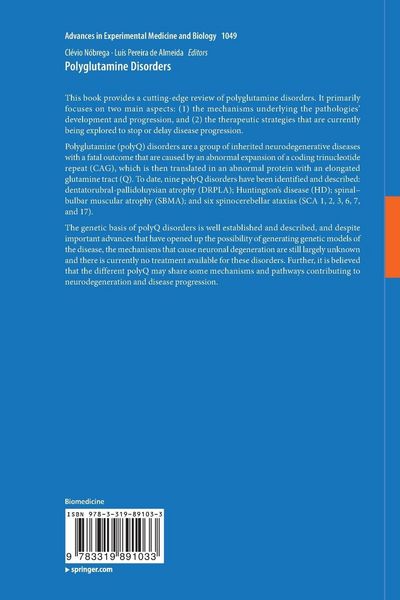
This book provides a cutting-edge review of polyglutamine disorders. It primarily focuses on two main aspects: (1) the mechanisms underlying the pathologies’ development and progression, and (2) the therapeutic strategies that are currently being explored to stop or delay disease progression.
Polyglutamine (polyQ) disorders are a group of inherited neurodegenerative diseases with a fatal outcome that are caused by an abnormal expansion of a coding trinucleotide repeat (CAG), which is then translated in an abnormal protein with an elongated glutamine tract (Q). To date, nine polyQ disorders have been identified and described: dentatorubral-pallidoluysian atrophy (DRPLA); Huntington’s disease (HD); spinal–bulbar muscular atrophy (SBMA); and six spinocerebellar ataxias (SCA 1, 2, 3, 6, 7, and 17).
The genetic basis of polyQ disorders is well established and described, and despite important advances that have opened up the possibility of generating genetic models of the disease, the mechanisms that cause neuronal degeneration are still largely unknown and there is currently no treatment available for these disorders. Further, it is believed that the different polyQ may share some mechanisms and pathways contributing to neurodegeneration and disease progression.
Noch keine Bewertungen vorhanden
Verfassen Sie die erste Bewertung zu diesem Artikel
Helfen Sie anderen Kundinnen und Kunden durch Ihre Meinung.
Kurze Frage zu unserer Seite
Vielen Dank für Ihr Feedback
Wir nutzen Ihr Feedback, um unsere Produktseiten zu verbessern. Bitte haben Sie Verständnis, dass wir Ihnen keine Rückmeldung geben können. Falls Sie Kontakt mit uns aufnehmen möchten, können Sie sich aber gerne an unseren Kund*innenservice wenden.
zum Kundenservice