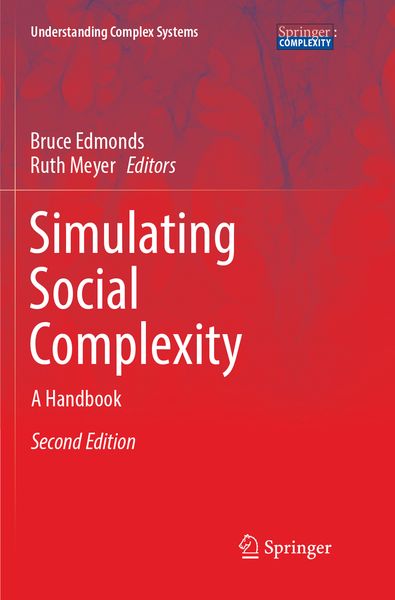
Simulating Social Complexity A Handbook
-
- Hardcover
- Taschenbuch ausgewählt
- eBook
-
Sprache:Englisch
374,99 €
inkl. gesetzl. MwSt.,
Beschreibung
Produktdetails
Einband
Taschenbuch
Erscheinungsdatum
01.09.2018
Abbildungen
VII, 838 p. 85 illus., 32 illus. in color.
Herausgeber
Bruce Edmonds + weitereVerlag
SpringerSeitenzahl
838
Maße (L/B/H)
23,5/15,5/4,6 cm
Gewicht
1258 g
Auflage
Second Edition 2017
Sprache
Englisch
ISBN
978-3-319-88352-6
This volume examines all aspects of using agent or individual-based simulation. This approach represents systems as individual elements having their own set of differing states and internal processes. The interactions between elements in the simulation represent interactions in the target systems. What makes this "social" is that it can represent an observed society.
Social systems include all those systems where the components have individual agency but also interact with each other. This includes human societies and groups, but also increasingly socio-technical systems where the internet-based devices form the substrate for interaction. These systems are central to our lives, but are among the most complex known. This poses particular problems for those who wish to understand them. The complexity often makes analytic approaches infeasible but, on the other hand, natural language approaches are also inadequate for relating intricate cause and effect. This is why individual and agent-based computational approaches hold out the possibility of new and deeper understanding of such systems.
This handbook marks the maturation of this new field. It brings together summaries of the best thinking and practices in this area from leading researchers in the field and constitutes a reference point for standards against which future methodological advances can be judged.
This second edition adds new chapters on different modelling purposes and applying software engineering methods to simulation development. Revised existing content will keep the book up-to-date with recent developments. This volume will help those new to the field avoid "reinventing the wheel" each time, and give them a solid and wide grounding in the essential issues. It will also help those already in the field by providing accessible overviews of current thought. The material is divided into four sections: Introduction, Methodology, Mechanisms, and Applications. Each chapter starts with a very brief section called 'Why read this chapter?' followed by an abstract, which summarizes the content of the chapter. Each chapter also ends with a section on 'Further Reading'.
Whilst sometimes covering technical aspects, this second edition of Simulating Social Complexity is designed to be accessible to a wide range of researchers, including both those from the social sciences as well as those with a more formal background. It will be of use as a standard reference text in the field and also be suitable for graduate level courses.
Noch keine Bewertungen vorhanden
Verfassen Sie die erste Bewertung zu diesem Artikel
Helfen Sie anderen Kundinnen und Kunden durch Ihre Meinung.
Kurze Frage zu unserer Seite
Vielen Dank für Ihr Feedback
Wir nutzen Ihr Feedback, um unsere Produktseiten zu verbessern. Bitte haben Sie Verständnis, dass wir Ihnen keine Rückmeldung geben können. Falls Sie Kontakt mit uns aufnehmen möchten, können Sie sich aber gerne an unseren Kund*innenservice wenden.
zum Kundenservice