• Produktbild: The Language of Money and Debt
  • Produktbild: The Language of Money and Debt
- 10%

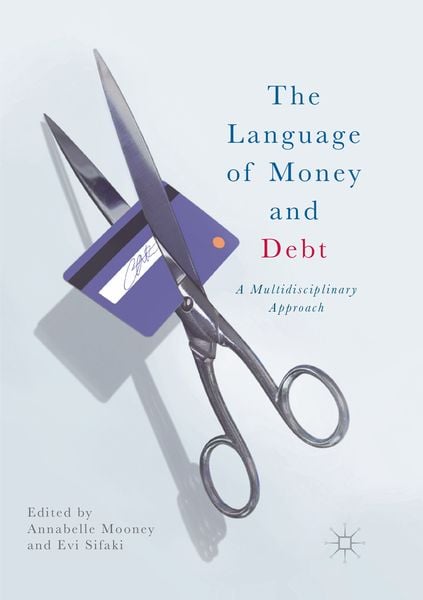
The Language of Money and Debt A Multidisciplinary Approach

10% sparen

95,99 € UVP 106,99 €

inkl. gesetzl. MwSt., Versandkostenfrei


Beschreibung

Produktdetails

Einband

Taschenbuch

Erscheinungsdatum

12.08.2018

Abbildungen

XV, 9 illus., 2 illus. in color., farbige Illustrationen, schwarz-weiss Illustrationen

Herausgeber

Annabelle Mooney + weitere

Verlag

Springer

Seitenzahl

316

Maße (L/B/H)

21/14,8/1,9 cm

Gewicht

431 g

Auflage

Softcover reprint of the original 1st edition 2017

Sprache

Englisch

ISBN

978-3-319-86196-8

Beschreibung

Portrait

Annabelle Mooney is Professor of Language and Society at the University of Roehampton, UK. Her research interests include the language of money and financial literacy, and the language of human rights.

Evi Sifaki is Senior Lecturer in Linguistics at the University of Roehampton, UK. Her main research focus is the syntax of different word order phenomena, and the documentation of various aspects of morphosyntactic change.

Produktdetails

Einband

Taschenbuch

Erscheinungsdatum

12.08.2018

Abbildungen

XV, 9 illus., 2 illus. in color., farbige Illustrationen, schwarz-weiss Illustrationen

Herausgeber

Verlag

Springer

Seitenzahl

316

Maße (L/B/H)

21/14,8/1,9 cm

Gewicht

431 g

Auflage

Softcover reprint of the original 1st edition 2017

Sprache

Englisch

ISBN

978-3-319-86196-8

Herstelleradresse

Springer-Verlag GmbH
Tiergartenstr. 17
69121 Heidelberg
DE

Email: ProductSafety@springernature.com

Noch keine Bewertungen vorhanden

Verfassen Sie die erste Bewertung zu diesem Artikel

Helfen Sie anderen Kundinnen und Kunden durch Ihre Meinung.

Kundinnen und Kunden meinen

Bewertungen (0)

  • Produktbild: The Language of Money and Debt
  • Produktbild: The Language of Money and Debt
  • Chapter 1:- Introduction: The View from the ground; Annabelle Mooney and Evi Sifaki.- I. Money and Childhood.- Chapter 2: Stories of value: The nature of money in three classic British picture books; Astrid Van den Bossche.- Chapter 3: The treatment of money and wealth in the Harry Potter series; Tanweer Ali and Eva Lebdušková.- II. Money and the Everyday.- Chapter 4: Money Talk at the Mass Observation Archive; Liz Moor.- Chapter 5: Snudging Cheapskates and Magnificent Profusion: The Conceptual Baggage of 'mean' and 'generous.'; Annabelle Mooney and Evi Sifaki.- Chapter 6: Neoliberalism in the academy: Have you drunk the Kool-Aid?; Liz Morrish.- Chapter 7: Falling Behind: Debtors' Emotional Relationships to Creditors; Anna Custers.- III. Money and the Media.- Chapter 8: The language of "Welfare Dependency" and "Benefit Cheats": Internalising and reproducing the hegemonic and discursive rhetoric of "benefit scroungers"; Chris Roberts.- Chapter 9: Does money talk equate to class talk?Audience responses to poverty porn in relation to money and debt; Laura L. Paterson, David Peplow and Karen Grainger.- Chapter 10: The Discourse of alternative credit: a multimodal critical examination of the  Cash Converters  mobile app; Gavin Brookes and Kevin Harvey.- IV. What is Money?.- Chapter 11: The Sociality of Debt: A Case Study of Kamba (Kenya) Conceptualisations of Borrowing and Lending; Froukje Krijtenburg.- Chapter 12: What is Money? Legal Language as Modern Day Alchemy; Kate Harrington.