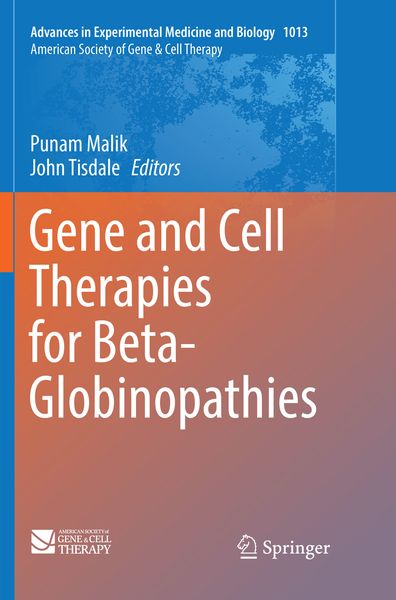
Gene and Cell Therapies for Beta-Globinopathies
-
- Hardcover
- Taschenbuch ausgewählt
- eBook
-
Sprache:Englisch
138,99 €
UVP
160,49 €
inkl. gesetzl. MwSt.,
Beschreibung
Produktdetails
Einband
Taschenbuch
Erscheinungsdatum
28.08.2018
Abbildungen
XII, 248 p. 16 illus., 12 illus. in color.
Herausgeber
Punam Malik + weitereVerlag
Springer UsSeitenzahl
248
Maße (L/B/H)
23,5/15,5/1,5 cm
Gewicht
400 g
Auflage
Softcover Reprint of the Original 1st 2017 edition
Sprache
Englisch
ISBN
978-1-4939-8446-6
Hemoglobin defects, specifically sickle cell disease & thalassemia, combined, constitute the most common monogenic disorders in the world. In fact, nearly 2% of the world’s population carries a globin gene mutation. The transfer of the corrective globin gene through the HSC compartment by allogeneic HSC transplantation (HSCT) has already proven curative in both SCD and thalassemia patients, and provides the proof of concept that genetic manipulation of the defective organ might be equally therapeutic. However, procedural toxicities and the requirement of an HLA-matched sibling donor limit this approach to a fraction of affected individuals. The editors review the progress & the state of the field in HSCT for hemoglobinopathies & shed light on the major changes expected in the next decade. Although allogeneic HSCT is a curative option, it is limited by the availability of matched donors, which are often available only to 15-20% of patients. An alternative to allogeneic HS
CT is genetic correction of autologous HSCs, to overcome donor availability & immune side effects. This Book reviews the progress made on additive gene therapy approaches & the current state of the field. Finally, targeted genetic correction is emerging as a novel therapeutic strategy in the hemoglobinopathies. Although ideal, the inefficiency of targeted correction was rate limiting for translation of this technology to the clinic. With advancements in zinc finger nucleases and TALE endonuclease mediated targeted correction, correction frequencies in hematopoietic stem cells is now reaching levels that may become clinically relevant. Furthermore, the ability to generate autologous embryonic stem cell like cells from primary somatic cells (skin fibroblasts or hematopoietic cells) of the affected individual has allowed for the potential application of genetic correction strategies.This Book reviews upcoming genetic strategies to reactivate fetal hemoglobin production and research advances.Noch keine Bewertungen vorhanden
Verfassen Sie die erste Bewertung zu diesem Artikel
Helfen Sie anderen Kundinnen und Kunden durch Ihre Meinung.
Kurze Frage zu unserer Seite
Vielen Dank für Ihr Feedback
Wir nutzen Ihr Feedback, um unsere Produktseiten zu verbessern. Bitte haben Sie Verständnis, dass wir Ihnen keine Rückmeldung geben können. Falls Sie Kontakt mit uns aufnehmen möchten, können Sie sich aber gerne an unseren Kund*innenservice wenden.
zum Kundenservice