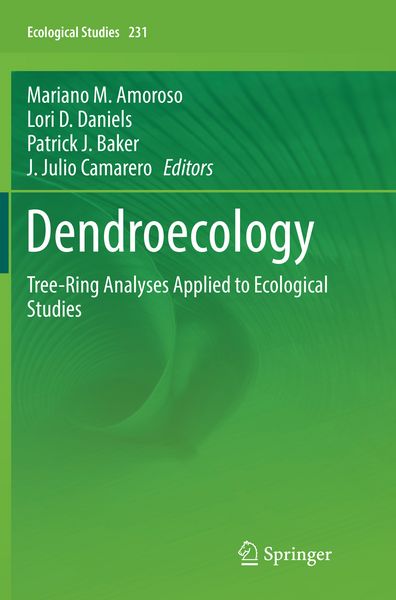
Produktbild: Dendroecology
Band 231

Dendroecology Tree-Ring Analyses Applied to Ecological Studies

Aus der Reihe Ecological Studies

152,99 €

inkl. gesetzl. MwSt., Versandkostenfrei


Beschreibung

Produktdetails

Einband

Taschenbuch

Erscheinungsdatum

24.05.2018

Abbildungen

XX, 56 illus., 41 illus. in color., schwarz-weiss Illustrationen, farbige Illustrationen

Herausgeber

Mariano M. Amoroso + weitere

Verlag

Springer

Seitenzahl

400

Maße (L/B/H)

23,5/15,5/2,3 cm

Gewicht

6321 g

Auflage

Softcover reprint of the original 1st ed. 2017

Sprache

Englisch

ISBN

978-3-319-87130-1

Beschreibung

Portrait

Mariano Amoroso is an Assistant Research Scientist in the Argentinean National Scientific and Technical Research Council (CONICET) and Adjunct Professor at the National University of Rio Negro. His academic degrees are in Agronomy (Engineering, University of Buenos Aires), Silviculture and Forest Protection (MSc, University of Washington) and Forest Ecology (PhD, University of British Columbia). His research interests are diverse including forest stand dynamics, disturbance ecology, climate-plant relationships and silviculture. Over the years, he has been studying the dynamics of forests in North and South America in response to natural disturbances and climate with the idea of applying research outcomes to forest management.

Lori Daniels is an Associate Professor of Forest Ecology in the Forest and Conservation Sciences Department at the University of British Columbia-Vancouver, where she directs the Tree-Ring Lab at UBC.  Her degrees are in Ecology (BSc, UManitoba), Forest Ecology (MSc UBC) and Biogeography (PhD UColorado-Boulder).  Her research, published in the journals  Science ,  Climatic Change ,  Ecology  and  International Journal of Wildland Fire , applies tree-ring analyses to investigate disturbance regimes and the impacts of climate and humans on forest dynamics. With her graduate students and international collaborators, Lori has on-going research on fire regimes and forest resilience to climate change in British Columbia and Alberta, Canada and in Northern Patagonia, Argentina.

Patrick Baker is an Australian Research Council Future Fellow and Associate Professor of Silviculture and Forest Dynamics at the University of Melbourne. He has a BA from Bowdoin College, an Msc Forestry from Yale University, and a PhD from the University of Washington. He held a joint research fellowship with the US Forest Service and The Nature Conservancy of Hawaii before his appointments at Monash University and the University of Melbourne. His research interests are in tropical ecology, silviculture, and palaeoclimate and he has ongoing research in Thailand, Vietnam, Australia, New Zealand, and Argentina.

J. Julio (Chechu) Camarero is researcher at the Pyrenean Institute of Ecology (IPE-CSIC). He leads the dendroecology and forest ecology group at this institution where he has established both national and international networks of collaborating colleagues. His main research interests include understanding the growth, mortality and recruitment patterns reflecting processes in woody plant communities, particularly forests. Chechu uses dendrochronology to understand how trees react to multiple environmental drivers such as climatic stressors (drought), rising atmospheric CO 2  concentrations or biotic agents (fungi, insects and mistletoe). He has published papers in ecology, forestry, global change and multidisciplinary journals ( Science, PNAS, Global

Change Biology, Ecological Monographs, Journal of Biogeography, Journal of Ecology).

Produktdetails

Einband

Taschenbuch

Erscheinungsdatum

24.05.2018

Abbildungen

XX, 56 illus., 41 illus. in color., schwarz-weiss Illustrationen, farbige Illustrationen

Herausgeber

Verlag

Springer

Seitenzahl

400

Maße (L/B/H)

23,5/15,5/2,3 cm

Gewicht

6321 g

Auflage

Softcover reprint of the original 1st ed. 2017

Sprache

Englisch

ISBN

978-3-319-87130-1

Herstelleradresse

Springer-Verlag GmbH
Tiergartenstr. 17
69121 Heidelberg
DE

Email: GPSR Kontakt

Noch keine Bewertungen vorhanden

Verfassen Sie die erste Bewertung zu diesem Artikel

Helfen Sie anderen Kundinnen und Kunden durch Ihre Meinung.

Kundinnen und Kunden meinen

Bewertungen (0)

  • Produktbild: Dendroecology
  • Foreword

    Introduction


    Part 1  Tree Growth and Forest Dynamics

    Ecological plasticity of the secondary meristem

    Dendroecological Studies in Neotropics: History, Status and Future Challenges

    Complex Historical Disturbance Regimes Shape Forest Dynamics Across a Seasonal Tropical Landscape in Western Thailand

    Low-hanging DendroDynamic Ecological Fruits in Temperate Mesic Forests

    Integrating Dendroecology With Other Disciplines Improves Understanding of Upper and Latitudinal Treelines

    Dendroecological Applications to Coarse Woody Debris Dynamics


    Part 2  Disturbance Regimes

    Deciphering the Complexity of Fire Regimes: Case Studies from the Western U.S. and Canada

    Fire history and fire regime shifts in Patagonia temperate forests

    Creating a Buzz: Insect Outbreaks and Disturbance Interactions

    Pathogens, Invasive Species and Prognosis for the Future

    Deciphering dendroecologic

    al fingerprints of geomorphic process activity


    Part 3  Forest Decline

    Forest declines in Spain as a result of multiple causes: drought, historical logging, competition and biotic stressors

    Forest Decline in Northern Patagonia: The Role of Climatic Variability


    Part 4  Human-Environment Interactions

    Hydraulic Cities, Colonial Catastrophes, and Nomadic Empires: Human-Environment Interactions in Asia

    “Dendro-archeo-ecology” in North America and Europe: Re-purposing Historical Materials to Study Ancient Human-Environment Interactions

    Dendroecology: Lessons Learned and Future Frontiers