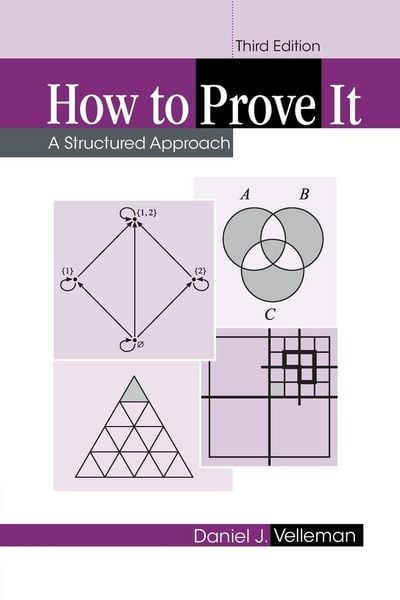
Produktbild: How to Prove It: A Structured Approach
- 18%

How to Prove It: A Structured Approach A Structured Approach

18% sparen

37,99 € UVP 46,50 €

inkl. gesetzl. MwSt., Versandkostenfrei


Beschreibung

Produktdetails

Verkaufsrang

33832

Einband

Taschenbuch

Erscheinungsdatum

01.09.2019

Abbildungen

10 tables, 536exercises

Verlag

Cambridge University Press

Seitenzahl

458

Maße (L/B/H)

22,5/15,1/2,3 cm

Gewicht

670 g

Farbe

Lichtgrau / Aubergine

Auflage

3. Auflage von 2019

Sprache

Englisch

ISBN

978-1-108-43953-4

Beschreibung

Rezension

'Not only does this book help students learn how to prove results, it highlights why we care so much. It starts in the introduction with some simple conjectures and gathering data, quickly disproving the first but amassing support for the second. Will that pattern persist? How can these observations lead us to a proof? The book is engagingly written, and covers - in clear and great detail - many proof techniques. There is a wealth of good exercises at various levels. I've taught problem solving before (at The Ohio State University and Williams College), and this book has been a great addition to the resources I recommend to my students.' Steven J. Miller, Williams College, Massachusetts

Produktdetails

Verkaufsrang

33832

Einband

Taschenbuch

Erscheinungsdatum

01.09.2019

Abbildungen

10 tables, 536exercises

Verlag

Cambridge University Press

Seitenzahl

458

Maße (L/B/H)

22,5/15,1/2,3 cm

Gewicht

670 g

Farbe

Lichtgrau / Aubergine

Auflage

3. Auflage von 2019

Sprache

Englisch

ISBN

978-1-108-43953-4

Herstelleradresse

Libri GmbH
Europaallee 1
36244 Bad Hersfeld
DE

Email: GPSR Kontakt

Noch keine Bewertungen vorhanden

Verfassen Sie die erste Bewertung zu diesem Artikel

Helfen Sie anderen Kundinnen und Kunden durch Ihre Meinung.

Kundinnen und Kunden meinen

Bewertungen (0)

Die Leseprobe wird geladen.
  • Produktbild: How to Prove It: A Structured Approach
  • 1. Sentential logic; 2. Quantificational logic; 3. Proofs; 4. Relations; 5. Functions; 6. Mathematical induction; 7. Number theory; 8. Infinite sets.