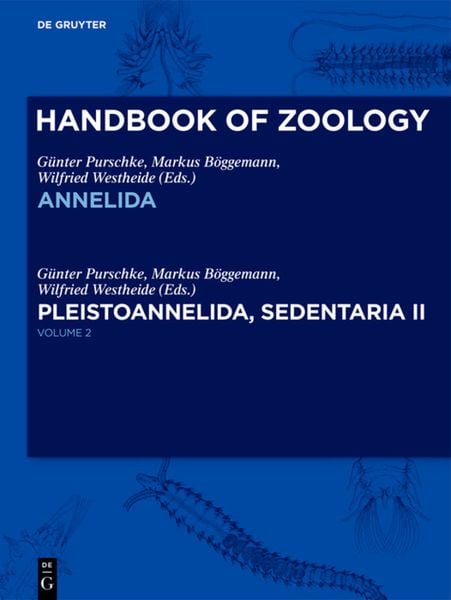
Pleistoannelida, Sedentaria II Volume 2: Pleistoannelida, Sedentaria II
309,99 €
UVP
360,00 €
inkl. gesetzl. MwSt.,
Beschreibung
Produktdetails
Einband
Gebundene Ausgabe
Erscheinungsdatum
24.02.2020
Abbildungen
170 col. Illustrationen
Herausgeber
Günter Purschke + weitereVerlag
De GruyterSeitenzahl
465
Maße (L/B/H)
28,6/21,5/3,1 cm
Gewicht
1331 g
Auflage
1
Sprache
Englisch
ISBN
978-3-11-029147-6
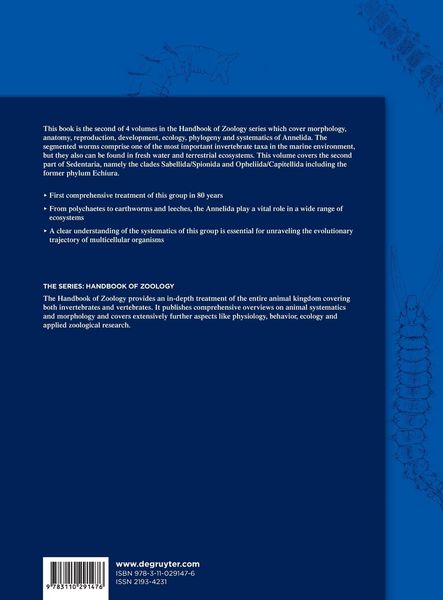
This book is the second volume in a series of 4 volumes in the Handbook of Zoology series treating morphology, anatomy, reproduction, development, ecology, phylogeny, systematics and taxonomy of polychaetous Annelida.
In this volume a comprehensive review of a few more derived higher taxa within Sedentaria are given, namely Sabellida, Opheliida/Capitellida as well as Hrabeiellidae. The former comprise annelids possessing a body divided into two more or less distinct regions or tagmata called thorax and abdomen. Here two groups of families are united, the spioniform and sabelliform polychaetes. Especially Spionidae and Sabellidae are speciose families within this group and represent two of the largest annelid families. These animals live in various types of burrows or tubes and all possess so-called feeding palps. In one group these appendages are differentiated as grooved feeding palps, whereas in the other they may form highly elaborated circular tentacular crowns comprising a number of radioles mostly giving off numerous filamentous pinnulae. Often additionally colourful, the latter are also received the common names "feather-duster worms", "flowers of the sea", "Christmas-tree worms". Opheliida/Capitellida including five families of truly worm-like annelids without appendages represents the contrary. Their members burrow in soft bottom substrates and may be classified as non-selective deposit feeders. Molecular phylogenetic analyses have shown that Echiura or spoon worms, formerly regarded to represent a separate phylum, are members of this group. Last not least Hrabeiellidae is one out of only two families of oligochaete-like terrestrial polychaetes and for this reason received strong scientific interest.
Kundinnen und Kunden meinen
Verfassen Sie die erste Bewertung zu diesem Artikel
Helfen Sie anderen Kund*innen durch Ihre Meinung
Kurze Frage zu unserer Seite
Vielen Dank für Ihr Feedback
Wir nutzen Ihr Feedback, um unsere Produktseiten zu verbessern. Bitte haben Sie Verständnis, dass wir Ihnen keine Rückmeldung geben können. Falls Sie Kontakt mit uns aufnehmen möchten, können Sie sich aber gerne an unseren Kund*innenservice wenden.
zum Kundenservice