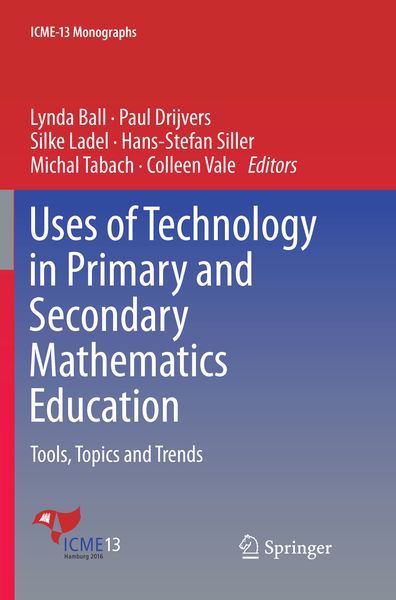
Uses of Technology in Primary and Secondary Mathematics Education Tools, Topics and Trends
-
- Hardcover
- Taschenbuch ausgewählt
- eBook
-
Sprache:Englisch
138,99 €
inkl. gesetzl. MwSt.,
Beschreibung
Produktdetails
Einband
Taschenbuch
Erscheinungsdatum
24.01.2019
Abbildungen
VII, 440 p. 129 illus.
Herausgeber
Lynda Ball + weitereVerlag
SpringerSeitenzahl
440
Maße (L/B/H)
23,5/15,5/2,5 cm
Gewicht
674 g
Auflage
1oftcover reprint of the origi
Sprache
Englisch
ISBN
978-3-030-09525-3
This book provides international perspectives on the use of digital technologies in primary, lower secondary and upper secondary school mathematics. It gathers contributions by the members of three topic study groups from the 13th International Congress on Mathematical Education and covers a range of themes that will appeal to researchers and practitioners alike. The chapters include studies on technologies such as virtual manipulatives, apps, custom-built assessment tools, dynamic geometry, computer algebra systems and communication tools.
Chiefly focusing on teaching and learning mathematics, the book also includes two chapters that address the evidence for technologies’ effects on school mathematics. The diverse technologies considered provide a broad overview of the potential that digital solutions hold in connection with teaching and learning. The chapters provide both a snapshot of the status quo of technologies in school mathematics, and outline how they might impact school mathematics ten to twenty years from now.
Noch keine Bewertungen vorhanden
Verfassen Sie die erste Bewertung zu diesem Artikel
Helfen Sie anderen Kundinnen und Kunden durch Ihre Meinung.
Kurze Frage zu unserer Seite
Vielen Dank für Ihr Feedback
Wir nutzen Ihr Feedback, um unsere Produktseiten zu verbessern. Bitte haben Sie Verständnis, dass wir Ihnen keine Rückmeldung geben können. Falls Sie Kontakt mit uns aufnehmen möchten, können Sie sich aber gerne an unseren Kund*innenservice wenden.
zum Kundenservice