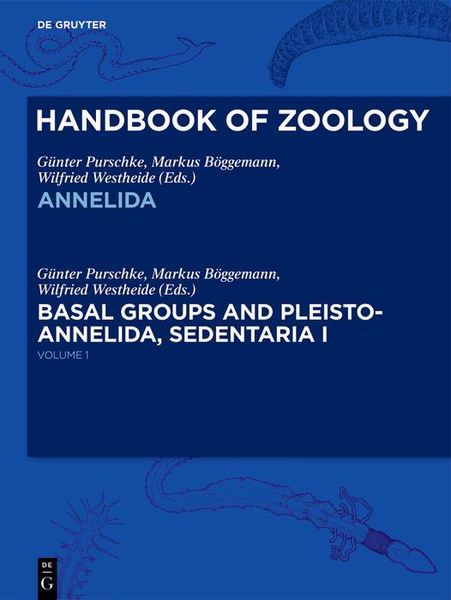
Annelida Basal Groups and Pleistoannelida, Sedentaria I Volume 1: Annelida Basal Groups and Pleistoannelida, Sedentaria I
-
- Einzelkauf Download ausgewählt
-
Sprache:Englisch
-
eBook Format:PDF
- PDF 370,00 € ausgewählt
- ePUB 370,00 €
370,00 €
inkl. gesetzl. MwSt.Beschreibung
Produktdetails
Format
Kopierschutz
Nein
Family Sharing
Nein
Text-to-Speech
Nein
Erscheinungsdatum
18.03.2019
Herausgeber
Günter Purschke + weitereVerlag
De Gruyter OldenbourgSeitenzahl
492 (Printausgabe)
Dateigröße
21137 KB
Auflage
1. Auflage
Sprache
Englisch
EAN
9783110291582
This book is the first in a series of 4 volumes in the Handbook of Zoology series about morphology, anatomy, reproduction, development, ecology, phylogeny and systematics of Annelida.
This first volume covers members of the so-called basal radiation and the first part of Sedentaria. It is supplemented by chapters on the history of annelid research, their fossil record, and an introduction to the phylogeny of annelids and their position in the tree of life. In the latter chapter the history of their systematic is reviewed giving an almost complete picture of systematic-scientific progress especially in the past years which changed our view on annelid phylogeny dramatically. The most basal annelids, lately united as Palaeoannelida, represent two families of aberrant polychaetes formerly often suggested to be highly derived which now give us a fresh look on how the ancestral annelid may have looked like. These lack certain key characters such as nuchal organs and possess rather simple nervous systems which now likely represent primitive character states. In this basal radiation the first taxon of apparently unsegmented and achaetigerous animals is positioned, the Sipuncula. Most likely another group of platyhelminth-like and unsegmented and even chaeta-lees annelids, Lobatocerebridae falls into this basal radiation. The section of Sedentaria starts with Orbiniida, a taxon characterized by elongated, thread-like worms which do not have anterior appendages like palps and comprises several families representing members of the Meiofauna. These minute worms often inhabiting the interstitial spaces in marine sands are suggested to have evolved by progenesis. The second higher taxon is represented by Cirratuliformia comprising nine families of typical sedentary polychaetes each of which showing a remarkable variation of the annelid body plan. Members of this taxon usually exhibit many annelid characters but certain also lack the most typical prostomial appendages, the palps.
Kundinnen und Kunden meinen
Verfassen Sie die erste Bewertung zu diesem Artikel
Helfen Sie anderen Kund*innen durch Ihre Meinung
Kurze Frage zu unserer Seite
Vielen Dank für Ihr Feedback
Wir nutzen Ihr Feedback, um unsere Produktseiten zu verbessern. Bitte haben Sie Verständnis, dass wir Ihnen keine Rückmeldung geben können. Falls Sie Kontakt mit uns aufnehmen möchten, können Sie sich aber gerne an unseren Kund*innenservice wenden.
zum Kundenservice