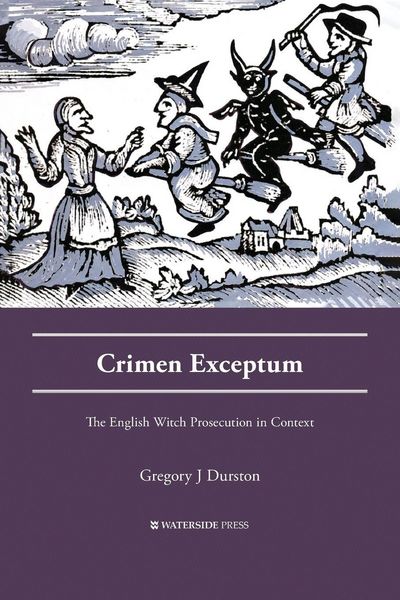
Crimen Exceptum The English Witch Prosecution in Context
-
- Taschenbuch ausgewählt
- eBook
-
Sprache:Englisch
49,99 €
inkl. gesetzl. MwSt.,
Beschreibung
Produktdetails
Einband
Taschenbuch
Erscheinungsdatum
05.06.2019
Verlag
Waterside PressSeitenzahl
240
Maße (L/B/H)
23,4/15,6/1,3 cm
Gewicht
371 g
Sprache
Englisch
ISBN
978-1-909976-65-8
As the author notes, ‘The early-modern European witch-hunts were neither orchestrated massacres nor spontaneous pogroms. Alleged witches were not rounded up at night and summarily killed extra-judicially or lynched as the victims of mob justice. They were executed after trial and conviction with full legal process’. A mix of superstition, fear, belief and ready explanations for ailments, misfortune or disasters caused law, politics and religion to indulge in criminalisation and the appearance of justice. Bearing echoes of modern-day ‘othering’ and marginalisation of outsiders he shows how witchcraft became akin to treason (with its special rules), how evidentially speaking storms, sickness or coincidence might be attributed to conjuring, magic, curses and spells. All this reinforced by examples and detailed references to the law and practice through which a desired outcome was achieved. In another resonance with modern times, the author shows how decisions were often diverted into the hands of witch-hunters, witch-finders (including self-appointed Witchfinder General, Matthew Hopkins), witch-prickers and other experts as well as the quaintly titled ‘cunning-folk’ consulted by prosecutors and ‘victims’. Crimen Exceptum (crimes apart). A straightforward and authoritative guide. Shows the rise and fall of prosecutions. Backed by a wealth of learning and research. Extract: ‘A range of specialist tests developed to establish that a suspect truly was a witch. These included "swimming", "pricking" … identifying a witch’s teat, requiring her to recite the Lord’s Prayer or other well-known passage of scripture … and any positive results obtained from the various techniques, such as scratching a suspect or boiling a victim’s urine … to break a spell or to identify who had cast it.’
Noch keine Bewertungen vorhanden
Verfassen Sie die erste Bewertung zu diesem Artikel
Helfen Sie anderen Kundinnen und Kunden durch Ihre Meinung.
Kurze Frage zu unserer Seite
Vielen Dank für Ihr Feedback
Wir nutzen Ihr Feedback, um unsere Produktseiten zu verbessern. Bitte haben Sie Verständnis, dass wir Ihnen keine Rückmeldung geben können. Falls Sie Kontakt mit uns aufnehmen möchten, können Sie sich aber gerne an unseren Kund*innenservice wenden.
zum Kundenservice