Beschreibung
Produktdetails
Einband
Gebundene Ausgabe
Erscheinungsdatum
09.09.2019
Verlag
Peter Lang Publishing Inc. New YorkSeitenzahl
184
Maße (L/B/H)
23,1/15,5/1,5 cm
Gewicht
349 g
Auflage
1
Sprache
Englisch
ISBN
978-1-4331-6880-2
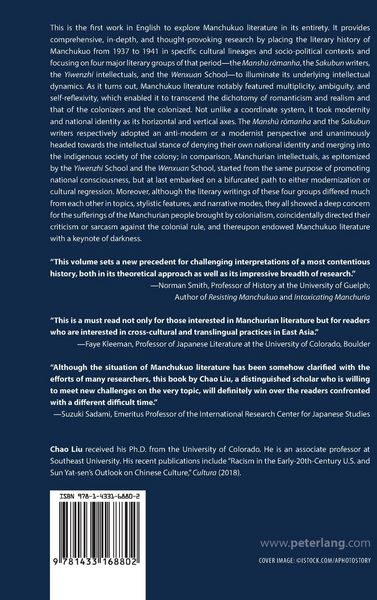
This is the first work in English to explore Manchukuo literature in its entirety. It provides comprehensive, in-depth, and thought-provoking research by placing the literary history of Manchukuo from 1937 to 1941 in specific cultural lineages and socio-political contexts and focusing on four major literary groups of that period—the Manshū rōmanha, the Sakubun writers, the Yiwenzhi intellectuals, and the Wenxuan School—to illuminate its underlying intellectual dynamics. As it turns out, Manchukuo literature notably featured multiplicity, ambiguity, and self-reflexivity, which enabled it to transcend the dichotomy of romanticism and realism and that of the colonizers and the colonized. Not unlike a coordinate system, it took modernity and national identity as its horizontal and vertical axes. The Manshū rōmanha and the Sakubun writers respectively adopted an anti-modern or a modernist perspective and unanimously headed towards the intellectual stance of denying their own national identity and merging into the indigenous society of the colony; in comparison, Manchurian intellectuals, as epitomized by the Yiwenzhi School and the Wenxuan School, started from the same purpose of promoting national consciousness, but at last embarked on a bifurcated path to either modernization or cultural regression. Moreover, although the literary writings of these four groups differed much from each other in topics, stylistic features, and narrative modes, they all showed a deep concern for the sufferings of the Manchurian people brought by colonialism, coincidentally directed their criticism or sarcasm against the colonial rule, and thereupon endowed Manchukuo literature with a keynote of darkness.
Noch keine Bewertungen vorhanden
Verfassen Sie die erste Bewertung zu diesem Artikel
Helfen Sie anderen Kundinnen und Kunden durch Ihre Meinung.
Kurze Frage zu unserer Seite
Vielen Dank für Ihr Feedback
Wir nutzen Ihr Feedback, um unsere Produktseiten zu verbessern. Bitte haben Sie Verständnis, dass wir Ihnen keine Rückmeldung geben können. Falls Sie Kontakt mit uns aufnehmen möchten, können Sie sich aber gerne an unseren Kund*innenservice wenden.
zum Kundenservice