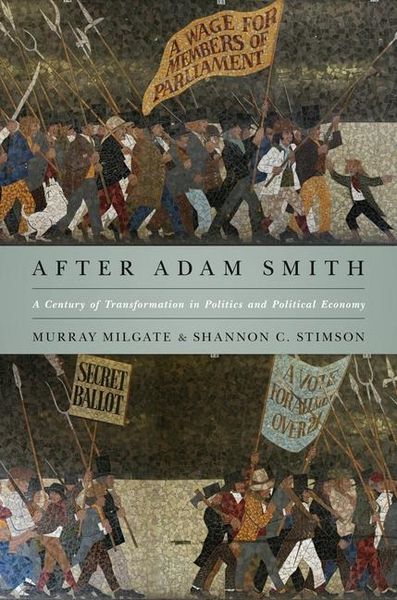
After Adam Smith A Century of Transformation in Politics and Political Economy
-
- Taschenbuch
- eBook ausgewählt
-
Form:Einzelkauf Download
-
Sprache:Englisch
35,99 €
inkl. gesetzl. MwSt.Beschreibung
Produktdetails
Format
Kopierschutz
Ja
Family Sharing
Ja
Text-to-Speech
Nein
Erscheinungsdatum
26.09.2011
Verlag
Princeton University PressSeitenzahl
320 (Printausgabe)
Dateigröße
922 KB
Sprache
Englisch
EAN
9781400831012
How writers after Adam Smith helped shape our thinking about economics and politics
Few issues are more central to our present predicaments than the relationship between economics and politics. In the century after Adam Smith's Wealth of Nations the British economy was transformed. After Adam Smith looks at how politics and political economy were articulated and altered. It considers how grand ideas about the connections between individual liberty, free markets, and social and economic justice sometimes attributed to Smith are as much the product of gradual modifications and changes wrought by later writers.
Thomas Robert Malthus, David Ricardo, James Mill, John Stuart Mill, and other liberals, radicals, and reformers had a hand in conceptual transformations that culminated in the advent of neoclassical economics. The population problem, the declining importance of agriculture, the consequences of industrialization, the structural characteristics of civil society, the role of the state in economic affairs, and the possible limits to progress were questions that underwent significant readjustments as the thinkers who confronted them in different times and circumstances reworked the framework of ideas advanced by Smith-transforming the dialogue between politics and political economy. By the end of the nineteenth century an industrialized and globalized market economy had firmly established itself. By exploring how questions Smith had originally grappled with were recast as the economy and the principles of political economy altered during the nineteenth century, this book demonstrates that we are as much the heirs of later images of Smith as we are of Smith himself.
Many writers helped shape different ways of thinking about economics and politics after Adam Smith. By ignoring their interventions we risk misreading our past-and also misusing it-when thinking about the choices at the interface of economics and politics that confront us today.
Noch keine Bewertungen vorhanden
Verfassen Sie die erste Bewertung zu diesem Artikel
Helfen Sie anderen Kundinnen und Kunden durch Ihre Meinung.
Kurze Frage zu unserer Seite
Vielen Dank für Ihr Feedback
Wir nutzen Ihr Feedback, um unsere Produktseiten zu verbessern. Bitte haben Sie Verständnis, dass wir Ihnen keine Rückmeldung geben können. Falls Sie Kontakt mit uns aufnehmen möchten, können Sie sich aber gerne an unseren Kund*innenservice wenden.
zum Kundenservice