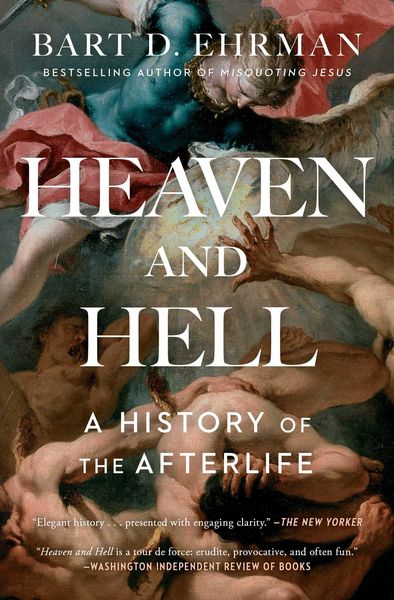
Heaven and Hell A History of the Afterlife
-
- Taschenbuch
- eBook ausgewählt
-
Form:Einzelkauf Download
-
Sprache:Englisch
-
Verlag:Simon & Schuster
14,83 €
inkl. gesetzl. MwSt.Beschreibung
Produktdetails
Format
ePUB
Kopierschutz
Ja
Family Sharing
Ja
Text-to-Speech
Ja
Erscheinungsdatum
31.03.2020
Verlag
Simon & SchusterSeitenzahl
352 (Printausgabe)
Dateigröße
4379 KB
Sprache
Englisch
EAN
9781501136757
A New York Times bestselling historian of early Christianity takes on two of the most gripping questions of human existence: where did the ideas of heaven and hell come from and why do they endure?
What happens when we die? A recent Pew Research poll showed that 72% of Americans believe in a literal heaven and 58% believe in a literal hell. Most people who hold these beliefs are Christian and assume they are the age-old teachings of the Bible. But eternal rewards and punishments are found nowhere in the Old Testament and are not what Jesus or his disciples taught.
So where did these ideas come from?
In this "eloquent understanding of how death is viewed through many spiritual traditions" (Publishers Weekly, starred review), Bart Ehrman recounts the long history of the afterlife, ranging from The Epic of Gilgamesh up to the writings of Augustine, focusing especially on the teachings of Jesus and his early followers. He discusses ancient guided tours of heaven and hell, in which a living person observes the sublime blessings of heaven for those who are saved and the horrifying torments of hell for those who are damned. Some of these accounts take the form of near death experiences, the oldest on record, with intriguing similarities to those reported today.
One of Ehrman's startling conclusions is that there never was a single Greek, Jewish, or Christian understanding of the afterlife, but numerous competing views. Moreover, these views did not come from nowhere; they were intimately connected with the social, cultural, and historical worlds out of which they emerged. Only later, in the early Christian centuries, did they develop into notions of eternal bliss or damnation widely accepted today.
In this "elegant history" (The New Yorker), Ehrman helps us reflect on where our ideas of the afterlife come from. With his "richly layered narrative" (The Boston Globe) he assures us that even if there may be something to hope for when we die, there certainly is nothing to fear.
What happens when we die? A recent Pew Research poll showed that 72% of Americans believe in a literal heaven and 58% believe in a literal hell. Most people who hold these beliefs are Christian and assume they are the age-old teachings of the Bible. But eternal rewards and punishments are found nowhere in the Old Testament and are not what Jesus or his disciples taught.
So where did these ideas come from?
In this "eloquent understanding of how death is viewed through many spiritual traditions" (Publishers Weekly, starred review), Bart Ehrman recounts the long history of the afterlife, ranging from The Epic of Gilgamesh up to the writings of Augustine, focusing especially on the teachings of Jesus and his early followers. He discusses ancient guided tours of heaven and hell, in which a living person observes the sublime blessings of heaven for those who are saved and the horrifying torments of hell for those who are damned. Some of these accounts take the form of near death experiences, the oldest on record, with intriguing similarities to those reported today.
One of Ehrman's startling conclusions is that there never was a single Greek, Jewish, or Christian understanding of the afterlife, but numerous competing views. Moreover, these views did not come from nowhere; they were intimately connected with the social, cultural, and historical worlds out of which they emerged. Only later, in the early Christian centuries, did they develop into notions of eternal bliss or damnation widely accepted today.
In this "elegant history" (The New Yorker), Ehrman helps us reflect on where our ideas of the afterlife come from. With his "richly layered narrative" (The Boston Globe) he assures us that even if there may be something to hope for when we die, there certainly is nothing to fear.
Noch keine Bewertungen vorhanden
Verfassen Sie die erste Bewertung zu diesem Artikel
Helfen Sie anderen Kundinnen und Kunden durch Ihre Meinung.
Kurze Frage zu unserer Seite
Vielen Dank für Ihr Feedback
Wir nutzen Ihr Feedback, um unsere Produktseiten zu verbessern. Bitte haben Sie Verständnis, dass wir Ihnen keine Rückmeldung geben können. Falls Sie Kontakt mit uns aufnehmen möchten, können Sie sich aber gerne an unseren Kund*innenservice wenden.
zum Kundenservice