• Produktbild: Molecular Aspects of Plant Beneficial Microbes in Agriculture
  • Produktbild: Molecular Aspects of Plant Beneficial Microbes in Agriculture

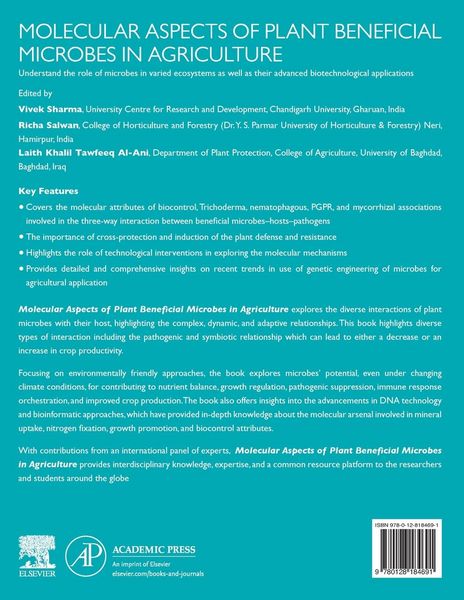
Molecular Aspects of Plant Beneficial Microbes in Agriculture

308,99 €

inkl. gesetzl. MwSt., Versandkostenfrei


Beschreibung

Produktdetails

Einband

Taschenbuch

Erscheinungsdatum

12.03.2020

Herausgeber

Sharma Vivek + weitere

Verlag

Elsevier Science & Technology

Seitenzahl

456

Maße (L/B/H)

27,9/21,6/2,3 cm

Gewicht

1050 g

Sprache

Englisch

ISBN

978-0-12-818469-1

Beschreibung

Portrait

Dr. Vivek Sharma is currently an Assistant Professor at the University Centre for Research and Development at Chandigarh University, Mohali (PB). He has more than 12 years of research experience exploring molecular attributes of Trichoderma. His research also involves examining the molecular aspects of microbes beneficial to plants such as Streptomyces and Bacillus. He has published several research papers in international journals, serves as an Academic Editor for PLOS ONE, a review editor for Frontiers in Bioengineering and Biotechnology, an associate editor of Chemical and Biological Technologies in Agriculture, and is also a member of the editorial board of Current Proteomics. He is also a recognized reviewer for the Journal of Advanced Research, Applied Microbiology and Biotechnology, Environmental Research, the Journal of Proteomics, BMC Genomics, BMC Plant Biology, AMB Express, Molecular Biotechnology, MDPI Pathogens, Folia Microbiology, Physiological and Molecular Plant Pathology and Archives of Microbiology.
Dr. Richa Salwan is currently an Assistant Professor of microbiology at the College of Horticulture and Forestry (Dr. YS Parmar University of Horticulture and Forestry), Neri, Hamirpur, Himachal Pradesh, India. Dr. Salwan's research interests and contributions are on the diversity of psychrotrophic bacteria from the Western Himalayas and their utilization for industrial applications. She has also worked on the exploration of extremophiles for industrially relevant enzymes and plant beneficial microbes for agricultural benefits. She has published two books and numerous research papers in several international journals. Dr. Salwan serves as an Academic Editor for PLOS ONE and is also a recognized reviewer for several journals including MDPI Genes, MDPI Diversity, MDPI Foods, BMC Microbiology, Journal of Plant Growth Regulation, and Microbial Ecology.
Dr. Laith Al-Ani is a lecturer at the Dept. of Plant protection -College of Agriculture - University of Baghdad. He has completed his Ph.D. in plant pathology at the School of Biological Sciences, University Sains Malaysia. He is an expert in plant pathology and management of plant diseases with the plant-fungal interaction. His research is focused on using alternative methods of synthetic pesticides. He has published many chapters and papers on biological control agents to control plant pathogens. He is having research experience of more than 17 years in using biological control against plant pathogens and pests and isolated several biological control agents such as PGPR, nonpathogenic Fusarium, Trichoderma, other fungi and entomopathogen such as Fusarium that also involved in different plant benefits.

Produktdetails

Einband

Taschenbuch

Erscheinungsdatum

12.03.2020

Herausgeber

Verlag

Elsevier Science & Technology

Seitenzahl

456

Maße (L/B/H)

27,9/21,6/2,3 cm

Gewicht

1050 g

Sprache

Englisch

ISBN

978-0-12-818469-1

Herstelleradresse

Libri GmbH
Europaallee 1
36244 Bad Hersfeld
DE

Email: GPSR Kontakt

Noch keine Bewertungen vorhanden

Verfassen Sie die erste Bewertung zu diesem Artikel

Helfen Sie anderen Kundinnen und Kunden durch Ihre Meinung.

Kundinnen und Kunden meinen

Bewertungen (0)

Die Leseprobe wird geladen.
  • Produktbild: Molecular Aspects of Plant Beneficial Microbes in Agriculture
  • Produktbild: Molecular Aspects of Plant Beneficial Microbes in Agriculture
  • 1. Overview and challenges in the implementation of plant beneficial microbes

    2. Plant beneficial microbes: do they have a role as antiviral agents in agriculture?

    3. Multilegume biofertilizer: a dream

    4. The effect of incompatible plant pathogens on the host plant

    5. Language of plant-microbe-microbe interactions in rhizosphere ecosystems

    6. Application and biological impact of endophytic bacteria as IAA producers

    7. Molecular aspects of biocontrol species of Streptomyces in agricultural crops

    8. Root exudates, a key factor in the plant-bacteria interaction mechanisms

    9. Insight into plant-bacteria-fungi interactions to improve plant performance via remediation of heavy metals: an overview

    10. Signaling pathway of induced systemic resistance

    11. Role of fungal elicitors in plant defense mechanism

    12. Versality of Trichoderma in plant disease management

    13. Knock, knock- let the bacteria in: enzymatic potential of plant associated bacteria

    14. Beneficial role of viruses in plants

    15. Microbial phytases in plant minerals acquisition

    16. PGPR secondary metabolites: an active syrup for improvement of plant health

    17. Volatile organic compounds mediated plant-microbe interactions in soil

    18. Molecular mechanisms in plant growth promoting bacteria (PGPR) to resist environmental stress in plants

    19. Biogeographic distribution of chickpea rhizobia in the world

    20. Arbuscular mycorrhiza, a fungal perspective

    21. Engineering bacterial ACC deaminase for improving plant productivity under stressful conditions

    22. Role of rhizobacteria in alleviating salt stress

    23. Nematophagous and entomopathogenic fungi: new insights into the beneficial fungus-plant interaction

    24. Secondary metabolites and lytic tool box of trichoderma and their role in plant health

    25. Endophytic fungi: a positive association with plants

    26. Using molecular techniques applied to beneficial microorganisms as biotechnological tools for controlling agricultural plant pathogents and pest

    27. CRISPR/Cas9 mediated genome engineering in microbes and its application in plant beneficial effects

    28. Understanding the molecular basis of the tripartite interaction between host-pathogen-bioagent through proteomic approach

    29. Frankia and the actinorhizal symbiosis

    30. Advances in Frankia genome studies and molecular aspects of tolerance to enrigonmental stresses

    31. Tripartite interactions between plants, trichoderma and the pathogenic fungi

    32. Applications of agriculturally important microorganisms for sustainable crop production

    33. Beneficial microorganisms in the remediation of heavy metals