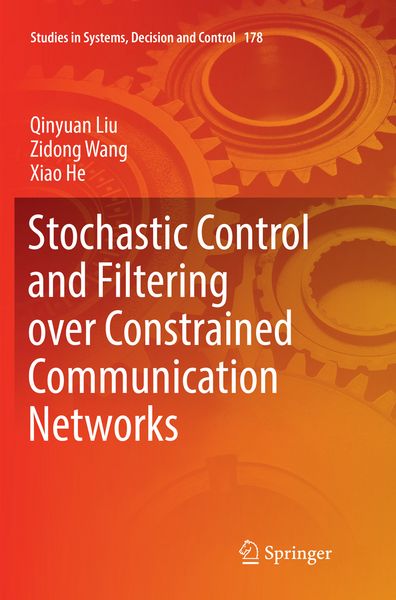
Produktbild: Stochastic Control and Filtering over Constrained Communication Networks
Band 178

Stochastic Control and Filtering over Constrained Communication Networks

115,99 €

inkl. gesetzl. MwSt., Versandkostenfrei


Beschreibung

Produktdetails

Einband

Taschenbuch

Erscheinungsdatum

10.12.2019

Verlag

Springer

Seitenzahl

222

Maße (L/B/H)

23,5/15,5/1,3 cm

Gewicht

421 g

Auflage

Softcover reprint of the original 1st ed. 2019

Sprache

Englisch

ISBN

978-3-030-13086-2

Beschreibung

Rezension

“This book is a research monograph, the authors make it be readable for graduate students of control theory. One only need some basic knowledge of stochastic process and control system theory to read it. I believe both beginners and experts can benefit from reading this book.” (Lu Qi, zbMATH 1428.93003, 2020)

Produktdetails

Einband

Taschenbuch

Erscheinungsdatum

10.12.2019

Verlag

Springer

Seitenzahl

222

Maße (L/B/H)

23,5/15,5/1,3 cm

Gewicht

421 g

Auflage

Softcover reprint of the original 1st ed. 2019

Sprache

Englisch

ISBN

978-3-030-13086-2

Herstelleradresse

Springer-Verlag KG
Sachsenplatz 4-6
1201 Wien
AT

Email: GPSR Kontakt

Noch keine Bewertungen vorhanden

Verfassen Sie die erste Bewertung zu diesem Artikel

Helfen Sie anderen Kundinnen und Kunden durch Ihre Meinung.

Kundinnen und Kunden meinen

Bewertungen (0)

  • Produktbild: Stochastic Control and Filtering over Constrained Communication Networks
  • Introduction.- Fundamental Limitations of Networked Systems over Fading Channels.- Event-based H∞ Consensus Control of Multi-agent Systems.- Event-Triggered Resilient Filtering with Measurement Quantization.- Event-based Distributed Filtering of Continuous-time Nonlinear Systems.- Event-based Distributed Filtering over Markovian Switching Topologies.- Event-based Recursive Distributed Filtering.- A Resilient Approach to Distributed Recursive Filter Design.- Consensus-based Recursive Distributed Filtering.- On Kalman-Consensus Filtering with Random Link Failures.- Moving-Horizon Estimation with Binary Encoding Schemes.- Conclusion and Further Work.