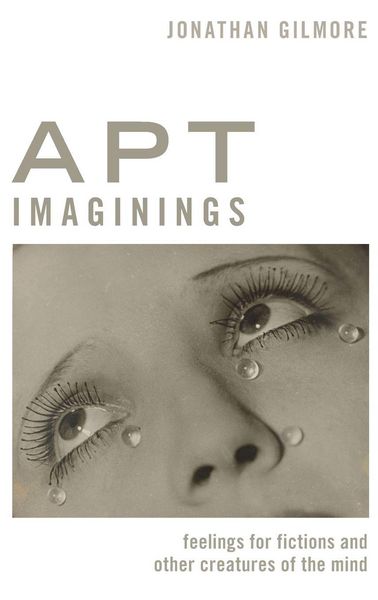
Apt Imaginings Feelings for Fictions and Other Creatures of the Mind
129,99 €
inkl. gesetzl. MwSt.,
Beschreibung
Produktdetails
Einband
Gebundene Ausgabe
Erscheinungsdatum
18.02.2020
Verlag
Oxford AcademicSeitenzahl
272
Maße (L/B/H)
24/16,1/1,9 cm
Gewicht
499 g
Sprache
Englisch
ISBN
978-0-19-009634-2
How do our engagements with fictions and other products of the imagination compare to our experiences of the real world? Are the feelings we have about a novel's characters modelled on our thoughts about actual people? If it is wrong to feel pleasure over certain situations in real life, can it nonetheless be right to take pleasure in analogous scenarios represented in a fantasy or film? Should the desires we have for what goes on in a make-believe story cohere with what we want to happen in the actual world? Such queries have animated philosophical and psychological theorizing about art and life from Plato's Republic and Aristotle's Poetics to contemporary debates over freedom of expression, ethics and aesthetics, the cognitive value of thought experiments, and the effects on audiences of exposure to violent entertainment. In Apt Imaginings, Jonathan Gilmore develops a new framework to pursue these questions, marshalling a wide range of research in aesthetics, the science of the emotions, moral philosophy, neuroscience, cognitive psychology, and film and literary theory. Gilmore argues that, while there is a substantial empirical continuity in our feelings across art and life, the norms that govern the appropriateness of those responses across the divide are discontinuous. In this view, the evaluative criteria that determine the fit, correctness, or rationality of our emotions and desires for what is internal to a fiction can be contrary to those that govern our affective attitudes toward analogous things in the real world. In short, it can be right to embrace within a story what one would condemn in real life. The theory Gilmore defends in this volume helps to explain our complex and sometimes conflicted attitudes toward works of the imagination; challenges the popular view that fictions serve to refine our moral sensibilities; and exposes a kind of autonomy of the imagination that can render our responses to art immune to standard real-world epistemic, practical, and affective kinds of criticism.
Noch keine Bewertungen vorhanden
Verfassen Sie die erste Bewertung zu diesem Artikel
Helfen Sie anderen Kundinnen und Kunden durch Ihre Meinung.
Kurze Frage zu unserer Seite
Vielen Dank für Ihr Feedback
Wir nutzen Ihr Feedback, um unsere Produktseiten zu verbessern. Bitte haben Sie Verständnis, dass wir Ihnen keine Rückmeldung geben können. Falls Sie Kontakt mit uns aufnehmen möchten, können Sie sich aber gerne an unseren Kund*innenservice wenden.
zum Kundenservice