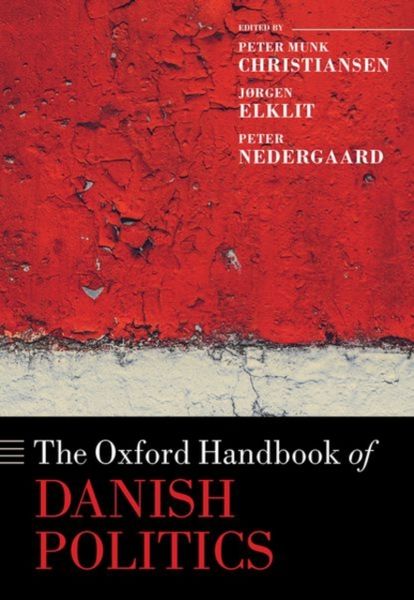
Produktbild: The Oxford Handbook of Danish Politics

The Oxford Handbook of Danish Politics

242,99 €

inkl. gesetzl. MwSt., Versandkostenfrei


Beschreibung

Produktdetails

Einband

Gebundene Ausgabe

Erscheinungsdatum

26.08.2020

Herausgeber

Peter Munk Christiansen + weitere

Verlag

Oxford University Press

Seitenzahl

736

Maße (L/B/H)

25,4/17,9/5 cm

Gewicht

1454 g

Sprache

Englisch

ISBN

978-0-19-883359-8

Beschreibung

Rezension

It is encouraging to see major publishers still printing carefully edited and curated collections by leading researchers. This thick volume brings about fifty leading Danish social scientists together to cover nearly every aspect of contemporary Danish government and politics. Eric S. Einhorn, Scandinavian Studies

Produktdetails

Einband

Gebundene Ausgabe

Erscheinungsdatum

26.08.2020

Herausgeber

Verlag

Oxford University Press

Seitenzahl

736

Maße (L/B/H)

25,4/17,9/5 cm

Gewicht

1454 g

Sprache

Englisch

ISBN

978-0-19-883359-8

Herstelleradresse

Libri GmbH
Europaallee 1
36244 Bad Hersfeld
DE

Email: gpsr@libri.de

Kundinnen und Kunden meinen

0 Bewertungen

Informationen zu Bewertungen

Zur Abgabe einer Bewertung ist eine Anmeldung im Konto notwendig. Die Authentizität der Bewertungen wird von uns nicht überprüft. Wir behalten uns vor, Bewertungstexte, die unseren Richtlinien widersprechen, entsprechend zu kürzen oder zu löschen.

Die Bewertungen sind nach Format, Anzahl Sterne und Datum sortiert.

Verfassen Sie die erste Bewertung zu diesem Artikel

Helfen Sie anderen Kund*innen durch Ihre Meinung

Kundinnen und Kunden meinen

0 Bewertungen filtern

Die Leseprobe wird geladen.
  • Produktbild: The Oxford Handbook of Danish Politics
    • 1: Peter Munk Christiansen, Jÿrgen Elklit, and Peter Nedergaard: Introduction: Why a Book on Danish Politics?

    • Part 1: POLITY

    • 2: Jens Peter Christensen: The Constitution

    • 3: Ulrik Pram Gad: Greenland, the Faroe Islands, and Denmark: Unity or Community?

    • 4: Jes Fabricius Mÿller: The Monarch: Head of State and National Symbol

    • 5: Jÿrgen Elklit: The Electoral System: Fair and Well-Functioning

    • 6: Kasper Mÿller Hansen: Electoral Turnouts: Strong Social Norms of Voting

    • 7: Helene Helboe Pedersen: The Parliament (Folketinget)

    • 8: Martin Ejnar Hansen: The Government and the Prime Minister: More Than Primus Inter Pares?

    • 9: Caroline Howard Grÿn and Heidi Houlberg Salomonsen: Organizing Central Government: A Pragmatic Meritocracy?

    • 10: Kurt Houlberg and Niels Ejersbo: Municipalities and Regions: Approaching the Limit of Decentralization?

    • 11: Peter Munk Christiansen: Corporatism: Exaggerated Death Rumours?

    • 12: Mette Frisk Jensen and Gert Tinggaard Svendsen: Corruption and Bureaucratic Reforms: 'Getting to Denmark'?

    • 13: Mads Dagnis Jensen and Peter Nedergaard: Coordination for the European Union: A Strong and Stable Institution

    • Part 2: POLITICS

    • 14: Christoffer Green-Pedersen and Karina Kosiara-Pedersen: Party System: Open yet Stable

    • 15: Christoffer Green-Pedersen and Asbjÿrn Skjÿveland: Governments in Action: Consensual Politics and Minority Governments

    • 16: Gitte Sommer Harrits and Rune Stubager: Classes and Politics: A Changing Relationship

    • 17: Peter Thisted Dinesen, Rune Slothuus, and Rune Stubager: Danish Public Opinion: Stability, Change and Polarization

    • 18: Rasmus Mariager and Niels Wium Olesen: The Social Democratic Party: From Exponent of Societal Change to Pragmatic Conservatism

    • 19: Flemming Juul Christiansen: The Liberal Party: From Agrarian and Liberal to Centre-Right Catch-All

    • 20: Karina Kosiara-Pedersen: The Danish People's Party: Centre Oriented Populists?

    • 21: Henrik Bech Seeberg and Ann-Kristin Kölln: The Red-Green Alliance: Is it Red or Green?

    • 22: Kasper Mÿller Hansen and Rune Stubager: Dynamic Stability: The Anchors of Voting Behaviour

    • 23: Christina Fiig and Birte Siim: Gender and Politics: The Limits of Equality Politics

    • 24: Ulrik Kjÿr: Local Elections: Localized Voting Within a Nationalized Party System

    • 25: Derek Beach: Referenda in Denmark: Influence on Politics

    • 26: Thomas Olesen: Media and Politics: The Danish Media System in Transformation?

    • 27: Anne Skorkjÿr Binderkrantz: Interest Groups: A Democratic Necessity and a Necessary Evil

    • Part 3: POLICIES

    • 28: Anders Wivel: In War and Peace: Security and Defence Policy in a Small State

    • 29: Henrik Larsen: Foreign Policy: New Directions in a Changing World Order?

    • 30: Mads Dagnis Jensen and Peter Nedergaard: Danish European Union Policies: Sailing Between Economic Benefits and Political Sovereignty

    • 31: Anne Mette Kjÿr: Development Policy: From Consensus to Contention?

    • 32: Torben M. Andersen: Economic Policy: From Disequilibrium to Flexicurity

    • 33: Klaus Petersen: Welfare State Policies: From the Beginning towards an End?

    • 34: Laust Hÿgedahl: The Danish Labour Market Model: Is the Bumblebee Still Flying?

    • 35: Susanne Wiborg: Education Policy: Power, Conflict, and Cooperation

    • 36: Lars Thorup Larsen: Health Policy: The Submerged Politics of Free and Equal Access 

    • 37: Kristina Bakkÿr Simonsen: Immigration and Immigrant Integration Policy: Public Opinion or Party Politics?

    • 38: Carsten Daugbjerg, Peder Andersen, Henning Otto Hansen, and Brian H. Jacobsen: Agricultural and Fisheries Policy: Towards Market Liberalism

    • 39: Peter Birch Sÿrensen: Environmental, Energy, and Climate Policy: From Energy Supply to Climate Gasses

    • 40: Kaare Aagaard and Niels Mejlgaard: Research Policy: The Strength of Transformation

    • 41: Peter Munk Christiansen, Jÿrgen Elklit, and Peter Nedergaard: Polity, Politics, and Policies: A Reconsideration