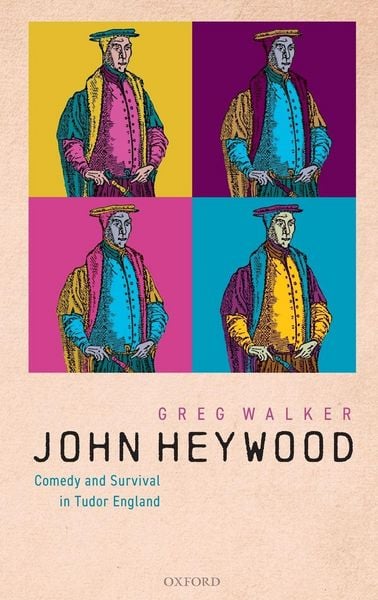
John Heywood Comedy and Survival in Tudor England
136,99 €
inkl. gesetzl. MwSt.,
Beschreibung
Produktdetails
Einband
Gebundene Ausgabe
Erscheinungsdatum
01.06.2020
Verlag
Oxford AcademicSeitenzahl
494
Maße (L/B/H)
24/16,1/3,1 cm
Gewicht
901 g
Sprache
Englisch
ISBN
978-0-19-885151-6
John Heywood was an important literary and theatrical pioneer in his own right, but he is also a revealing lens through which to view the wider tumultuous history of the sixteenth century. He was, through the period from the mid-1520s to the 1560s, as near to a celebrity as Tudor England possessed, famed for his 'merry' persona and good humour. But his public image concealed a deeper engagement with religious and political history. Enduringly resistant to extremism, he variously entertained, counselled, and cautioned his readers and audiences through four reigns, finding himself, as regimes changed and religious policies shifted, successively celebrated, marginalised, anathematised, condemned to death, recuperated, and celebrated once more before finally retreating into exile on the Continent in 1564. He produced plays at the courts of Henry VIII, Edward VI, Mary and Elizabeth, performed and taught keyboard music, wrote lyric poetry and songs, and from the mid-sixteenth century turned to collecting and publishing highly successful volumes of proverbs and epigrams for which he was remembered well into the seventeenth century. Each of these works provides a subtle, often courageously critical engagement with the politics of its moment. To study Heywood's career takes us beyond the clichés of popular history, beyond Shakespeare and the Elizabethan playhouses, beyond the canonical Henrician court poets and the writers of the Elizabethan 'Golden Age', beyond even the experiences of the century's chief ministers, intellectuals, and martyrs, to a theatrical and literary world less visible in the conventional sources. It opens a window on a culture in which the actions of monarchs, their councillors, and their victims were witnessed and reflected upon at one remove from the centres of power. And it allows us to re-examine the significance of an individual who deserves our attention, not only for his considerable artistic achievements, but also for the determination with which, often against the odds, he used his talents in pursuit of wider humanist cultural principles for over half a century.
Noch keine Bewertungen vorhanden
Verfassen Sie die erste Bewertung zu diesem Artikel
Helfen Sie anderen Kundinnen und Kunden durch Ihre Meinung.
Kurze Frage zu unserer Seite
Vielen Dank für Ihr Feedback
Wir nutzen Ihr Feedback, um unsere Produktseiten zu verbessern. Bitte haben Sie Verständnis, dass wir Ihnen keine Rückmeldung geben können. Falls Sie Kontakt mit uns aufnehmen möchten, können Sie sich aber gerne an unseren Kund*innenservice wenden.
zum Kundenservice