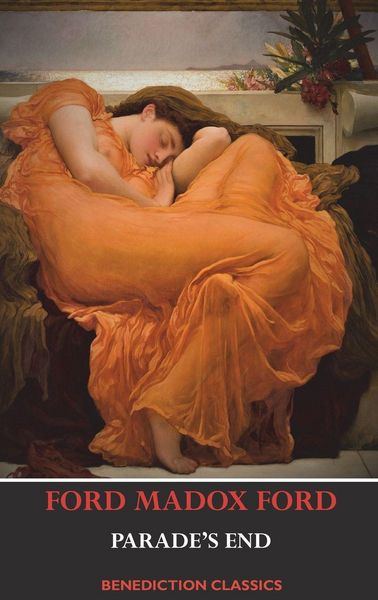
Parade's End (Full Tetralogy Some Do Not, No More Parades , A Man Could Stand Up, and Last Post)
-
- Hardcover ausgewählt
- Taschenbuch
- eBook
-
Sprache:Englisch
-
Verlag:Benediction Classics
39,99 €
inkl. gesetzl. MwSt.,
Beschreibung
Produktdetails
Einband
Gebundene Ausgabe
Erscheinungsdatum
01.11.2019
Verlag
Benediction ClassicsSeitenzahl
446
Maße (L/B/H)
24/16,1/3,1 cm
Gewicht
912 g
Sprache
Englisch
ISBN
978-1-78943-056-1
Not just about the war but about a whole era and its destruction "quite simply, the best fictional treatment of war in the history of the novel"-Mary Gordon. "There are not many English novels which deserve to be called great: Parade's End is one of them." -W. H. Auden. Parade's End (including Some Do Not, No More Parades, A Man Could Stand Up, and Last Post) is an epic portrait of the end of an era; the irrevocable destruction of the comfortable, predictable society that vanished during World War I. It follows Christopher Tietjens, a brilliant government statistician from the English gentry, who serves on the Western Front in the First World War, as did Ford Madox Ford, who wrote the tetralogy after recuperating from the psychological toll of the war. Tietjens, who shares many of the author's traits, is regarded as one of the great creations of English literature. He sees himself as the last gentleman in an England going to the dogs. The work is original in several ways. First, despite being set amid the destruction of war, Ford's primary interest is in Tietjens' consciousness, not the events. Also, David Ayers observes, "Parade's End is virtually alone of the male writing of the time in affirming the ascendance of women and advocating a course of graceful withdrawal from dominance for men". Ford Madox Ford's stated purpose in creating this work, regarded as one of the great 20th-century English novels, was "the obviating of all future wars". This edition is complete and unabridged. Ford Madox Ford (1873-1939) was an English novelist, poet, critic, and editor. He was an international influence in early 20th-century literature. Ford grew up in a cultured, artistic environment as the son of a German music critic and grandson of the Pre-Raphaelite Ford Madox Brown. He wrote his first novel at 18 and went on to publish more than 70 works. He is remembered for Parade's End and his generous encouragement of younger writers.
Kundinnen und Kunden meinen
Verfassen Sie die erste Bewertung zu diesem Artikel
Helfen Sie anderen Kund*innen durch Ihre Meinung
Kurze Frage zu unserer Seite
Vielen Dank für Ihr Feedback
Wir nutzen Ihr Feedback, um unsere Produktseiten zu verbessern. Bitte haben Sie Verständnis, dass wir Ihnen keine Rückmeldung geben können. Falls Sie Kontakt mit uns aufnehmen möchten, können Sie sich aber gerne an unseren Kund*innenservice wenden.
zum Kundenservice