• Produktbild: Papst Franziskus
  • Produktbild: Papst Franziskus

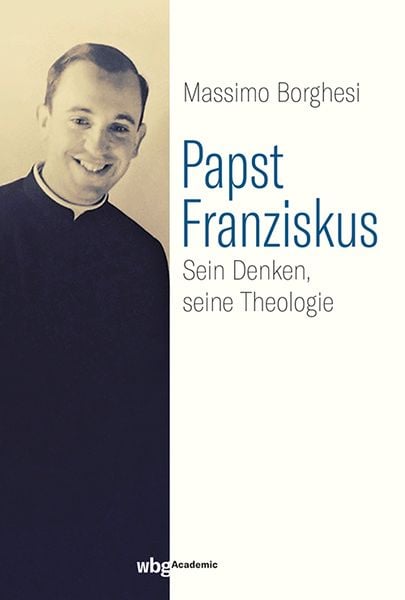
Papst Franziskus Sein Denken, seine Theologie

12,99 €

inkl. gesetzl. MwSt., Versandkostenfrei


Beschreibung

Produktdetails

Einband

Gebundene Ausgabe

Erscheinungsdatum

03.09.2020

Herausgeber

Elisabeth-Marie Richter

Verlag

Wbg Academic in Herder

Seitenzahl

344

Maße (L/B/H)

22,3/15,5/3,2 cm

Gewicht

574 g

Auflage

1. Auflage

Originaltitel

Jorge Mario Bergoglio

Übersetzt von

Elisabeth-Marie Richter

Sprache

Deutsch

ISBN

978-3-534-27163-4

Beschreibung

Rezension

»Die intellektuelle Biographie erkundet klar und detailliert den Glaubens- und Studienweg des Menschen Bergoglio in steter Auseinandersetzung mit der Moderne ... Die Untersuchung zeigt das originelle Denken eines außergewöhnlichen Mannes.« Il sole 24 ore

»If Massimo Borghesi's book, The Mind of Pope Francis, had been published earlier in the pontificate it could have helped prevent the surprisingly easy adoption of a superficial narrative depicting the new pope as an intellectual lightweight set on undoing much of what his predecessors had accomplished. An important and unique contribution to the books that have been written about him.« Cindy Wooden, Chief of Rome Bureau, Catholic News Service

»Massimo Borghesi's book is the first real intellectual biography of Jorge Mario Bergoglio and it builds a bridge between the different universes of today's global Catholicism: different generations of Catholics; different areas of the world; different theological, philosophical, and socio-political backgrounds. This book is an invaluable contribution for the comprehension of this pontificate and potentially a game-changer for the reception of Pope Francis, especially in the English-speaking world.« Massimo Faggioli, Professor of Historical Theology, Villanova University

»Pope Francis' predecessor was an internationally renowned theologian. Perhaps because of that, many have dismissed the Argentinian pope as lacking in intellectual `heft.' Massimo Borghesi's fascinating and informative study of the intellectual influences on Pope Francis has exploded that canard, demonstrating the intellectual breadth, subtlety and perspicacity of Francis' thought. Borghesi helps us see that behind Pope Francis' famous `evangelical simplicity' lies `a rich and original thought process,' one informed by such thinkers as Amelia Podetti, Alberto Methol Ferre, and Romano Guardini. Thanks to Borghesi we can better appreciate the subtle and creative mind of this `simple' pope.« Richard Gaillardetz, Joseph Professor of Catholic Systematic Theology, Boston College

»The English edition of Borghesi's work goes beyond previous books about Pope Francis, not only by including material from private interviews with the Holy Father, but also by opening to English-speakers the thinking of men and women like Alberto Methol Ferré and Amelia Podetti, philosophers from Latin America, who deeply influenced Pope Francis and his ideas about the holy, faithful, People of God and about listening to those at the peripheries. The work of Borghesi is a wonderful contribution to understanding the thinking and person of Pope Francis and to receiving and implementing his magisterium at a time of change in the Church and the world. It is my sincere hope that bishops, priests, seminary professors, lay theologians and leaders will profit greatly from this text as they carry out the important work of the New Evangelization.« Archbishop Christophe Pierre, Apostolic Nuncio to the United States

»Any Catholic thinker, priest, or seminarian who wants to grasp the intricacies of the intellectual formation of Pope Francis has to read this book. Even the best biographies have up to now been unable to recount the true influence of Gaston Fessard, Amelia Podetti, and Alberto Methol Ferré. This book was hard to put down. The interplay of the modern dialectic and classical analogy under the rubric of Jesuit polarity is itself worthy of a small monograph. The record is now corrected. Friends and foes can learn for the first time the multiple and diverse strands of Latin American, Ignatian, and European thought that the inquisitive Bergoglio brought from the Southern Cone of his native hemisphere to the chair of St. Peter.« Peter Casarella, University of Notre Dame

Produktdetails

Einband

Gebundene Ausgabe

Erscheinungsdatum

03.09.2020

Herausgeber

Elisabeth-Marie Richter

Verlag

Wbg Academic in Herder

Seitenzahl

344

Maße (L/B/H)

22,3/15,5/3,2 cm

Gewicht

574 g

Auflage

1. Auflage

Originaltitel

Jorge Mario Bergoglio

Übersetzt von

Elisabeth-Marie Richter

Sprache

Deutsch

ISBN

978-3-534-27163-4

Herstelleradresse

wbg Academic
Hermann-Herder-Straße 4
79104 Freiburg
DE

Email: kundenservice@herder.de

Kundinnen und Kunden meinen

0 Bewertungen

Informationen zu Bewertungen

Zur Abgabe einer Bewertung ist eine Anmeldung im Konto notwendig. Die Authentizität der Bewertungen wird von uns nicht überprüft. Wir behalten uns vor, Bewertungstexte, die unseren Richtlinien widersprechen, entsprechend zu kürzen oder zu löschen.

Die Bewertungen sind nach Format, Anzahl Sterne und Datum sortiert.

Verfassen Sie die erste Bewertung zu diesem Artikel

Helfen Sie anderen Kund*innen durch Ihre Meinung

Kundinnen und Kunden meinen

0 Bewertungen filtern

Die Leseprobe wird geladen.
  • Produktbild: Papst Franziskus
  • Produktbild: Papst Franziskus
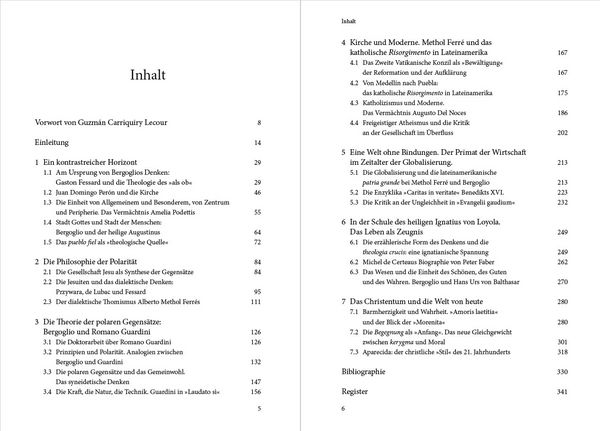
  • Vorwort von Guzmán Carriquiry Lecour 8
    Einleitung 14
    1 Ein kontrastreicher Horizont 29
    1.1 Am Ursprung von Bergoglios Denken: Gaston Fessard und die Theologie des »als ob« 29
    1.2 Juan Domingo Perón und die Kirche 46
    1.3 Die Einheit von Allgemeinem und Besonderem, von Zentrum und Peripherie. Das Vermächtnis Amelia Podettis 55
    1.4 Stadt Gottes und Stadt der Menschen: Bergoglio und der heilige Augustinus 64
    1.5 Das pueblo fiel als »theologische Quelle« 72
    2 Die Philosophie der Polarität 84
    2.1 Die Gesellschaft Jesu als Synthese der Gegensätze 84
    2.2 Die Jesuiten und das dialektische Denken: Przywara, de Lubac und Fessard 95
    2.3 Der dialektische Thomismus Alberto Methol Ferrés 111
    3 Die Theorie der polaren Gegensätze: Bergoglio und Romano Guardini 126
    3.1 Die Doktorarbeit über Romano Guardini 126
    3.2 Prinzipien und Polarität. Analogien zwischen Bergoglio und Guardini 132
    3.3 Die polaren Gegensätze und das Gemeinwohl. Das syneidetische Denken 147
    3.4 Die Kraft, die Natur, die Technik. Guardini in »Laudato si« 156
    4 Kirche und Moderne. Methol Ferré und das katholische Risorgimento in Lateinamerika 167
    4.1 Das Zweite Vatikanische Konzil als »Bewältigung« der Reformation und der Aufklärung 167
    4.2 Von Medellín nach Puebla: das katholische Risorgimento in Lateinamerika 175
    4.3 Katholizismus und Moderne.
    Das Vermächtnis Augusto Del Noces 186
    4.4 Freigeistiger Atheismus und die Kritik an der Gesellschaft im Überfluss 202
    5 Eine Welt ohne Bindungen. Der Primat der Wirtschaft im Zeitalter der Globalisierung 213
    5.1 Die Globalisierung und die lateinamerikanische patria grande bei Methol Ferré und Bergoglio 213
    5.2 Die Enzyklika »Caritas in veritate« Benedikts XVI. 223
    5.3 Die Kritik an der Ungleichheit in »Evangelii gaudium« 232
    6 In der Schule des heiligen Ignatius von Loyola. Das Leben als Zeugnis 249
    6.1 Die erzählerische Form des Denkens und die theologia crucis: eine ignatianische Spannung 249
    6.2 Michel de Certeaus Biographie von Peter Faber 262
    6.3 Das Wesen und die Einheit des Schönen, des Guten
    und des Wahren. Bergoglio und Hans Urs von Balthasar 270
    7 Das Christentum und die Welt von heute 280
    7.1 Barmherzigkeit und Wahrheit. »Amoris laetitia« und der Blick der »Morenita« 280
    7.2 Die Begegnung als »Anfang«. Das neue Gleichgewicht zwischen kerygma und Moral 301
    7.3 Aparecida: der christliche »Stil« des 21. Jahrhunderts 318
    Bibliographie 330
    Register 339