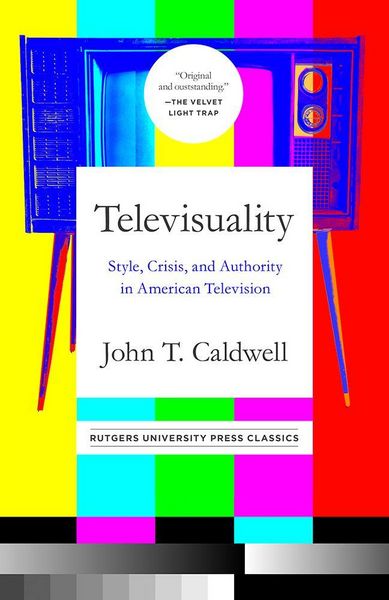
Produktbild: Televisuality

Televisuality Style, Crisis, and Authority in American Television

139,99 €

inkl. gesetzl. MwSt., Versandkostenfrei


Beschreibung

Produktdetails

Einband

Gebundene Ausgabe

Erscheinungsdatum

14.08.2020

Verlag

Rutgers University Press

Seitenzahl

666

Maße (L/B/H)

20,3/13,2/4,6 cm

Gewicht

513 g

Sprache

Englisch

ISBN

978-1-978816-21-3

Beschreibung

Rezension

"This may be the most sophisticated study of the American television medium, industry, and aesthetic to date. Caldwell ranges through industry bumf and the academic bibliography to rescue the medium from theoretical simplifications. [An] insightful and allusive text that leaves virtually no familiar generalization unchallenged." (Choice, Outstanding Academic Title) "An original and outstanding contribution to television scholarship.... Illuminating both in its examination of television at a specific historical moment and in challenging common academic conceptions about the medium for their failure to engage with the historical changes in television production. - Allan D. Campbell (Velvet Light Trap) "[A] well-researched volume." (Library Journal) "With its combined attention to television aesthetic, economic, and technological aspects, it [is] a highly innovative book that question[s] a great deal of conventional wisdom." (European Journal of Media Studies) "Engrossing and thought-provoking.... Televisuality points to a hole in television studies and highlights an interdisciplinary approach-combining the economic with the aesthetic and ideological-that could help to plug it." - Matthew P. McAllister (Film Quarterly) "Televisuality is a theoretical term coined by John Caldwell in the mid-1990s to characterize a change in the look and practice of television programming. This change began around 1980 and continues to the present day. Describing and discussing television through the lens of televisuality requires one to consider television as a mode of mass communication reliant on popularity with viewers and created in an industrial context whose labor relations affect how shows are produced. Overall, the main identifying feature of 'the televisual' is 'an excess of style.' Thus, programs produced from the 1980s onward are likely to break with traditional 'invisible' production styles and to innovate in ways that call the viewer's attention to the constructedness of the show-that it is a televisual text and that the viewer is watching (or, in a best-case scenario, participating) in the construction of meaning through attraction to or investment in the style of the televisual text." (Encyclopedia of Gender in Media Televisuality) "Intense and complex." - Markus Stauff (University of Amsterdam)

Produktdetails

Einband

Gebundene Ausgabe

Erscheinungsdatum

14.08.2020

Verlag

Rutgers University Press

Seitenzahl

666

Maße (L/B/H)

20,3/13,2/4,6 cm

Gewicht

513 g

Sprache

Englisch

ISBN

978-1-978816-21-3

Herstelleradresse

Libri GmbH
Europaallee 1
36244 Bad Hersfeld
DE

Email: gpsr@libri.de

Noch keine Bewertungen vorhanden

Verfassen Sie die erste Bewertung zu diesem Artikel

Helfen Sie anderen Kundinnen und Kunden durch Ihre Meinung.

Kundinnen und Kunden meinen

Bewertungen (0)

Die Leseprobe wird geladen.
  • Produktbild: Televisuality
  • Preface           
    Part I The Problem of the Image
    1          Excessive Style: The Crisis of Network Television
    2          Unwanted Houseguests and Altered States: A Short History of Aesthetic Posturing           
    3          Modes of Production: The Televisual Apparatus      
    Part II The Aesthetic Economy of Televisuality
    4          Boutique: Designer Television/Auteurist Spin Doctoring    
    5          Franchiser: Digital Packaging/Industrial-Strength Semiotics           
    6          Loss Leader: Event Status Programming/Exhibitionist History       
    7          Trash TV: Thrift-Shop Video/More Is More 
    8          Tabloid TV: Styled Live/Ontological Stripmall        
    Part III Cultural Aspects of Televisuality
    9          Televisual Audience: Interactive Pizza         
    10        Televisual Economy: Recessionary Aesthetics         
    11        Televisual Politics: Negotiating Race in the L.A. Rebellion 
    Postscript: Intellectual Culture, Image, and Iconoclasm       
    Acknowledgments
    Notes  
    Bibliography  
    Index