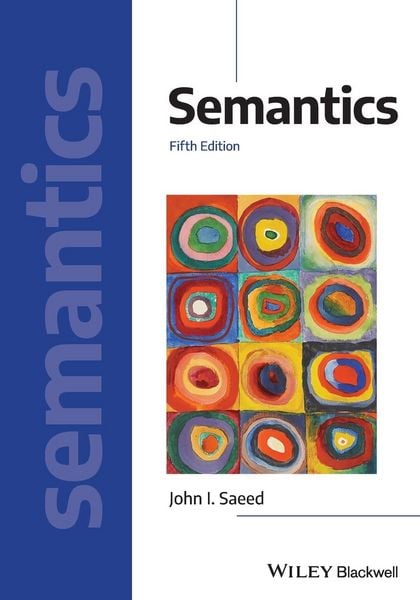
Semantics
Aus der Reihe
Introducing Linguistics
-
- Taschenbuch ausgewählt
- eBook
-
Sprache:Englisch
53,99 €
inkl. gesetzl. MwSt.,
Beschreibung
Produktdetails
Einband
Taschenbuch
Erscheinungsdatum
22.12.2022
Verlag
John Wiley & SonsSeitenzahl
592
Maße (L/B/H)
17,8/25,3/3,4 cm
Gewicht
1130 g
Auflage
5. Auflage
Sprache
Englisch
ISBN
978-1-119-70985-5
The latest edition of the bestselling introduction to the field of linguistic semantics, updated throughout and featuring a wholly new chapter on inferential pragmatics
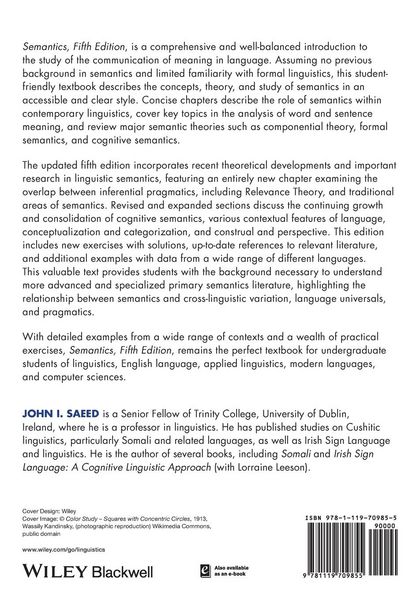
Semantics, Fifth Edition, is a comprehensive and well-balanced introduction to the study of the communication of meaning in language. Assuming no previous background in semantics and limited familiarity with formal linguistics, this student-friendly textbook describes the concepts, theory, and study of semantics in an accessible and clear style. Concise chapters describe the role of semantics within contemporary linguistics, cover key topics in the analysis of word and sentence meaning, and review major semantic theories such as componential theory, formal semantics, and cognitive semantics.
The updated fifth edition incorporates recent theoretical developments and important research in linguistic semantics, featuring an entirely new chapter examining the overlap between inferential pragmatics and Relevance Theory, truth-conditional meaning, and other traditional areas of semantics. Revised and expanded sections discuss the continuing growth and consolidation of cognitive semantics, various contextual features of language, conceptualization and categorization, and construal and perspective. This edition includes new exercises with solutions, up-to-date references to relevant literature, and additional examples with data from a wide range of different languages.
* Covers basic concepts and methods as well as key theoretical models, current lines of research, and important writers
* Explains general concepts in semantics before gradually moving to more advanced topics in semantic description and theoretical approaches
* Highlights the relation between cross-linguistic variation and language universals
* Provides students with the background necessary to understand more advanced and specialized primary semantics literature
* Includes a glossary of technical terms and numerous exercises arranged by level of difficulty
* Highlights the relationship between semantics and cross-linguistic variation, language universals, and pragmatics
With detailed examples from a wide range of contexts and a wealth of practical exercises, Semantics, Fifth Edition, remains the perfect textbook for undergraduate students of linguistics, English language, applied linguistics, modern languages, and computer sciences.
Semantics, Fifth Edition, is a comprehensive and well-balanced introduction to the study of the communication of meaning in language. Assuming no previous background in semantics and limited familiarity with formal linguistics, this student-friendly textbook describes the concepts, theory, and study of semantics in an accessible and clear style. Concise chapters describe the role of semantics within contemporary linguistics, cover key topics in the analysis of word and sentence meaning, and review major semantic theories such as componential theory, formal semantics, and cognitive semantics.
The updated fifth edition incorporates recent theoretical developments and important research in linguistic semantics, featuring an entirely new chapter examining the overlap between inferential pragmatics and Relevance Theory, truth-conditional meaning, and other traditional areas of semantics. Revised and expanded sections discuss the continuing growth and consolidation of cognitive semantics, various contextual features of language, conceptualization and categorization, and construal and perspective. This edition includes new exercises with solutions, up-to-date references to relevant literature, and additional examples with data from a wide range of different languages.
* Covers basic concepts and methods as well as key theoretical models, current lines of research, and important writers
* Explains general concepts in semantics before gradually moving to more advanced topics in semantic description and theoretical approaches
* Highlights the relation between cross-linguistic variation and language universals
* Provides students with the background necessary to understand more advanced and specialized primary semantics literature
* Includes a glossary of technical terms and numerous exercises arranged by level of difficulty
* Highlights the relationship between semantics and cross-linguistic variation, language universals, and pragmatics
With detailed examples from a wide range of contexts and a wealth of practical exercises, Semantics, Fifth Edition, remains the perfect textbook for undergraduate students of linguistics, English language, applied linguistics, modern languages, and computer sciences.
Kundinnen und Kunden meinen
Verfassen Sie die erste Bewertung zu diesem Artikel
Helfen Sie anderen Kund*innen durch Ihre Meinung
Kurze Frage zu unserer Seite
Vielen Dank für Ihr Feedback
Wir nutzen Ihr Feedback, um unsere Produktseiten zu verbessern. Bitte haben Sie Verständnis, dass wir Ihnen keine Rückmeldung geben können. Falls Sie Kontakt mit uns aufnehmen möchten, können Sie sich aber gerne an unseren Kund*innenservice wenden.
zum Kundenservice