
Contemporary Perspectives on Social Capital in Educational Contexts (hc)
-
- Englisch ausgewählt
137,99 €
inkl. gesetzl. MwSt.,
Beschreibung
Produktdetails
Einband
Gebundene Ausgabe
Erscheinungsdatum
23.04.2019
Herausgeber
RoSusan D. Bartee + weitereVerlag
Information Age PublishingSeitenzahl
262
Maße (L/B/H)
24/16,1/1,9 cm
Gewicht
561 g
Sprache
Englisch
ISBN
978-1-64113-639-6
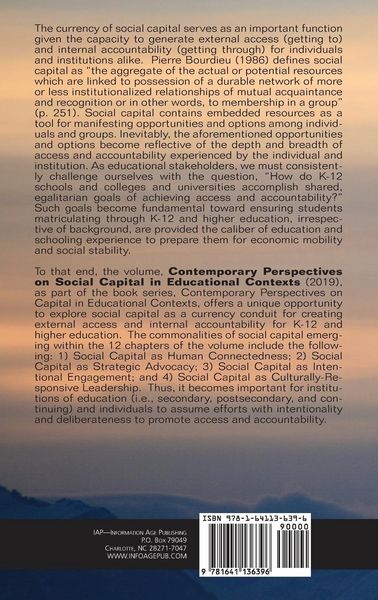
The currency of social capital serves as an important function given the capacity to generate external access (getting to) and internal accountability (getting through) for individuals and institutions alike. Pierre Bourdieu (1986) defines social capital as "the aggregate of the actual or potential resources which are linked to possession of a durable network of more or less institutionalized relationships of mutual acquaintance and recognition or in other words, to membership in a group" (p. 251). Social capital contains embedded resources as a tool for manifesting opportunities and options among individuals and groups. Inevitably, the aforementioned opportunities and options become reflective of the depth and breadth of access and accountability experienced by the individual and institution. As educational stakeholders, we must consistently challenge ourselves with the question, "How do K-12 schools and colleges and universities accomplish shared, egalitarian goals of achieving access and accountability?" Such goals become fundamental toward ensuring students matriculating through K-12 and higher education, irrespective of background, are provided the caliber of education and schooling experience to prepare them for economic mobility and social stability. To that end, the volume, Contemporary Perspectives on Social Capital in Educational Contexts (2019), as part of the book series, Contemporary Perspectives on Capital in Educational Contexts, offers a unique opportunity to explore social capital as a currency conduit for creating external access and internal accountability for K-12 and higher education. The commonalities of social capital emerging within the 12 chapters of the volume include the following: 1) Social Capital as Human Connectedness; 2) Social Capital as Strategic Advocacy; 3) Social Capital as Intentional Engagement; and 4) Social Capital as Culturally-Responsive Leadership. Thus, it becomes important for institutions of education (i.e. secondary, postsecondary, continuing) and individuals to assume efforts with intentionality and deliberateness to promote access and accountability.
Noch keine Bewertungen vorhanden
Verfassen Sie die erste Bewertung zu diesem Artikel
Helfen Sie anderen Kundinnen und Kunden durch Ihre Meinung.
Kurze Frage zu unserer Seite
Vielen Dank für Ihr Feedback
Wir nutzen Ihr Feedback, um unsere Produktseiten zu verbessern. Bitte haben Sie Verständnis, dass wir Ihnen keine Rückmeldung geben können. Falls Sie Kontakt mit uns aufnehmen möchten, können Sie sich aber gerne an unseren Kund*innenservice wenden.
zum Kundenservice