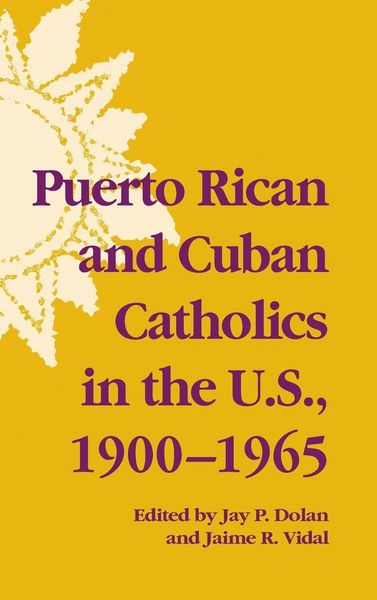
Puerto Rican and Cuban Catholics in the U.S., 1900-1965
-
- Hardcover ausgewählt
- Taschenbuch
- eBook
-
Sprache:Englisch
132,99 €
inkl. gesetzl. MwSt.,
Beschreibung
Produktdetails
Einband
Gebundene Ausgabe
Erscheinungsdatum
31.10.1994
Herausgeber
Jay P. Dolan + weitereVerlag
University Of Notre Dame PressSeitenzahl
268
Maße (L/B/H)
23,5/15,7/2 cm
Gewicht
590 g
Sprache
Englisch
ISBN
978-0-268-03805-2
When Puerto Ricans and Cubans arrived in the United States both groups presented to American Catholics the paradox of cultures pervaded by Catholic symbols, attitudes, and traditions, but out of touch with the values and priorities of the institutional Church. Furthermore, both Cubans and Puerto Ricans tend to perceive themselves as being in the U.S. provisionally and therefore insist on holding on to their language and culture, while striving to build communities of their own where these values will be preserved. In this seminal volume Jaime R. Vidal and Lisandro Pérez present for the first time an in-depth historical analysis of the Puerto Rican and Cuban-American Catholic experience, beginning with their roots in the history of their homelands up to the closing of Vatican II. In the first section of Puerto Ricans, Vidal discusses the American Church's attempt to assimilate them into its structure and style, which was at cross purposes with the Puerto Rican "revolving door" migration trends that have constantly reinforced their identity. Focusing on the Puerto Rican community in New York City, Vidal demonstrates that the policies of the institutional Church have made it difficult for them to find their place within the U.S. Catholic structure. This has led to a certain amount of marginalization of the Church within the Puerto Rican Community. Alisandro Pérez then discusses the Cuban-American Catholic experience, especially the first waves of Cuban migration during the 1960s. Since the first political exiles were from the upper and middle classes of Cuban society, this led to expectations that the Cubans would quickly blend into the white, middle-class American community at both the religious and the social levels. Pérez analyzes the response of the Miami diocese to support the exiles and concludes that the Cubans have not been fully assimilated into the American Catholic Church because they view themselves as an exiled society that hopes eventually to return to Cuba.
Noch keine Bewertungen vorhanden
Verfassen Sie die erste Bewertung zu diesem Artikel
Helfen Sie anderen Kundinnen und Kunden durch Ihre Meinung.
Kurze Frage zu unserer Seite
Vielen Dank für Ihr Feedback
Wir nutzen Ihr Feedback, um unsere Produktseiten zu verbessern. Bitte haben Sie Verständnis, dass wir Ihnen keine Rückmeldung geben können. Falls Sie Kontakt mit uns aufnehmen möchten, können Sie sich aber gerne an unseren Kund*innenservice wenden.
zum Kundenservice