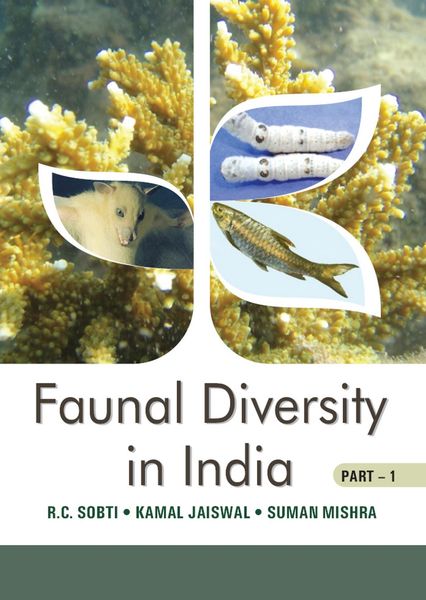
Faunal Diversity In India Part I
-
- Einzelkauf Download ausgewählt
-
Sprache:Englisch
623,99 €
inkl. gesetzl. MwSt.Beschreibung
Produktdetails
Format
ePUB
Kopierschutz
Ja
Family Sharing
Ja
Text-to-Speech
Ja
Erscheinungsdatum
30.06.2017
Verlag
Narendra Publishing HouseSeitenzahl
298 (Printausgabe)
Dateigröße
9388 KB
Sprache
Englisch
EAN
9789389660593
It has been commonly accepted that biodiversity is an important natural resource for the functioning of the ecosystem that provides us with beneûts essential for human wellbeing. It provides the basis for ecosystems and the services they provide, upon which all people fundamentally depend. There is much public concern about threats to global biodiversity. Industrial pollution, changes in agricultural practices and climate change, are all having a direct impact on biodiversity. The book "Faunal Diversity" through the individual chapters, provides a broad view of diversity and the importance of different faunal groups in India. India is rich in terms of biological diversity due to its diversiûed habitat and climatic conditions and is one among the 17 mega-biodiversity countries. India harbours as much as 7 % of the total animal species of the world, though the Indian landmass is about 2 %. India has a coastline of 8,118 km, with an exclusive economic zone (EEZ) of 2.02 million km2 and a continental shelf area of 468,000 km2, spread across 10 maritime States and 7 Union Territories, including Andaman and Nicobar Islands and Lakshadweep Islands. There are about 2,546 species of fishes (about 11% of the world species) found in Indian waters. About 197 species of amphibians (4.4% of the world total) and more than 408 reptile species (6% of the world total) are found in India. Among these groups the highest levels of endemism are found in the amphibians. There are about 1,250 species of birds from India, with some variations, depending on taxonomic treatments, accounting for about 12% of the world species. There are about 410 species of mammals known from India, which is about 8.86% of the world species. This excellent text includes the work of around 35 authors who are experts in their field of specialization. The book offers a solid description of the current understanding of faunal diversity from microbial world to mammals, from endoparasites to ectoparasites from water borne animals to terrestrial, from piscine to avian fauna and from terrestrial mammals to flying mammals.
Noch keine Bewertungen vorhanden
Verfassen Sie die erste Bewertung zu diesem Artikel
Helfen Sie anderen Kundinnen und Kunden durch Ihre Meinung.
Kurze Frage zu unserer Seite
Vielen Dank für Ihr Feedback
Wir nutzen Ihr Feedback, um unsere Produktseiten zu verbessern. Bitte haben Sie Verständnis, dass wir Ihnen keine Rückmeldung geben können. Falls Sie Kontakt mit uns aufnehmen möchten, können Sie sich aber gerne an unseren Kund*innenservice wenden.
zum Kundenservice