Gutscheinbedingungen

Gültig bis 13.07.2026 | Gültig für Spielzeug (außer Tonieboxen & ausgewählte Tonies), Filme, Musik, Software, Games, Schreibwaren, Hörbücher und Hörbuch-Downloads (außer Abo & Shelfies), gebrauchte Bücher, nicht preisgebundene Bücher und Kalender | Einlösbar unter osiander.de und in der Osiander App | Click & Collect nur mit Online-Zahlung (Paypal/Kreditkarte) vorab | Einzelne Artikel können ausgeschlossen sein | Nicht kombinierbar mit anderen Gutscheinen oder Preisaktionen | Nur einmal pro Einkauf einlösbar | Gutschein wird auf max. 500€ Bestellwert angerechnet | Keine Barauszahlung | Digitale Hörbücher nur für Android | Nicht gültig für preisgebundene Artikel (aufgrund der Buchpreisbindung sind Gutscheine nicht auf Bücher, eBooks, Presse einlösbar), tolino eReader & Zubehör, Elektronik, Geschenke & Trends, Abonnements & Flatrates, Geschenkkarten, Versandkosten und Services

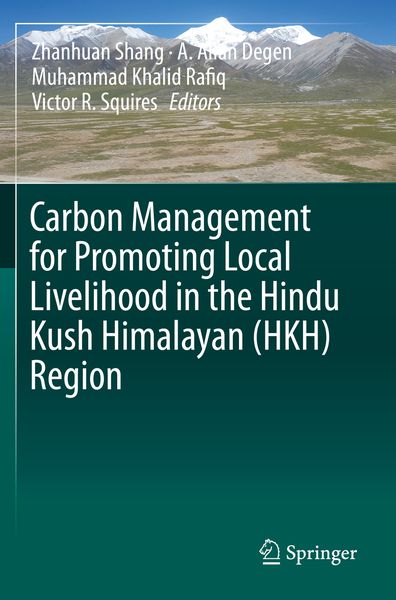
  • Produktbild: Carbon Management for Promoting Local Livelihood in the Hindu Kush Himalayan (HKH) Region
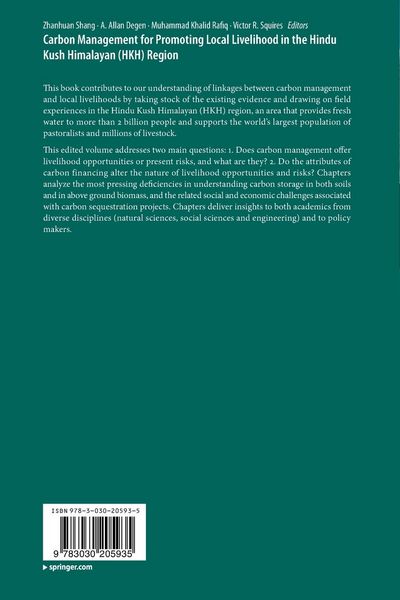
  • Produktbild: Carbon Management for Promoting Local Livelihood in the Hindu Kush Himalayan (HKH) Region

Carbon Management for Promoting Local Livelihood in the Hindu Kush Himalayan (HKH) Region

86,99 €

inkl. gesetzl. MwSt., Versandkostenfrei


Beschreibung

Produktdetails

Einband

Taschenbuch

Erscheinungsdatum

14.08.2020

Herausgeber

Zhanhuan Shang + weitere

Verlag

Springer

Seitenzahl

347

Maße (L/B/H)

23,5/15,5/2,1 cm

Gewicht

563 g

Auflage

1st ed. 2020

Sprache

Englisch

ISBN

978-3-030-20593-5

Beschreibung

Portrait

Dr. Zhanhuan Shang is a Professor at the School of Life Sciences, Lanzhou University in China. 

Dr. Muhammad Khalid Rafiq is a Senior Scientific Officer at the Pakistan Agricultural Research Council in Islamabad, Pakistan. 

Dr. Victor R. Squires is an Ex-Professor and Consultant at International Dryland Management Consultant, Adelaide University, Australia.

Produktdetails

Einband

Taschenbuch

Erscheinungsdatum

14.08.2020

Herausgeber

Verlag

Springer

Seitenzahl

347

Maße (L/B/H)

23,5/15,5/2,1 cm

Gewicht

563 g

Auflage

1st ed. 2020

Sprache

Englisch

ISBN

978-3-030-20593-5

Herstelleradresse

Springer-Verlag KG
Sachsenplatz 4-6
1201 Wien
AT

Email: GPSR Kontakt

Noch keine Bewertungen vorhanden

Verfassen Sie die erste Bewertung zu diesem Artikel

Helfen Sie anderen Kundinnen und Kunden durch Ihre Meinung.

Kundinnen und Kunden meinen

Bewertungen (0)

  • Produktbild: Carbon Management for Promoting Local Livelihood in the Hindu Kush Himalayan (HKH) Region
  • Produktbild: Carbon Management for Promoting Local Livelihood in the Hindu Kush Himalayan (HKH) Region
  • Chapter1: Managing Carbon Cycle Linkage to Livelihood in HKH Region.- Chapter2: Climate Change Mitigation and Pastoral Livelihood in the Hindu Kush Himalaya Region: Research Focuses, Opportunities and Challenges.- Chapter3: Tracking of Vegetation Carbon Dynamics from 2001 to 2016 by MODIS GPP in HKH region.- Chapter4: Livelihood and Carbon Management by Indigenous People in Southern Himalayas.- Chapter5: Effects of Different Grassland Management Patterns on Soil Properties on the Qinghai-Tibetan Plateau.- Chapter6: Carbon Management of the Livestock Industry in the HKH Region.- Chapter7: Wetlands as a Carbon Sink: Insight into the Himalayan Region.- Chapter8: Milk and Dung Production by Yaks (Poephagus grunniens): Important Products for the Livelihood of the Herders and for Carbon Recycling on the Qinghai-Tibetan Plateau.- Chapter9: Interactive Mechanism of Service Function of Ecosystems and the Effect of Climate Change to the Service Function of Ecosystem in Alpine Grassland of Tibetan Plateau.- Chapter10: Prospects of Biochar for Carbon Sequestration and Livelihood Improvement in the Tibetan Grasslands.- Chapter11: Optimizing the Alpine Grazing System to Improve Carbon Management and Livelihood for Tibetan Herders.- Chapter12: Promoting Artificial Grasslands to Improve Carbon Sequestration and Livelihood of Herders.- Chapter13: Prospects for REDD+ Financing in Promoting Forest Sustainable Management in HKH.- Chapter14: Designing Water Resource Use for Poverty Reduction in the HKH Region: Institutional and Policy Perspectives.- Chapter15: Indigenous Practice in Agro-pastoralism and Carbon Management from a Gender Perspective: A Case from Nepal.- Chapter16: Adaptation by Herders on the Qinghai-Tibetan Plateau in Response to Climate Change and Policy Reforms: the Implications for Carbon Sequestration and Livelihoods.- Chapter17: Developing Linkages for Carbon Sequestration, Livelihoods and Ecosystem Service Provision in Mountain Landscapes--Challenges and Opportunities in the Himalaya Hindu Kush (HKH) Region.- Chapter18: Experience for Future Good Practice and Policy of Combined Carbon Management and Livelihood in HKH Region.