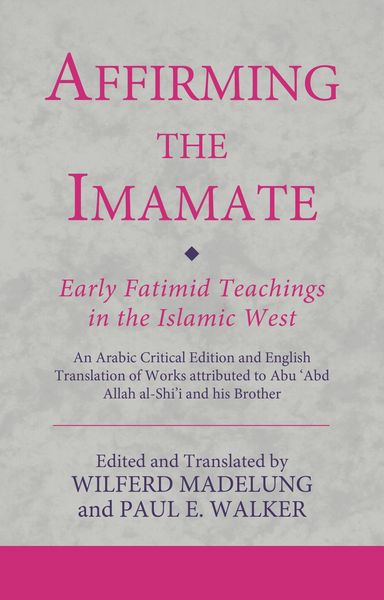
Affirming the Imamate Early Fatimid Teachings in the Islamic West: An Arabic critical edition and English translation of works attributed to Abu Abd Allah al-Shi'i and his brother Abu'l-'Abbas
-
- Hardcover ausgewählt
- Taschenbuch
- eBook
-
Sprache:Englisch
115,99 €
inkl. gesetzl. MwSt.,
Beschreibung
Produktdetails
Einband
Gebundene Ausgabe
Erscheinungsdatum
25.02.2021
Herausgeber
Wilferd Madelung + weitereVerlag
Tauris, I.B.Seitenzahl
248
Maße (L/B/H)
22,2/14,5/1,7 cm
Gewicht
440 g
Sprache
Englisch
ISBN
978-0-7556-3732-4
I.B. Tauris in association with the Institute of Ismaili Studies The two sermons edited and translated here for the first time are primary material from the years before the establishment of the Fatimid caliphate in 297/909. The authors have been identified as Abu 'Abd Allah al-Shi'i and Abu'l-'Abbas Muhammad, two brothers who were central to the success of the Ismaili da'wa in North Africa. Da'wa, a term used to describe how Muslims teach others about the beliefs and practices of their Islamic faith, therefore provide a unique view of the nature and development of Islam throughout history. In this case, the primary texts shed light on the development of Islam among the Berbers of the Maghreb. The first text by Abu 'Abd Allah al-Shi'i shows how the arguments for belief in the 'imamate' of the family of the Prophet, that is, the Shi'a belief that all imams should be spiritual descendants of the Prophet Muhammad and his household, were developed and presented to bring new adherents to the cause. The Book of the Keys to Grace by his elder brother Abu'l-'Abbas, too, concerns not only the centrality of the imam in the faith but also sheds light on the hierarchy of the da'wa in this early period and its organisational sophistication. Both texts also reveal the contemporary theology propagated by the Ismaili da'wa, including for instance, the powerful analogy of Moses/Aaron and Muhammad/'Ali, the awareness of a variety of religious traditions and the use of detailed Qur'anic quotations and a wide range of hadith. As such they constitute primary source material of interest not only for Ismaili history but for this early period of Islam in general.
Kundinnen und Kunden meinen
Verfassen Sie die erste Bewertung zu diesem Artikel
Helfen Sie anderen Kund*innen durch Ihre Meinung
Kurze Frage zu unserer Seite
Vielen Dank für Ihr Feedback
Wir nutzen Ihr Feedback, um unsere Produktseiten zu verbessern. Bitte haben Sie Verständnis, dass wir Ihnen keine Rückmeldung geben können. Falls Sie Kontakt mit uns aufnehmen möchten, können Sie sich aber gerne an unseren Kund*innenservice wenden.
zum Kundenservice