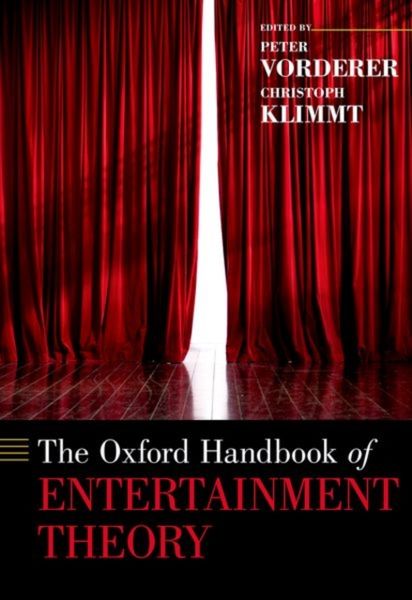
Produktbild: Oxford Handbook of Entertainment Theory

Oxford Handbook of Entertainment Theory

277,99 €

inkl. gesetzl. MwSt., Versandkostenfrei


Beschreibung

Produktdetails

Einband

Gebundene Ausgabe

Erscheinungsdatum

01.03.2021

Abbildungen

25 illustrations

Herausgeber

Christoph Klimmt + weitere

Verlag

Oxford Academic

Seitenzahl

890

Maße (L/B/H)

25,6/18/5 cm

Gewicht

1624 g

Sprache

Englisch

ISBN

978-0-19-007221-6

Beschreibung

Produktdetails

Einband

Gebundene Ausgabe

Erscheinungsdatum

01.03.2021

Abbildungen

25 illustrations

Herausgeber

Verlag

Oxford Academic

Seitenzahl

890

Maße (L/B/H)

25,6/18/5 cm

Gewicht

1624 g

Sprache

Englisch

ISBN

978-0-19-007221-6

Herstelleradresse

Libri GmbH
Europaallee 1
36244 Bad Hersfeld
DE

Email: gpsr@libri.de

Kundinnen und Kunden meinen

0 Bewertungen

Informationen zu Bewertungen

Zur Abgabe einer Bewertung ist eine Anmeldung im Konto notwendig. Die Authentizität der Bewertungen wird von uns nicht überprüft. Wir behalten uns vor, Bewertungstexte, die unseren Richtlinien widersprechen, entsprechend zu kürzen oder zu löschen.

Die Bewertungen sind nach Format, Anzahl Sterne und Datum sortiert.

Verfassen Sie die erste Bewertung zu diesem Artikel

Helfen Sie anderen Kund*innen durch Ihre Meinung

Kundinnen und Kunden meinen

0 Bewertungen filtern

Die Leseprobe wird geladen.
  • Produktbild: Oxford Handbook of Entertainment Theory
    • Preface

    • Section I: General Theoretical Accounts of Media Entertainment

    • Chapter 1: A Brief Analysis of the State of Entertainment Theory: Historical Achievements, Contemporary Challenges, and Future Possibilities

    • Peter Vorderer, Christoph Klimmt, and Jennings Bryant

    • Chapter 2: Entertainment Is a Journey, Not Just a Destination: Process Perspectives in Entertainment Theories

    • Andreas Fahr and Hannah Früh

    • Chapter 3: The Narrative Enjoyment and Appreciation Rationale

    • Ron Tamborini, Sara Grady, Joshua Baldwin, Nikki McClaran, and Robert Lewis

    • Chapter 4: Life-Span Developmental Changes in Media Entertainment Experiences

    • Marie-Louise Mares and James Alex Bonus

    • Chapter 5: A Systematic Gender Perspective on Entertainment Theory

    • Sabine Reich

    • Chapter 6: How Universal Is Media Entertainment, Really? On the Enriching Potential of Cross-Cultural Approaches for Existing Entertainment Scholarship

    • Özen Odag

    • Chapter 7: Entertainment and Resonance

    • Peter Vorderer

    • Chapter 8: Finding Elusive Resonance Across Cultures and Time

    • Gerald C. Cupchik, Despina Stamatopoulou, and Siying Duan

    • Section II: Models and Theories Dedicated to Specific Experiential Processes

    • Chapter 9: Selection of Entertainment Media: From Mood Management Theory to the SESAM Model

    • Kate T. Luong and Silvia Knobloch-Westerwick

    • Chapter 10: Binge-Watching as a Case of Escapist Entertainment Use

    • Annabell Halfmann and Leonard Reinecke

    • Chapter 11: Media Entertainment as Guilty Pleasure? The Appraisal of Media Use, Self-Control, and Entertainment (AMUSE) Model

    • Leonard Reinecke and Adrian Meier

    • Chapter 12: Advances in Research on the Model of Intuitive Morality and Exemplars (MIME)

    • Allison Eden, Ron Tamborini, Melinda Aley, and Henry Goble

    • Chapter 13: Stories Enlarge the Experience of Self: Evidence for the Temporarily Expanded Boundaries of the Self (TEBOTS) Model

    • Benjamin K. Johnson, Michael D. Slater, Nathaniel A. Silver, and David R. Ewoldsen

    • Chapter 14: Stepping In and Out of Media Characters: Identification and Dynamic Shifts in Users' Positioning towards Entertainment Messages

    • Jonathan Cohen and Christoph Klimmt

    • Chapter 15: Involvement with Media Personae and Entertainment Experiences

    • William J. Brown

    • Chapter 16: Only Project: A Psychological Principle Explored in a Novel

    • Keith Oatley

    • Chapter 17: The Role of Narrative Cues in Shaping ADT: What Makes Audiences Think that Good Things Happen to Good People?

    • Ron Tamborini, Matthew Grizzard, Lindsay Hahn, Kevin Kryston, and Ezgi Ulusoy

    • Chapter 18: Media Entertainment, Flow Experiences, and the Synchronization of Audiences

    • Jacob T. Fisher, Chelsea Lonergan, Frederic R. Hopp, and René Weber

    • Chapter 19: Transcending Eudaimonic Entertainment: A Review and Expansion of Meaningful Entertainment

    • Sophie H. Janicke-Bowles, Anne Bartsch, Mary Beth Oliver, and Arthur A. Raney

    • Chapter 20: Biographic Resonance Theory of Eudaimonic Media Entertainment

    • Christoph Klimmt and Diana Rieger

    • Chapter 21: Kama Muta as an Eudaimonic Entertainment Experience

    • Sophie H. Janicke-Bowles, Thomas Schubert, and Johanna K. Blomster

    • Chapter 22: Entertained by Amazement and Wonder: The Role of the Emotion Awe in Media Reception

    • Daniel Possler and Arthur A. Raney

    • Section III: Models on Entertainment Phenomena Bound to Specific Media or Message Types

    • Chapter 23: Humor and Comedy

    • Jeffrey Goldstein

    • Chapter 24: Portrayals of Human Sexuality as Entertainment

    • Francesca R. Dillman Carpentier and Farnosh Mazandarani

    • Chapter 25: Cooling Down or Charging Up? Engagement with Aggressive Entertainment Contents as an Emotion Regulation Strategy of Boredom and Anger

    • Heidi Vandebosch and Karolien Poels

    • Chapter 26: Sports as (Digital) Media Entertainment

    • Nicky Lewis

    • Chapter 27: News as Entertainment Format: Applying Affective Disposition Theory and the Affective News Extended Model

    • Melissa J. Robinson and Silvia Knobloch-Westerwick

    • Chapter 28: An Extended Dual-Process Model of Entertainment Effects on Political Information Processing and Engagement

    • Frank M. Schneider, Anne Bartsch, and Larissa Leonhard

    • Chapter 29: Cinematic Entertainment: Contemporary Adolescents' Uses-and-Gratifications of Going to the Movies

    • Maite Soto-Sanfiel

    • Chapter 30: How Do People Evaluate Movies? Insights from the Associative-Propositional Evaluation Model

    • Frank M. Schneider, Ines C. Vogel, Uli Gleich, and Anne Bartsch

    • Chapter 31: TV Series Fandom as Eudaimonic Consumption

    • José Antonio Muñiz-Velázquez and Javier Lozano Delmar

    • Chapter 32: A Synergistic Multi-Process Model of Video Game Entertainment

    • Christoph Klimmt and Daniel Possler

    • Chapter 33: Interactivity as Demand: Implications for Interactive Media Entertainment

    • Nicholas D. Bowman

    • Chapter 34: Players' Moral Decisions in Virtual Worlds: Morality in Video Games

    • André Melzer and Elisabeth Holl

    • Chapter 35: Player-Avatar Identification, Relationships, and Interaction: Entertainment through Asocial, Parasocial, and Fully Social Processes

    • Nicholas D. Bowman and Jaime Banks

    • Chapter 36: Entertainment in Virtual Reality and Beyond: The Influence of Embodiment, Co-Location, and Cognitive Distancing on Users' Entertainment Experience

    • Tilo Hartmann and Jesse Fox

    • Section IV: Models on Consequences or Correlates of Entertainment Phenomena

    • Chapter 37: Retrospective Imaginative Involvement and Entertainment Narratives: Initial Forays

    • David R. Ewoldsen, Rick Busselle, Neha Sethi, and Michael D. Slater

    • Chapter 38: Media Entertainment as a Self-Regulatory Resource: The Recovery and Resilience in Entertaining Media Use (R²EM) Model

    • Leonard Reinecke and Diana Rieger

    • Chapter 39: Entertainment Media and Social Consciousness

    • Meghan S. Sanders, Chun Yang, Anthony Ciaramella, Rachel Italiano, Stephanie L. Whitenack, and Hope M. Hickerson

    • Chapter 40: Entertainment Theories and Media Addiction

    • Felix Reer, Robin Janzik, Lars-Ole Wehden, and Thorsten Quandt

    • Chapter 41: Theorizing Entertainment-Education: A Complementary Perspective to

    • the Development of Entertainment Theory

    • Hua Wang and Arvind Singhal