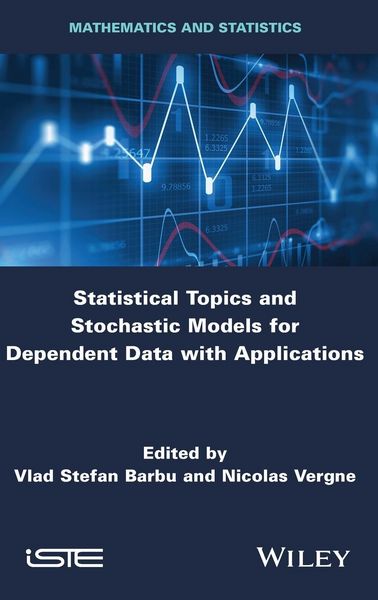
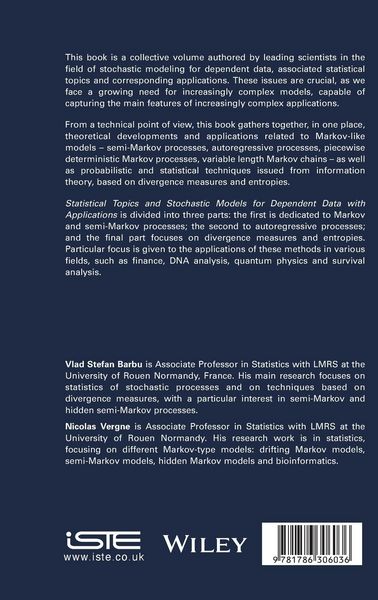
• Produktbild: Statistical Topics and Stochastic Models for Dependent Data with Applications
  • Produktbild: Statistical Topics and Stochastic Models for Dependent Data with Applications

Statistical Topics and Stochastic Models for Dependent Data with Applications

197,99 €

inkl. gesetzl. MwSt., Versandkostenfrei


Beschreibung

Produktdetails

Einband

Gebundene Ausgabe

Erscheinungsdatum

23.10.2020

Herausgeber

Vlad Stefan Barbu + weitere

Verlag

John Wiley & Sons

Seitenzahl

280

Maße (L/B/H)

24/16,1/2 cm

Gewicht

589 g

Auflage

1. Auflage

Sprache

Englisch

ISBN

978-1-78630-603-6

Beschreibung

Produktdetails

Einband

Gebundene Ausgabe

Erscheinungsdatum

23.10.2020

Herausgeber

Verlag

John Wiley & Sons

Seitenzahl

280

Maße (L/B/H)

24/16,1/2 cm

Gewicht

589 g

Auflage

1. Auflage

Sprache

Englisch

ISBN

978-1-78630-603-6

Herstelleradresse

Libri GmbH
Europaallee 1
36244 Bad Hersfeld
DE

Email: GPSR Kontakt

Noch keine Bewertungen vorhanden

Verfassen Sie die erste Bewertung zu diesem Artikel

Helfen Sie anderen Kundinnen und Kunden durch Ihre Meinung.

Kundinnen und Kunden meinen

Bewertungen (0)

Die Leseprobe wird geladen.
  • Produktbild: Statistical Topics and Stochastic Models for Dependent Data with Applications
  • Produktbild: Statistical Topics and Stochastic Models for Dependent Data with Applications
  • Preface xi
    Vlad Stefan BARBU and Nicolas VERGNE
     
    Part 1. Markov and Semi-Markov Processes 1
     
    Chapter 1. Variable Length Markov Chains, Persistent Random Walks: A Close Encounter 3
    Peggy CÉNAC, Brigitte CHAUVIN, Frédéric PACCAUT and Nicolas POUYANNE
     
    1.1. Introduction 3
     
    1.2. VLMCs: definition of the model 6
     
    1.3. Definition and behavior of PRWs 9
     
    1.3.1. PRWs in dimension one 9
     
    1.3.2. PRWs in dimension two 13
     
    1.4. VLMC: existence of stationary probability measures 15
     
    1.5. Where VLMC and PRW meet 19
     
    1.5.1. Semi-Markov chains and Markov additive processes 19
     
    1.5.2. PRWs induce semi-Markov chains 20
     
    1.5.3. Semi-Markov chain of the alpha-LIS in a stable VLMC 22
     
    1.5.4. The meeting point 23
     
    1.6. References 27
     
    Chapter 2. Bootstraps of Martingale-difference Arrays Under the Uniformly Integrable Entropy 29
    Salim BOUZEBDA and Nikolaos LIMNIOS
     
    2.1. Introduction and motivation 29
     
    2.2. Some preliminaries and notation 30
     
    2.3. Main results 35
     
    2.4. Application for the semi-Markov kernel estimators 36
     
    2.5. Proofs 41
     
    2.6. References 45
     
    Chapter 3. A Review of the Dividend Discount Model: From Deterministic to Stochastic Models 47
    Guglielmo D'AMICO and Riccardo DE BLASIS
     
    3.1. Introduction 47
     
    3.2. General model 48
     
    3.3. Gordon growth model and extensions 50
     
    3.3.1. Gordon model 50
     
    3.3.2. Two-stage model 51
     
    3.3.3. H model 52
     
    3.3.4. Three-stage model 52
     
    3.3.5. N-stage model 53
     
    3.3.6. Other extensions 53
     
    3.4. Markov chain stock models 54
     
    3.4.1. Hurley and Johnson model 54
     
    3.4.2. Yao model 56
     
    3.4.3. Markov stock model 57
     
    3.4.4. Multivariate Markov chain stock model 61
     
    3.5. Conclusion 64
     
    3.6. References 65
     
    Chapter 4. Estimation of Piecewise-deterministic Trajectories in a Quantum Optics Scenario 69
    Romain AZAIS and Bruno LEGGIO
     
    4.1. Introduction 69
     
    4.1.1. The postulates of quantum mechanics 69
     
    4.1.2. Dynamics of open quantum Markovian systems 71
     
    4.1.3. Stochastic wave function: quantum dynamics as PDPs 74
     
    4.1.4. Estimation for PDPs 76
     
    4.2. Problem formulation 77
     
    4.2.1. Atom-field interaction 77
     
    4.2.2. Piecewise-deterministic trajectories 78
     
    4.2.3. Measures 80
     
    4.3. Estimation procedure 80
     
    4.3.1. Strategy 80
     
    4.3.2. Least-square estimators 82
     
    4.3.3. Numerical experiments 83
     
    4.4. Physical interpretation 86
     
    4.5. Concluding remarks 87
     
    4.6. References 88
     
    Chapter 5. Identification of Patterns in a Semi-Markov Chain 91
    Brenda Ivette GARCIA-MAYA and Nikolaos LIMNIOS
     
    5.1. Introduction 91
     
    5.2. The prefix chain 93
     
    5.3. The semi-Markov setting 94
     
    5.4. The hitting time of the pattern 100
     
    5.5. A genomic application 102
     
    5.6. Concluding remarks 106
     
    5.7. References 106
     
    Part 2. Autoregressive Processes 109
     
    Chapter 6. Time Changes and Stationarity Issues for Continuous Time Autoregressive Processes of Order p 111
    Valérie GIRARDIN and Rachid SENOUSSI
     
    6.1. Introduction 111
     
    6.2. Basics 112
     
    6.3. Stationary AR processes 114
     
    6.3.1. Formulas for the two first-order moments 114
     
    6.3.2. Examples 116
     
    6.3.3. Conditions for stationarity of CAR1(p) processes 118
     
    6.4. Time transforms 125
     
    6.4.1. Properties of time transforms 125
     
    6.4