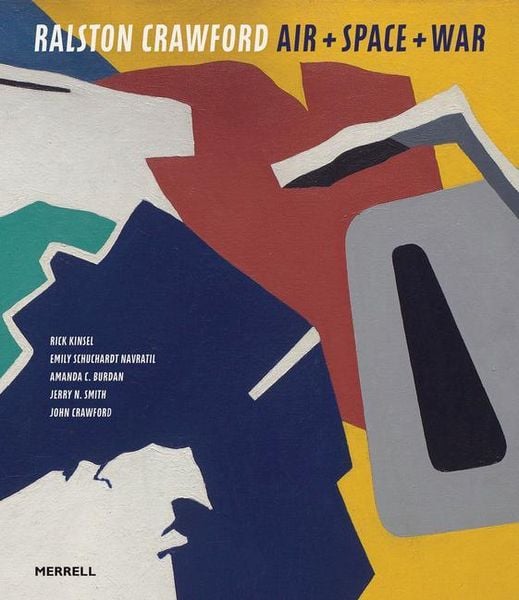
Ralston Crawford: Air + Space + War
-
- Englisch ausgewählt
58,99 €
UVP
66,00 €
inkl. gesetzl. MwSt.,
Beschreibung
Produktdetails
Einband
Gebundene Ausgabe
Erscheinungsdatum
02.03.2021
Verlag
MerrellSeitenzahl
224
Maße (L/B/H)
29,7/25,7/2,5 cm
Gewicht
1814 g
Sprache
Englisch
ISBN
978-1-85894-691-7
Crawford's painting during the 1930s had largely been a dazzling series of Precisionist works that reflected American advances in industry, engineering and technology. After the United States entered World War II, Crawford served in the Weather Division of the Army Air Forces. He created pictorial representations of weather patterns for airplane pilots, and was exposed to countless photographs of air crashes. He continued working as an artist throughout the conflict, receiving a commission to paint the Curtiss-Wright aircraft plant in Buffalo, New York, and, in 1946, an assignment to observe and record one of the atomic bomb tests at Bikini Atoll. These experiences had a profound impact on Crawford, and marked a major turning point in his life and art.
Published to coincide with an exhibition opening at the Dayton Art Institute, Ralston Crawford: Air & Space & War presents a remarkable selection of Crawford's paintings, drawings, photographs and prints from this time. These vary from powerful images of chaos and devastation to ordered and precise paintings of airplane assembly at the Curtiss-Wright plant and cover illustrations and charts related to weather, flight and radar for Fortune magazine. The evolution of many of the works can be traced from photograph and drawing to the finished painting, revealing Crawford's decisions about form and space, which were informed by his experiences with airplanes and flight. Accompanying the artworks is a series of perceptive essays. Rick Kinsel considers Crawford's war years in the context of developments in both aviation and American art. Emily Schuchardt Navratil reflects on aerial views by Crawford and on his Curtiss-Wright commission. Amanda Burdan looks at Crawford's work for Fortune, while Jerry Smith surveys various American and European abstract renditions of airplanes and flight as a means by which to place Crawford's interest in aviation during World War II into a broader historical context. In the final essay, John Crawford examines the importance of photography in his father's work, and explores collage as both a compositional technique and as a term that may be used to describe the series of intense experiences that contributed to Crawford's development as an artist in the 1940s and early 1950s.
Noch keine Bewertungen vorhanden
Verfassen Sie die erste Bewertung zu diesem Artikel
Helfen Sie anderen Kundinnen und Kunden durch Ihre Meinung.
Kurze Frage zu unserer Seite
Vielen Dank für Ihr Feedback
Wir nutzen Ihr Feedback, um unsere Produktseiten zu verbessern. Bitte haben Sie Verständnis, dass wir Ihnen keine Rückmeldung geben können. Falls Sie Kontakt mit uns aufnehmen möchten, können Sie sich aber gerne an unseren Kund*innenservice wenden.
zum Kundenservice